|
|||||||
|
|
|||||||
|
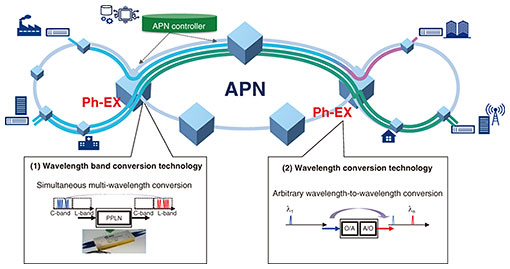
Feature Articles: Toward Commercial Deployment of IOWN APN step3 Vol. 24, No. 1, pp. 20–25, Jan. 2026. https://doi.org/10.53829/ntr202601fa2 Key Technologies Driving APN step3 DeploymentAbstractThis article introduces three essential technologies for deploying APN step3: Photonic Exchange (Ph-EX), Photonic Gateway (Ph-GW), and Subchannel Circuit eXchange (SCX). Ph-EX enables flexible wavelength configuration and interconnection between different fibers, balancing cost and energy efficiency. Ph-GW supports optical multicast and real-time control for dynamic connectivity. SCX allows subchannel-level bandwidth control and multi-site connections, ensuring deterministic communication. Keywords: Photonic Exchange, Photonic Gateway, Subchannel Circuit eXchange  1. Advancement of foundational APN technologies supporting IOWNThe Innovative Optical and Wireless Network (IOWN), proposed by NTT, is a next-generation infrastructure concept aimed at revolutionizing information processing and communications. At its core lies the All-Photonics Network (APN), which applies photonic technologies across all layers of communication to achieve ultra-low latency, high reliability, and massive capacity—capabilities that were difficult to achieve with conventional networks. Starting with APN 1.0, which enables low-latency and deterministic communication within local areas, APN step2 expands this capability to long-distance communication. Currently under development, APN step3 aims to further enhance functionality and broaden its applications. One key feature is the ability to connect to the APN on demand, which requires flexible control over even larger-capacity paths. These use cases are supported by the integration of technologies such as Photonic Exchange (Ph-EX), Photonic Gateway (Ph-GW), and Subchannel Circuit eXchange (SCX), forming the foundation for the social implementation of the IOWN concept. This article explains the technical background, challenges, solutions, and future outlook of the three key technologies—Ph-EX, Ph-GW, and SCX—that play a vital role in deploying APN step3. 2. Ph-EX: Optical transmission system technology that balances cost efficiency and energy savingPh-EX is one of the core technologies of the APN within the IOWN concept, enabling flexible configuration of optical paths and efficient transmission. As shown in Fig. 1, conventional optical transmission systems have primarily focused on optical cross-connect functionality. In contrast, Ph-EX incorporates additional capabilities such as wavelength band conversion between different bands (e.g., C-band and L-band) and per-wavelength conversion, which allows for arbitrary input wavelengths to be converted into arbitrary output wavelengths. These functions enable flexible wavelength changes within APN optical paths, facilitating the effective use of existing equipment and economical network deployment. This is particularly important in environments where multiple types of optical fiber transmission lines coexist, as wavelength band conversion plays a crucial role in constructing end-to-end optical paths. Wavelength conversion helps avoid wavelength collisions within the APN, enabling end-to-end paths across APNs operated by different providers, and contributes to energy savings and reduced equipment costs.
We introduce two representative wavelength conversion technologies used in Ph-EX:
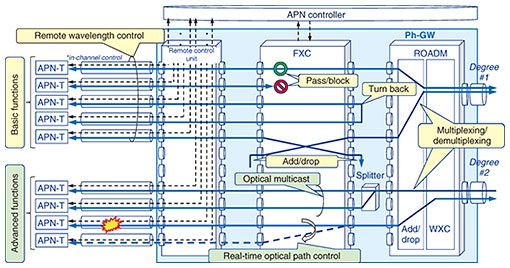
2.1 Wavelength band conversion using PPLNNTT Science and Core Technology Laboratory Group is developing a wavelength band conversion technology based on PPLN. This technology enables direct optical connections between transmission lines with different optical specifications, or between existing networks that use a single wavelength band and APNs that use multiple bands. PPLN is a nonlinear optical material known for its high conversion efficiency and broad bandwidth. Leveraging these properties, a system configuration called the band-switchable multi-band optical cross-connect has been proposed [1]. This configuration allows for flexible switching between multiple wavelength bands to construct optical paths, significantly enhancing network flexibility and scalability. Detailed evaluations of the impact on optical signal characteristics after passing through PPLN-based converters have demonstrated that signal quality is maintained even after more than 20 conversions. Thanks to these features, wavelength signals can be connected without termination, enabling low-power operation and flexible wavelength band usage without compromising the APN’s energy efficiency. 2.2 OAO wavelength conversion technologyThe OAO wavelength conversion method converts optical signals into analog electrical signals then back into optical signals, enabling conversion to arbitrary wavelengths. Unlike the conventional optical-electrical-optical (OEO) method, OAO eliminates the need for digital signal processing, offering significant advantages in terms of power consumption and latency. NTT has evaluated the performance of this OAO-based wavelength conversion technology and demonstrated that it delivers sufficient transmission performance for core networks [2]. Compared with conventional methods, it is expected to reduce power consumption by approximately 90% and latency by about 99%. This technology is key to enabling direct optical connections across multiple operators and networks. While the OEO method faces challenges such as increased delay and power consumption due to digital processing, the OAO method avoids these issues through analog processing while still achieving the required wavelength conversion. The OAO method also supports the APN’s characteristics of low latency, low power consumption, and high reliability, making it suitable for future diverse use cases. Applications are particularly expected in areas requiring real-time performance such as video transmission, remote control, and medical or industrial fields. 3. Ph-GW architecture technologiesPh-GW is an optical access node placed at the entry point of the APN, designed to accommodate a wide variety of APN transceivers (APN-Ts). It is based on a disaggregated architecture consisting of multiple functional modules, which can be separated according to usage. In addition to the aggregation and distribution functions provided by transmission equipment (reconfigurable optical add/drop multiplexer (ROADM)) in conventional wavelength-division multiplexing (WDM) networks, Ph-GW also offers connection control and gateway functions for variety of optical signals. This section introduces the basic functions of Ph-GW on the basis of the above architecture, as well as advanced capabilities such as optical multicast and real-time optical path control. 3.1 Ph-GW node architectureAn example of a node configuration that enables the basic functions of Ph-GW is shown in the upper part of Fig. 2. In addition to the ROADM functional module used in conventional WDM networks, it includes a remote control unit and fiber cross-connect (FXC), forming a disaggregated architecture. Control of APN-Ts is achieved through in-channel control, eliminating the need for external control via separate lines. The remote control unit multiplexes and demultiplexes control and data signals, establishing control and monitoring channels between APN-Ts distributed in the access area outside operator’s building and the APN controller. By wavelength multiplexing the control signals to the data signals, Ph-GW can accommodate various APN-Ts regardless of the protocol or transmission scheme of the data signals. FXC enables pass-through and blocking functions, allowing for optical signals to pass only when an optical path is established, and blocking signals from unauthorized APN-Ts. It also supports the turn back function, which achieves the shortest pass connection for traffic between APN-Ts accommodated in the same Ph-GW, and add/drop function, which enables intermediate processing at the Ph-GW for electrical processing. Compared with wavelength cross-connects (WXCs) used in ROADM, FXC has lower wavelength dependency, enabling it to transfer optical signals outside the C-band (1530–1565 nm) suitable for long-distance transmission. Therefore, it is expected to support short-distance use cases that adopt economical optical transceivers using O-band wavelengths (1260–1360 nm). The IOWN Global Forum defines the Open APN Functional Architecture consisting of two layers: a wavelength path layer, which provides end-to-end optical paths, and fiber path layer, which provides tunnels independent of wavelength. The node configuration shown in the upper part of Fig. 2, which achieves the basic functions of Ph-GW, conforms to this functional architecture.
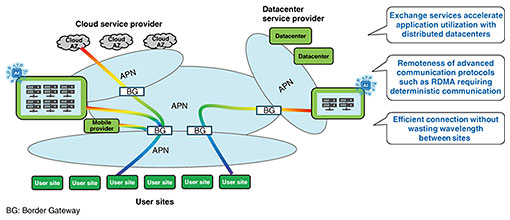
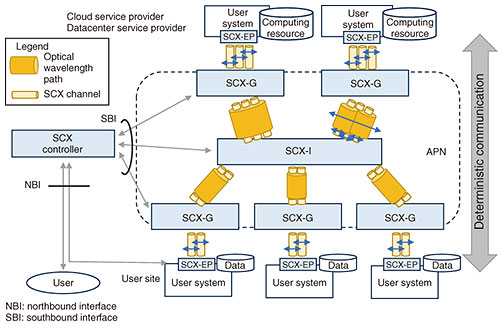
3.2 Advanced functions using Ph-GWResearch and development are also underway to achieve advanced functions using Ph-GW such as optical multicast transmission and real-time optical path control. A node-configuration example for these functions is shown in the lower part of Fig. 2. In the APN, communication between two APN-Ts is typically based on a point-to-point (P2P) connection. However, to further develop the APN, it is important to support various communication schemes. For example, in public viewing scenarios where large-screen displays are used to watch live sports events across multiple locations, it is necessary to distribute high-capacity video data to multiple sites. In such cases, a point-to-multipoint connection scheme, rather than P2P, is expected to be applied. To address this, an optical multicast transmission scheme is being considered, in which optical signals are copied in their optical form using devices such as splitters placed between FXC and ROADM. Since signal duplication is not executed electrically, this scheme is expected to achieve low power consumption. In mission-critical services, such as remote control of robots or drones over the network, stabilizing network quality becomes crucial. Therefore, real-time optical path control technology is being studied to quickly restore optical path quality in the event of degradation. The controller monitors the service quality of the established optical path and switches the path upon detecting degradation, thus continuing to provide APN services that meet the user’s quality requirements (Fig. 2, lower part). While protection and restoration mechanisms had been practically implemented, protection requires double the network resources due to redundancy, and restoration can take minutes to recover quality. Real-time optical path control, on the other hand, uses FXC capable of fast switching, enabling the controller to collect, analyze, and control the established optical path. This enables optical path switching within tens of milliseconds. This approach achieves both stabilization of established optical path quality and improved efficiency in network-resource utilization. The quality information used for analysis in real-time optical path control can also be extended to domains outside the APN through external collaboration functions. This enables quality control not only for APN services but also for end-to-end services including edge computing and wireless networks. NTT has thus far conducted demonstrations of remote robot operation in collaboration with computing resources and optical path control coordinated with wireless segment switching in cooperation with Cradio®, a multi-radio proactive control technology [3]. 4. SCX: Optical circuit switching technology that combines deterministic communication and flexibilityWith the APN, optical wavelength paths can be provisioned on demand between arbitrary locations. To further expand APN’s applicability across diverse use cases, NTT is advancing the research and development of SCX technology. SCX builds dedicated networks for each service by leveraging multiple optical wavelength paths, thus actualizing the Function Dedicated Network (FDN) concept within IOWN/APN. The concept of FDN is also being proposed as a Deterministic Network (DN) architecture by the IOWN Global Forum, and SCX can be considered a key enabling technology for DN. This research is being conducted as a commissioned project by the National Institute of Information and Communications Technology (NICT), and the results presented here are based on the commissioned research JPJ012368C09001. SCX enables simultaneous communication across multiple sites by combining multiple wavelength paths. It executes relay, multiplexing, and demultiplexing through electrical processing, while achieving APN’s characteristic deterministic communication—guaranteed bandwidth, lossless transmission, and jitter-free performance—end-to-end. This enables advanced communication technologies—such as remote direct memory access (RDMA)-based graphics processing unit (GPU)-to-GPU communication, currently limited to a single site—to be extended across multiple sites (Fig. 3). SCX constructs logical communication channels called subchannels over APN’s optical wavelength paths (Fig. 4). To do so, SCX consists of the following components:
To create logical paths (subchannels), SCX-C coordinates SCX-EPs (network interface cards), SCX-Gs, and SCX-Is, managing bandwidth across the entire network to prevent congestion. While SCX-Gs/Is use general-purpose hardware used in packet communication, communication between SCX-G/I links is executed by assigning time slots to each subchannel. On the basis of packet technology, subchannel circuit switching is achieved using SRv6 source routing. At an SCX-EP, packets are assigned with a segment routing header containing circuit IDs (identifiers) for intermediate paths, and quality-of-service control is applied for bandwidth management. These control mechanisms and technologies enable SCX to achieve deterministic communication. Through this architecture, SCX allows for multiple subchannels to share optical wavelength paths while maintaining APN’s communication quality—lossless, low latency, and minimal jitter—end-to-end. It also enhances user experience by enabling simultaneous connections to multiple sites, flexible switching of connection destinations, and dynamic bandwidth adjustments. 5. Toward a foundational system supporting APN step3Ph-EX, Ph-GW, and SCX are core technologies of the system infrastructure for IOWN APN step3, each offering distinct value: cost efficiency, flexibility, and determinism. Through the integration of these technologies, next-generation network infrastructure is expected to permeate society in a more high-performance and sustainable manner. References
|
|||||||