|
|||||||||||||||||||
|
|
|||||||||||||||||||
|
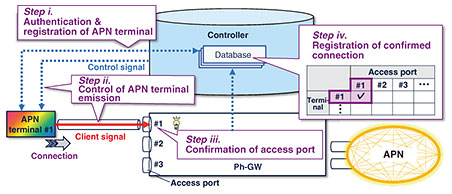
Feature Articles: Toward Commercial Deployment of IOWN APN step3 Vol. 24, No. 1, pp. 26–32, Jan. 2026. https://doi.org/10.53829/ntr202601fa3 Control Technologies Supporting APN step3AbstractThis article introduces key control technologies developed by NTT to enable on-demand provisioning and management of optical paths in All-Photonics Network (APN) step3. Specifically, it describes: (i) optical path provisioning technology that enables plug-and-play automatic APN terminal connections; (ii) optical path design technology that enables resource optimization through wavelength conversion; and (iii) control and management technology that enables seamless connectivity between diverse devices and systems with the controller. Keywords: APN step3, plug and play, wavelength conversion  1. Overview of APN control technologiesAll-Photonics Network (APN) step3, planned for commercial deployment around 2028, aims to enable users at various locations to connect to the Innovative Optical and Wireless Network (IOWN) APN on demand—only when and for as long as required. To achieve this, network operators must intelligently control APN equipment by appropriately configuring wavelength resources and power consumption within the optical transmission network in response to user requests for optical path setup. NTT is advancing the sophistication of APN controller components to meet these requirements. This article introduces key enabling technologies: (i) optical path provisioning technology for plug-and-play automatic APN terminal connections; (ii) optical path design technology for resource optimization considering wavelength-converted paths; and (iii) control and management technology that extends interfaces and management models to connect diverse devices and systems with the controller. 2. Optical path provisioning technology for plug-and-play automatic APN terminal connectionsNTT proposed the Photonic Gateway (Ph-GW) as an optical access node in the future APN [1]. Exploiting Ph-GW node architecture, we are studying control technologies to enable plug-and-play operation, accommodation of various types of optical paths, and real-time optical path switching in access areas [2]. Plug and play enables an optical path to be established at any time simply by connecting an APN terminal to the APN at any location within the APN area. It is a control technology expected to enable more on-demand provisioning of optical paths at the APN step3 phase. 2.1 Challenges toward enabling more on-demand optical path usageAPN step3, which supports the spread of APN services, aims to promptly respond to diversified service needs by providing optical paths while efficiently using wavelength resources. To achieve this, further advances in on-demand optical path provisioning technologies [3, 4] are required. One of these advanced features is plug and play, which enables an optical path to be established anywhere, anytime within the APN area, simply by connecting an APN terminal to the APN, supporting more on-demand use case scenarios. For example, in a remote-production use case where footage from a sports or event venue is sent to a broadcasting station, an APN terminal can be brought to the venue according to the event schedule, and a temporary optical path can be established between the venue and editing site. This eliminates the need to permanently install an APN terminal at each venue, reducing the number of APN terminals used per user. APN node ports connected to APN terminals can also be shared alternately among users. This utilization is expected to improve cost efficiency per user and lead to the widespread use of APN services. To automatically establish optical paths, the APN controller needs to recognize the connection relationship between the APN terminal and the access port of the Ph-GW to which the terminal connects. This ensures that optical signals from and to the APN terminal are transferred according to the designed optical path route by appropriately setting transfer routes inside the Ph-GW automatically. This novel port management and operation that automatically confirms and identifies the access port connected to the APN terminal at the time of initial connection enables the establishment of an optical path on demand for any APN terminal connected to the APN without having to register accommodation design information into the APN controller in advance. 2.2 Control method to enable plug and play of APN terminalsFigure 1 shows an overview of a control method for automatically connecting APN terminals to the APN in a plug-and-play manner without the need for prior input of accommodation design information into the APN controller. When an APN terminal is connected, the APN controller authenticates the terminal through the exchange of control signals and registers terminal information in the database (Step i). Next, the APN controller controls the output of the client-signal light from the APN terminal (Step ii) then confirms the connection between the APN terminal and the access port of the Ph-GW (Step iii). The confirmed connection is registered in the database (Step iv). Even when multiple APN terminals are connected in a short period, the APN controller successfully confirms the access ports by sequentially controlling the main-signal light of each APN terminal [5]. Through these steps, the APN controller can set the transfer route inside the Ph-GW by referring to the connection table generated at initial connection, enabling automatic establishment of the optical path. This plug-and-play operation provides optical path establishment more on-demand, improving operational efficiency during the APN service expansion period. By applying an in-channel control scheme that wavelength-multiplexes main-signal light and control-signal light between the Ph-GW and APN terminals, plug-and-play operation is achieved even when APN terminals are placed at user sites widely distributed in the access area.
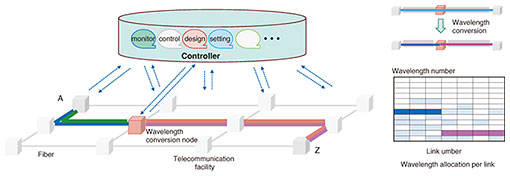
3. Optical path design technology for resource optimization through wavelength conversion3.1 Issues related to path design in the APNNTT is also developing optical path design technology toward APN step3 implementation. APN step3 provides high quality and low latency by assigning optical paths per user or service. To provide optical paths on demand per user/service, rapid design of numerous optical path routes and wavelengths is necessary. Optical path routing and wavelength assignment in the APN are defined as path computation functions in the controller [6], which are essential for software-based control and automated path setup in the transport layer. For optical paths of the continuously operating optical link, shortest or near-shortest routes between two points are generally selected. One wavelength is assigned per route, requiring the same wavelength on all links along the path, which is called the wavelength continuity constraint [7]. The process involves determining the route on the basis of user demand and assigning a wavelength to each constituent link of that route. However, the method used for wavelength assignment impacts the capacity utilization efficiency. Improving this efficiency leads to reduced capital investment. Consequently, a key challenge is to establish a path design method that enables the flexible and cost-effective operation of the APN. 3.2 Path design method for considering wavelength conversionWhen assigning a wavelength to an optical path in the APN, it is typically necessary to assign the same wavelength end-to-end. However, with the introduction of wavelength conversion technology, where wavelength conversion can be flexibly applied in the intermediate equipment, it becomes possible to use multiple wavelengths even within a single optical path [8]. In such cases, in addition to configuring the route and wavelength for the transport equipment, configuration information for the wavelength converters must also be generated and applied to the transport equipment (Fig. 2). Assuming wavelength conversion is applied, a method is needed to assign multiple wavelengths to a single path. One method for wavelength assignment is the traditional first-fit (FF) rule, which assigns wavelengths starting from the lowest channel number sequentially. FF can efficiently allocate wavelength resources using a simple procedure. Therefore, we are proceeding with verification, using simulation and other techniques, for a method that combines wavelength conversion and FF to assign wavelengths to a single optical path.
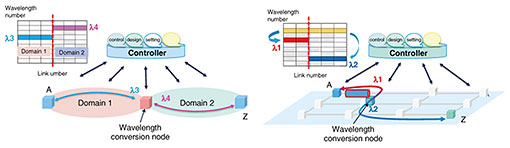
3.3 Wavelength resource optimization in the APNApplications of wavelength conversion include connecting different network domains, such as between transport networks, or connecting different service provider networks (as shown in Fig. 3, left). These connections are often characterized by different management authorities or operational rules. When connecting these networks via a wavelength, it is necessary to negotiate the wavelength to be used. Even when mutual agreement on the same wavelength is not possible, using wavelength conversion can simplify or eliminate the need for such negotiation. This thus enhances the end-to-end connectivity of the optical path while minimizing the need for additional resources. Another application is using wavelength conversion as an alternative to equipment expansion. When the number of accommodated paths increases and the maximum wavelength number reaches a threshold, equipment expansion is needed. Using wavelength conversion to assign lower-numbered wavelengths can delay expansion timing (Fig. 3, right). The effectiveness depends on factors such as current path accommodation status, path route and length, and wavelength conversion positions. Further verification will clarify conditions under which wavelength conversion path design is especially effective.
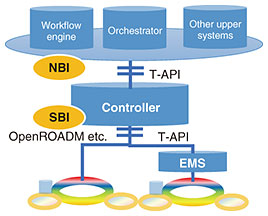
4. Control and management technology connects various devices and systems with the controllerIn APN step3, the APN controller is required to flexibly configure and manage end-to-end optical paths on demand while controlling APN devices. Specifically, the northbound interface (NBI) handles service requests from upper-layer systems and enables advanced control of APN functions through the controller. The southbound interface (SBI) connects to and manages APN devices, including new functions such as wavelength band conversion. A unified data model enables the controller to manage both target devices and optical paths. NTT is developing optical network controller technologies, including specifications for the NBI, SBI, and data model—core components of the APN controller. On the basis of the open interface standards established by organizations such as the Open Networking Foundation (ONF), NTT is promoting the publication of these specifications to enhance interoperability, lower development barriers for adding new APN functions, and accelerate real-world deployment. NTT is also studying optical path management models for paths that incorporate emerging technologies such as wavelength band conversion. 4.1 Overview of NBI and SBI using open interfacesNTT improves connectivity with upper-layer systems, including service orchestrators and workflow engines, and devices, by adopting interface standards that comply with open standards for its optical network controller. Regarding SBI, we are preparing for scenarios in which controlling devices through the element management system (EMS) will be necessary—covering not only direct control of devices but also considering the transition from current optical transport networks to the APN. We are thus progressing with studies based on two control methods: controlling devices directly and via EMS (Fig. 4).
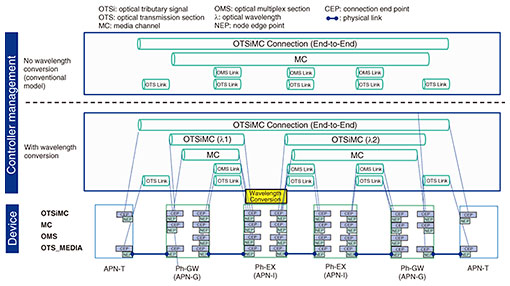
Regarding NBI, we use the Transport Application Programming Interface (T-API), standardized by ONF and widely used in commercial controller products. Considering real-world operational use cases and the functions needed for APN step3 on-demand connections, we are also exploring extensions to the T-API specification. Regarding SBI, we use OpenROADM (reconfigurable optical add/drop multiplexer) for direct device control from the controller. For device control via EMS, we use T-API, which is supported by many commercial EMS systems. Even when interfaces for devices and EMS follow standard specifications, vendors might have their own interpretations. Therefore, we examine the interfaces of commercial products using actual equipment, define the requirements SBI should implement, and draft the related specifications. On the basis of these efforts, NTT has developed interface specification documents for the optical network controller. To help understand these specifications and speed up development, we have also created a user guide summarizing design and implementation guidelines. These documents are publicly available on NTT’s website [9]. Using an optical network controller that implements these specifications, we conducted proof-of-concept experiments connecting to actual APN devices to verify the feasibility of the interface specifications. 4.2 Optical wavelength path management model with wavelength band conversionNTT is exploring an optical wavelength path management model necessary for the optical network controller to manage end-to-end optical wavelength paths that include sections with wavelength changes, using wavelength band conversion technology—a new key technology for the APN. The current optical path management model defined in T-API assumes the use of a single wavelength for end-to-end paths (Fig. 5, upper). However, managing wavelength conversion paths requires the controller to differentiate and manage different optical signal connections. Alternatively, end-to-end network connections can be treated and managed as a single path. In line with these requirements, NTT has developed an optical wavelength path management model (Fig. 5, lower) that enables both detailed management of each optical wavelength path component by the controller and operational flexibility by handling it as a single optical path. This is achieved by separating the connections representing optical signals by wavelength and building multi-tiered end-to-end connections that span optical wavelength paths at a higher level.
The research results related to NBI, SBI, and the optical wavelength path management model were obtained from the grant program (No. JPJ012368G60301) by National Institute of Information and Communications Technology (NICT), Japan. 5. Future outlookThis article discussed key technologies related to APN control that NTT is developing to achieve APN step3. Moving forward, we will evaluate the viability of each technology through proof-of-concept experiments and support the commercial deployment of APN step3. References
|
|||||||||||||||||||