|
|||
|
|
|||
        |
Feature Articles: Toward Commercial Deployment of IOWN APN step3 Vol. 24, No. 1, pp. 33–37, Jan. 2026. https://doi.org/10.53829/ntr202601fa4 Demonstrating Timely Optical Path Establishment Achieved by APN step3AbstractWe are advancing technical studies on All-Photonics Network (APN) step3 to achieve a new connection form that enables users at various locations to connect to the APN only when needed and for the required duration. For the effectiveness and value of this new connection form to appeal to APN users, we have conducted technical demonstrations and use case demonstrations using commercial lines. This article introduces these activities. Keywords: APN step3, optical path establishment, technology demonstration
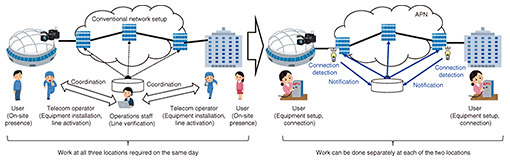
1. IntroductionIn the Innovative Optical and Wireless Network (IOWN) initiative, the IOWN All-Photonics Network (APN) leverages cutting-edge photonic technology to provide users with high-capacity and low-latency optical paths while minimizing power consumption. This is expected to enable a wide range of applications such as interactive live video streaming services, remote surgeries, and digital transformation in factories. Since the launch of the IOWN APN 1.0 service by NTT EAST and NTT WEST in March 2023, NTT has been conducting various demonstrations that showcase the advantages of the APN’s high-capacity and low-latency characteristics. As an example of IOWN APN step1 and step2 for Enterprise, NTT successfully established a stable and ultra-low-latency connection over approximately 3000 km between Japan and Taiwan using APN technology. As an example of these steps for datacenter exchange, NTT is also advancing APN-based interconnection between datacenters overseas. NTT is now aiming for the next stage—APN step3—which envisions a new mode of APN connectivity where users at various locations can establish on-demand connections to the IOWN APN only when needed and for the required duration, and is studying underlying technologies. To promote the effectiveness and value of the APN, technical demonstrations and use case demonstrations using commercial lines have been conducted. This article introduces these activities. 2. APN step3 technical demonstrationOne notable use case of APN step3 is remote video production, where, instead of producing content on-site, high-capacity and low-latency data transmission enables real-time video production in the cloud or at broadcasting stations. By connecting stadiums or event venues and production centers via the APN, large-capacity, low-latency video collection becomes possible. When providing APN connections to users, it is currently necessary to dispatch technicians to the site to install data transceivers. Technicians at both ends may have to coordinate with network operators who configure APN devices to establish the optical path. For sports broadcasts and live broadcasts from various stadiums and event venues, the APN will be expected to connect between various locations and video production centers. Therefore, it is desirable to set each optical path in a timely manner. To provide optical paths more promptly, it is essential to enable users to simply connect a pre-shipped data transceiver to the APN at their convenience—without the need for on-site technicians—and have the APN automatically detect the connection and configure the optical path (see Fig. 1).
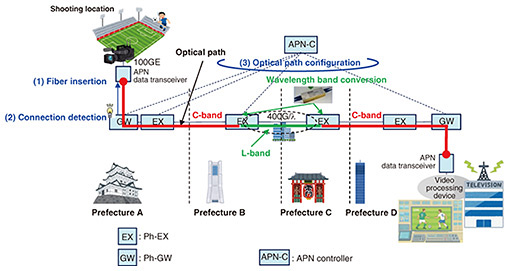
It is necessary to provide an optical path over a wide area since there are stadiums and event venues nationwide, and various types of optical fibers already deployed in networks are used. Since the optimal wavelength band for optical transmission varies depending on the type of fiber, the APN must also support wavelength band conversion to ensure the optical path uses the most suitable wavelength. To address these challenges, NTT has been developing key technologies to support IOWN APN step3, including the Photonic Gateway (Ph-GW), Photonic Exchange (Ph-EX), and APN controller, and has been conducting technical demonstrations simulating a remote video production use case. The demonstration configuration and procedure are shown in Fig. 2. On the assumption that video production sites that execute video processing collect video from shooting sites such as stadiums, a network composed of six APN devices was constructed. Ph-GW has a plug-and-play function from which the APN controller recognizes transceiver information when a data transceiver is connected. In addition to the functions in conventional optical node systems, Ph-EX has a function of wavelength band conversion, which enables bulk conversion of transmission wavelength bands. Assuming that current fiber facilities are used, both single-mode fiber and dispersion-shifted fiber were applied to connect APN devices. In the above demonstration configuration, when data transceivers located at remote sites were connected to the APN, Ph-GW successfully detected the connection automatically using plug-and-play functionality, and an on-demand optical path between the video capture site and production center was established. Some functions of the APN leveraged outcomes obtained from the grant program (No. JPJ012368G60301) by the National Institute of Information and Communications Technology (NICT), Japan.
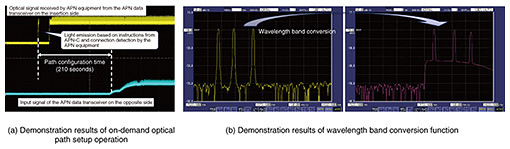
Figure 3(a) shows the demonstration results of the on-demand optical path setting operation. After detecting optical signals from data transceivers at the APN device, the APN controller sets the optical path to the data transceiver, and the data transceiver outputs an optical signal. Figure 3(b) shows the demonstration results of the wavelength band conversion function in Ph-EX. It was confirmed that the optical paths with the C-band wavelengths were set in the single-mode-fiber section, while the optical paths with the L-band wavelengths were set in the dispersion-shifted-fiber section through the wavelength band conversion in Ph-EX. We thus successfully demonstrated two basic technologies: a plug-and-play function that enables users to automatically connect APN devices to the APN wherever and whenever needed and a wavelength band conversion function that enables expansion of APN services using existing infrastructure.
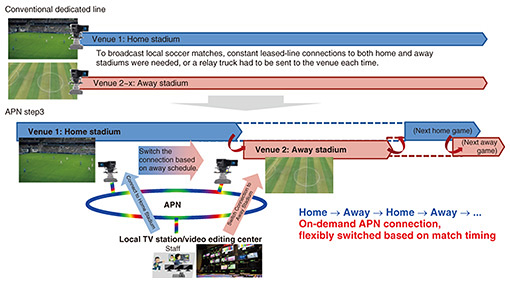
3. Use case demonstration of APN step3 using commercial linesWhile the key technologies of APN step3 were demonstrated in laboratory environments, it is necessary to clarify the application domains of these technologies and indicate their effectiveness through use cases toward the service deployment. The conventional version of the APN has been deployed for providing point-to-point dedicated optical wavelength paths featuring ultra-low latency, large capacity, and low power consumption. In the future, artificial intelligence and real-time processing via the cloud will expand further; thus, connecting a single site to multiple sites will be needed. Achieving such multi-point connectivity using conventional dedicated optical wavelength paths has limitations in terms of flexibility and cost-effectiveness, so the APN needs to become more on-demand in terms of location and time, especially for use cases in which communication between locations is required for a limited period. A specific use case is remote video production collecting large-capacity, low-latency video from nationwide venues for the cloud or broadcast stations (Fig. 4). Such massive video data transmission with minimal latency is key to creating new value in the content creation industry.
When using conventional dedicated lines, constant connection is needed at each venue. On the contrary, APN step3 enables on-demand switching of connection destinations. By connecting terminal equipment to the APN, the route and wavelength are immediately determined by the end-to-end optical path design, the difference in fiber type is absorbed by the wavelength conversion and wavelength band conversion, and the connection settings are automatically configured through the plug-and-play function. Therefore, preparation of connection that previously required months of coordination can now be completed in a short time. It is thus important to achieve APN step3 as a service that covers long-distance and multiple-location use, so a verification in a laboratory with an optimum environment is insufficient in terms of demonstrating its performance and effectiveness. To evaluate realistic requirements, such as large-capacity transmission, over distances of several hundred kilometers and connections across different types of optical fibers, long-distance demonstrations using commercial lines are essential. In this demonstration, NTT’s commercial APN step2 line was used as a part of the verification network, and a network covering multiple domains with different fiber types was constructed from NTT Musashino R&D Center to Yumeshima, Osaka (the site of Expo 2025 Osaka, Kansai, Japan). The key technologies of APN step3—end-to-end optical path design, wavelength conversion and wavelength band conversion, and plug-and-play functionality—were applied and confirmed to effectively operate in this realistic environment. This demonstrated reliability beyond lab tests. The results are directly applicable to large-capacity and low-latency use cases, such as remote video production, and have potential applications to disaster backup and the industrial and medical fields. At the Expo site exhibiting part of this demonstration, feedback included:
Such feedback provides valuable insights to accelerate social implementation of APN technology. 4. ConclusionThe new connection form envisioned in APN step3 is expected to expand APN services for more diverse use cases. On the basis of the technical demonstration results and Expo exhibits, we will proceed with research and development for commercialization in 2028. We will also continue to promote further demonstrations toward the widespread deployment of APN technology by leveraging the IOWN Global Forum and making proposals to the Open APN Functional Architecture. |
||