|
|||
|
|
|||
        |
Global Standardization Activities Vol. 24, No. 1, pp. 42–45, Jan. 2026. https://doi.org/10.53829/ntr202601gls The Activities of ITU-T Study Group 13 (Future Networks and Emerging Network Technologies)AbstractInternational Telecommunication Union - Telecommunication Standardization Sector (ITU-T) Study Group 13 (SG13) is working on the concept of future networks. Emerging network technologies, such as networks of low latency and energy efficiency, next-generation mobile networks, and quantum information technologies, are being discussed for their implementation around 2030. This article introduces the future network studies in ITU-T SG13. Keywords: future networks, IMT, low latency, energy efficiency
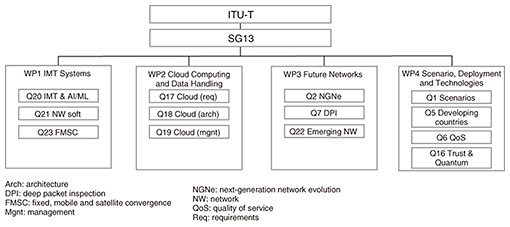
1. IntroductionGlobal standardization community is working toward new network technologies and concepts such as International Mobile Telecommunications (IMT)-2030, quantum information technologies, artificial intelligence/machine learning (AI/ML) and its applications, and cloud computing. International Telecommunication Union - Telecommunication Standardization Sector (ITU-T) designates Study Group 13 (SG13) as the lead SG mandated to progress the work on the concept of future networks as well as necessary coordination among the groups in ITU-T. Experts from telecom operators and vendors as well as academic organizations are involved in the work in SG13. This article introduces the topics of the future networks being discussed at the recent SG13 meetings. 2. Structure of SG13Thirteen Questions, which are small groups tasked to conduct specific study subjects, have been established in SG13. As shown in Fig. 1, these Questions are allocated to 4 Working Parties (WPs), which are the middle level groups between SGs and Questions and have certain authority such as launching approval process of draft recommendations. WP1 is responsible for the study on IMT and allocated 3 Questions. WP2 is responsible for the study on cloud computing and data-handling technologies and allocated 3 Questions. WP3 is responsible for the emerging technologies of future networks and allocated 3 Questions. WP4 is responsible for the study on scenarios, deployment, and technologies of future networks and allocated 4 Questions. In this study period starting from 2025, the structure of Questions is basically maintained as it was in the previous study period until 2024. The number of WPs has been increased from 3 WPs in the previous study period to 4 WPs in the current study period. This change in the WP structure makes Questions of each WP more aligned and will contribute to more efficient technical discussion.
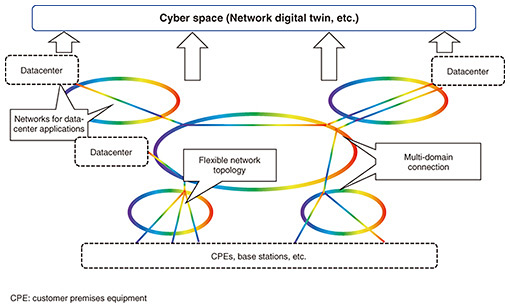
Most of the technical discussions in SGs are conducted in WPs and Questions. SG13 establishes other types of groups to conduct activities which are more supported by flexible environments. A Focus Group (FG) is a group defined for specific subjects that require short-term and intensive efforts. The work methods of FGs are defined in ITU-T Recommendation A.7. Limited lifetime (usually 1 year) and participation of non-members of ITU-T are major features of FGs. SG13 established FGs for the works on IMT-2020, cloud computing, and AI applications and produced the study results accelerating the work for ITU-T Recommendations in these fields. FG-AINN (Focus Group on AI-Native Networks) is in operation to promote the study on AI native networks. A Joint Coordination Activity (JCA) is a group for coordinating specific study subjects across SGs in ITU-T as well as standards development organizations. Two JCAs are currently in operation: JCA-AI/ML, which coordinates AI/ML related studies, and JCA-IMT 2030, which coordinates IMT-2020 and beyond related studies. SG13 also closely cooperates with JCA-QKDN (Joint Coordination Activity on Quantum Key Distribution Network), although this JCA is not under SG13. A Reginal Group (RG) is a group to promote the work of SGs in the designated region. Two RGs, SG13 RG-EECAT (SG13 Regional Group for Eastern Europe, Central Asia and Transcaucasia) and SG13 RG-AFR (SG13 Regional Group for Africa), are currently in operation. RG-AFR works closely with Question 5, which is responsible for future networks in developing countries and encourages contributions from the African region. 3. Recent technical discussions3.1 Low-latency and energy-efficient networkThere has been a growing demand for low-latency communication in the field of distributed cloud computing and radio access networks of mobile systems. Energy consumption of telecommunication networks is also gaining the attention of industry experts. The current packet-based networks have limitations of low latency and energy efficiency; thus, a new technical approach is needed. The All-Photonics Network (APN) is one possible solution to overcome the limitation of low latency and energy efficiency by existing packet-based networks. Although the APN is being established as an enabler of low-latency and energy-efficient communication, there remain unresolved issues such as how this APN technology is used in large-scale networks across different network operators. ITU-T is expected to resolve such issues for actual deployment in public networks. At SG13 meeting in July 2024, the volunteer companies including NTT and KDDI submitted a contribution proposing the new work item for draft ITU-T Recommendation Y.L2E2net-frm. This draft recommendation aims to describe the framework of the future network with the features of low latency and energy efficiency as exemplified by the APN. As shown in Fig. 2, the scenarios of the network described in this draft recommendation cover connection between datacenters and between a datacenter and terminals or base stations with flexible network topologies supporting data backup and flexible wireless access networks. The network in this draft recommendation may consist of multiple domains as appeared as rings in Fig. 2.
Some members showed their concerns about the proposal. One member proposed to change to a technical report, which is a non-normative publication of ITU-T with lower status than a recommendation. The proponents, including NTT, made efforts to convince the opponents who addressed their concerns. The meeting concluded that the proposed new work item will be launched with a change in the approval process from the alternative approval process, which is the faster process applied for the technical recommendations, to the traditional approval process, which is the more careful process applied for the recommendations with regulatory and/or policy implications. This draft recommendation is targeted for completion by the middle of 2026. While this draft recommendation addresses the computation-related communications between datacenters, SG13 has been working on the emerging technical area where computing and networking technologies are more closely cooperating, referred as coordination of networking and computing (CNC). The features of low latency and energy efficiency are expected to contribute to reducing energy consumption of AI/ML applications by leveraging CNC technologies. 3.2 IMTThree Questions in WP1 are conducting the studies on IMT. Since the studies on IMT-2020, which is the current generation of mobile systems implemented around 2020, have been completed, the focus on IMT studies has moved to advanced features of IMT-2020, which is called IMT-2020 beyond, and IMT-2030, which is the next-generation mobile system expected to be implemented around 2030. At the SG13 meeting in March 2025, the proposals for new technical reports on IMT-2030 were made in Questions 20, 21 and 23. These proposals were accepted. In 2023, ITU Radiocommunication Sector (ITU-R) has approved ITU-R Recommendation M.2160, which describes the framework on IMT-2030. This ITU-R Recommendation stimulates further detailed technical studies in SG13. IMT consists of radio and non-radio parts. ITU defines a clear demarcation between ITU-T, which is responsible for non-radio aspects of IMT, and ITU-R, which is responsible for radio aspects of IMT. By this demarcation, the work of SG13 specifically focuses on non-radio aspects and each work item on IMT clarifies its scope within the mandate of SG13. Questions 20 and 21 are considering application of AI/ML as a direction of enhancing IMT-2020. FG-ML5G (Focus Group on Machine Learning for Future Networks including 5G), which was in operation from 2018 to 2020, and FG-AN (Focus Group on Autonomous Networks), which was in operation from 2020 to 2024, produced a number of useful deliverables on the possible use of AI/ML in future networks including mobile systems. These deliverables are considered in the work of Questions 20 and 21. One possible approach for the study on IMT is the use of satellite communications. Satellite communications enable telecom operators to provide mobile services in remote areas including the sea where current mobile systems cannot provide their services. Low-latency communications will be possible by using low earth orbit satellites. Chinese experts are active in the area and promotes studies on FMSC (fixed, mobile and satellite convergence). Twenty-seven work items are in progress as of July 2025. 3.3 Quantum-key-distribution networksQuantum key distribution is a security mechanism using effects of quantum physics, while the conventional security mechanisms rely on complexities of mathematical algorithms. Quantum key distribution can ensure long-term security while the conventional security mechanisms have a risk of future vulnerabilities due to enhanced computation power. However, quantum key distribution has difficulty with long-distance transmission. Therefore, application for large-scale networks, such as nation-wide networks and international networks, is considered as a major challenge. Quantum key distribution is mainly discussed in Question 16, while its quality-of-service aspect is discussed in Question 6. Nineteen work items including revision of existing recommendations in Question 16 and 11 work items in Question 6 are being discussed as of July 2025. These work items include the integration into security protocols such as IPsec (Security Architecture for Internet Protocol) and TLS (Transport Layer Security) and integration with applications. 4. ConclusionsThis article introduced the future network studies in ITU-T SG13. By 2028, the end of the current study period, it is expected to progress the work on IMT-2030, which will be implemented in 2030. At that time, the works on application of AI/ML and CNC, which are being discussed in SG13, will become mature. Emerging network technologies, such as quantum key distribution, will become business interests from academic interests through development of ITU-T Recommendations. The low-latency and energy-efficient networks proposed by Japanese experts including NTT is being discussed as a common network infrastructure. SG13 will promote studies on the concepts of these future network technologies by developing ITU-T Recommendations. |
||