|
|||
|
|
|||
|
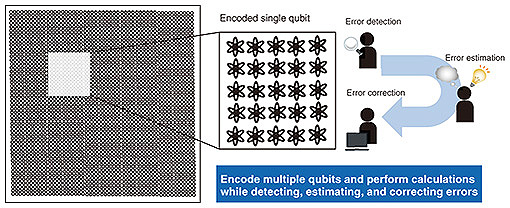
Rising Researchers Vol. 24, No. 1, pp. 8–13, Jan. 2026. https://doi.org/10.53829/ntr202601ri1  Quantum Error Mitigation: A Key Approach to Overcoming the Barriers to Practical Application of Quantum TechnologyAbstractQuantum computers, currently being researched and developed worldwide, still face several challenges before they can be put to practical use. One of the largest challenges is the frequent occurrence of calculation errors caused by a variety of factors. Overcoming errors caused by the fundamental properties of quantum states is the most important issue for full-scale practical application of quantum computers, and many people worldwide have high hopes for the emergence of large-scale quantum computers with fault tolerance. In this article, we spoke with Suguru Endo, a distinguished researcher at NTT Computer and Data Science Laboratories and a frontrunner who established the world’s first practical method for quantum error mitigation and was selected as one of the “Innovators Under 35 Japan 2021” by MIT Technology Review. Keywords: quantum computing, quantum error mitigation, continuous-variable error correction  Taking the first steps toward the practical application of ultimate “universal quantum computing”—What exactly is quantum error mitigation? Quantum technology is currently being researched and developed worldwide; however, quantum computers suffer frequent errors caused by external noise such as heat and magnetic fields. Under current circumstances, this noise problem cannot be solved overnight, and eliminating these errors is a prerequisite for the long-awaited practical application of quantum computers. One practical approach to solving this problem is “quantum error correction.” This approach makes it possible to restore the original state of a quantum bit (qubit) even if an error occurs by adding redundancy with numerous qubits. For example, calculations on conventional computers are based on the binary digits “0” and “1”. Let’s presume “0” is represented as “000” and “1” as “111.” Even if a quantum error occurs and the “000” becomes “010,” it can be inferred that the “010” was originally “000,” so it is possible to detect the error and restore the “010” to the original “000.” By increasing the number of digits, to “00000...,” for example, to create redundancy, quantum error correction improves the accuracy of error correction (Fig. 1).
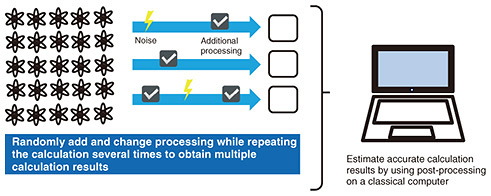
However, current quantum computers are limited to a few hundred qubits, so allocating power for quantum error correction would impair their inherent computing power. Integrating physical qubits to create logical qubits capable of correcting errors requires tens to hundreds of physical qubits. Under the assumption that the same number of logical qubits are required for meaningful calculations on a quantum computer, correcting errors by quantum error correction places an excessive burden on current quantum hardware. Considering this burden, I’m therefore researching an approach called “quantum error mitigation,” which aims to reduce quantum errors without impairing the capabilities of quantum computers. As a means of error reduction, quantum error mitigation, roughly speaking, removes errors from calculation results by statistically processing the results outputted from a quantum computer and estimating the correct results (Fig. 2). Since quantum error mitigation executes statistical processing using a conventional (classical) computer to estimate the results calculated with multiple quantum processors, it is considered suitable for current medium-scale quantum computers, which have a limited number of qubits. Various methods of quantum error mitigation have been proposed.
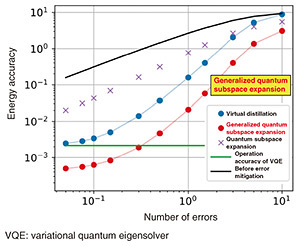
In fact, in the case of a large-scale 127-qubits quantum device developed by a certain company, the error rate of 10% or greater was reduced to the range of a few percent to a few tenths of a percent by using my proposed method of quantum error mitigation, namely, “exponential extrapolation.” Although quantum error mitigation is essential for reducing computational errors, it has some drawbacks. Regarding quantum mechanics, measurement results are generally random, and statistical errors occur when calculating the expectation value of observables. Quantum error mitigation increases the variance of the expectation value, requiring more measurements. Nevertheless, quantum error mitigation is currently a powerful approach used in many quantum experiments. —Could you please tell us about the “hybrid error reduction”—which combines quantum error correction and mitigation? The current mainstream quantum computer is called a “noisy intermediate-scale quantum computer,” which cannot correct errors that occur with a certain probability. The number of qubits currently handled by quantum devices is steadily increasing, and devices with more than 1000 qubits have appeared. However, as the number of physical qubits increases, the impact of errors increases exponentially. It is therefore believed that with current technology, it is extremely difficult to properly operate large-scale devices with more than 1000 physical qubits. The key factor in operating a quantum computer properly is not the number of physical qubits that are likely to cause errors before error correction; instead, it is the number of logical qubits that can correct errors. In other words, it is not simply a matter of increasing the number of physical qubits. In theory, quantum computers are said to have computing power that far exceeds that of classical computers (including supercomputers). In reality, however, it is difficult to demonstrate their true capabilities without technologies such as quantum error correction and mitigation. Therefore, we proposed a method called “hybrid error reduction,” which combines quantum error correction and quantum error mitigation to reduce computational errors by using logical qubits, the errors of which can be corrected. Although this method is complex, it basically involves correcting quantum errors so as to reduce the error rate sufficiently then completely eliminating computational errors by using quantum error mitigation. We have shown that hybrid error reduction can reduce the number of physical qubits required for early-stage fault-tolerant quantum computing by as much as 80%. I believe hybrid error reduction will become essential for implementing early-stage fault-tolerant quantum computing. Aiming to develop the ultimate method for quantum error mitigation, we integrated several methods for quantum error mitigation. Up until now, various methods for quantum error mitigation, such as “extrapolation,” “virtual distillation,” “quasi-probability method,” and “quantum-subspace expansion,” have been proposed. The “generalized quantum subspace expansion” method we proposed can be said to be the ultimate form that integrates these methods into a single framework. This method makes it possible to cancel out computational errors by preparing copies of quantum states affected by multiple computational errors in parallel and making them interfere. The error mitigation effect of generalized quantum subspace expansion is significantly higher than that of previous mitigation methods [1] (Fig. 3). This effect becomes immediately apparent when we compare the results (energy accuracy) obtained from a quantum state affected by noise with those obtained from a quantum state in which errors have been suppressed by using generalized quantum subspace expansion (Fig. 3).
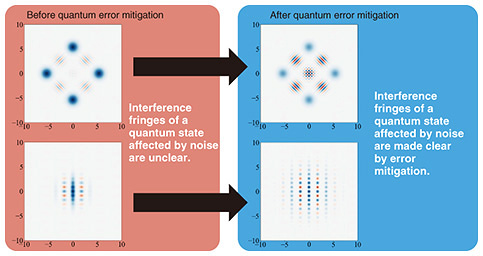
Pioneering a new frontier with a new method of error correction using light—What are the prospects for your future research? I’m also involved in various other research projects related to quantum technology, and the technology that I’m currently focusing on is “continuous-variable error correction.” This new error correction method uses light. It has been found that the error correction capability of light can sometimes significantly reduce the number of errors in physical qubits. I hadn’t approached quantum error correction from this angle before, but this research project is taking advantage of our strengths, namely, “NTT = optics.” This is a field in which I hope to see more cross-institutional discussion, since I believe it holds the potential for significant research breakthroughs. Since error correction methods using light remain largely unexplored, one of my current goals is to develop fusion techniques that effectively utilize light to create even-more-effective methods for quantum error correction and mitigation. This research on continuous-variable error correction using light faces many challenges, and it may be ten years from now (by around 2035) before we achieve practical error reduction with optical systems. However, we have already made some theoretical progress, and as shown in Fig. 4, quantum error mitigation (for microwave light) can be applied to the quantum state of a continuous-variable error-correction code, and quantum error mitigation can improve the accuracy of the code state.
—What led you to join NTT? The major reason I decided to join NTT was that I met a researcher at NTT Basic Research Laboratories to ask him a question related to my bachelor’s thesis. After receiving the initial answer, I ended up receiving research guidance from that researcher, and I got a long-term internship at NTT mentored by him. During that period, I was also helped by many other people at NTT, and the valuable guidance I received from them was a major motivation for me. It was on my mentor’s recommendation that I subsequently went abroad to study at University of Oxford in the UK. At Oxford, where my research was related to quantum error mitigation, I met more people who became mentors and guided me to my current career. At that time, the great potential of quantum computers was gathering attention worldwide, and researchers started saying that quantum computers might be able to solve some of the problems that could not be solved with classical computers. I can say that it was thanks to my study in the UK that I was able to build a career in the field of quantum technology. After completing my doctoral studies in the UK, I returned to Japan in 2020. When it came time to start looking for a job in Japan, I realized once again the importance of the benefits that I’d received from NTT. To return the favor, I couldn’t imagine finding employment anywhere other than NTT, the company that has supported me since my student days. Thus, in January 2020, I joined NTT Secure Platform Laboratories, and in July 2021, after the reorganization of NTT’s laboratories, I transferred to my current position at NTT Computer and Data Science Laboratories, where I remain to this day. Looking back, I realize that my journey as a researcher has always been, and continues to be, with NTT and the people at NTT. I hope to continue to pursue my research with a deep sense of gratitude to everyone at NTT. —What do you consider important when conducting research? One of the things I value in my research is not being bound by fixed ideas. When a new concept emerges, I try to look at things from the perspective of “could this concept be used in other ways?” or “could it be generalized?” When I see a breakthrough that overturns fixed ideas, I think it’s important to share it with other researchers and listen to their opinions so that we can all work together to create something good. No matter how talented a person is, there are always limits to what just one person’s skills and insight can achieve. I believe it’s important not to be self-centered but to work as a group. From the perspective of practical application, research on quantum technology is still in its infancy. In fact, quantum error correction and mitigation have only just begun to take shape in the past few years. Quantum computational power available with current technology is still at a level that allows conventional classical computers (including supercomputers) to handle most problems sufficiently. It is highly likely that my lifetime will be insufficient to implement and commercialize a fault-tolerant large-scale quantum computer capable of the universal quantum computing anticipated worldwide. Given that likelihood, in parallel with my research, I’m currently focusing on mentoring the next generation of quantum scientists. NTT has joint research agreements with several universities, primarily the University of Tokyo and Keio University, and I provide mentoring to students. While my current research guidance focuses primarily on students from those two universities, I have also mentored interns, for example, from Nagoya University and MIT (Massachusetts Institute of Technology). Naturally, I enjoy interacting with such talented students from a variety of universities. Among the current students that I meet through internships and other opportunities, some actually possess top-level abilities and skills. One has produced a mathematical proof of the efficiency of an algorithm in a manner that would have been impossible with my skills, and another (majoring in experimental studies) proposed a beautiful theory that is far more general than what I have proposed. I often get the sense that an incredible next generation is already out there, and I have high hopes for such young people. —Please tell us about your current position at NTT Computer and Data Science Laboratories and NTT Research Center for Theoretical Quantum Information. At NTT Computer and Data Science Laboratories, we are pursuing innovative research in the fields of computer science and data science. The results of this research will enable us to process data that was previously difficult to handle due to the scale and complexity and create useful value for people and society. The Laboratories as a whole values next-generation computing technology. I’m extremely grateful that I’m able to pursue research in the field of quantum computing, which has not yet been put to practical use, thanks to NTT investing a considerable budget and valuing the independent thinking of each researcher. In addition to theoretically focused basic researchers like me, many researchers at the Laboratories are working on development, and the Laboratories’ research covers a wide range of genres. Aiming to create innovative technologies that are only possible through quantum properties, NTT Research Center for Theoretical Quantum Information promotes cutting-edge theoretical research in the field of quantum information science based on the principles of quantum mechanics. Although it is still a relatively new laboratory, it is home to many experts in quantum technology. Through deep discussions with these experts, I hope to make completely new proposals—such as the aforementioned continuous-variable error correction—that differ from anything that has been proposed before. In fact, with its foundations as a research laboratory already in place, the Center is full of potential.
—What is your message to researchers and students? I’m so grateful to my collaborators, who always provide me with inspiring ideas and different perspectives in a manner that enables me to pursue stimulating research every day. Students also provide me with ideas. Our relationship is not one way; we stimulate each other and I feel like I’m growing with them. I hope to continue my good relationships with these people. NTT is a very desirable environment for someone who conducts basic research like me, so I encourage anyone interested in quantum technology to come and join us. If you choose to join, as I have done, we can work hard together and enjoy researching with other NTT researchers. Reference
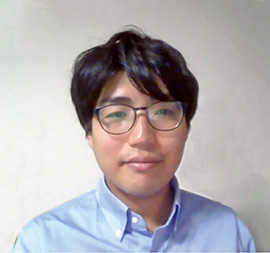
■Interviewee profileSuguru Endo graduated from the Department of Applied Physics and Physico-Informatics at Keio University in 2014. He completed a Master’s degree in physics in the School of Fundamental Science and Technology at the same university in 2016. He studied abroad at the University of Oxford from 2017 to 2019 and completed a doctoral course in the department of materials. He joined Nippon Telegraph and Telephone Corporation, where he entered NTT Secure Platform Laboratories in 2020. Since 2021, he has been with NTT Computer and Data Science Laboratories. He was selected as the MIT Technology Review Innovator Under 35 Japan in 2021 and Project Management Institute Future 50 in 2022. |
|||