|
|||||||||||
|
|
|||||||||||
|
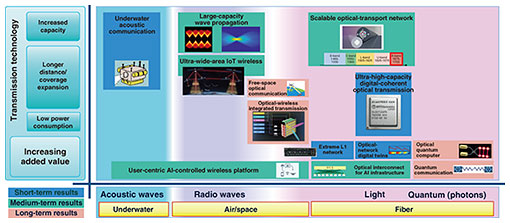
Feature Articles: High-value-added Transmission Technologies through the Convergence of Optical and Wireless Technologies for IOWN/6G Vol. 24, No. 2, pp. 16–23, Feb. 2026. https://doi.org/10.53829/ntr202602fa1 Innovation in Next-generation Network and Computing Infrastructure Driven by the Convergence of Optical and Wireless TechnologiesAbstractWe at NTT Network Innovation Laboratories leverage world-leading communication technologies and networking technologies that maximize their potential to achieve dramatic improvements in communication performance and pioneer new application domains. We are advancing research and development aiming to create groundbreaking “world’s best” and “world’s first” achievements that transcend conventional wisdom and generate new value through societal implementation of those achievements. These technologies are discussed in this article. Keywords: optical transmission technology, wireless transmission technology, All-Photonics Network (APN)  1. IntroductionThe rapid spread of generative artificial intelligence (AI) has led to an explosive increase in data-processing volume and communication traffic, which has accelerated the construction of datacenters worldwide. Therefore, power consumption of datacenters and connectivity between datacenters have become serious issues. Expectations surrounding quantum computers are also increasing worldwide. For example, quantum computers are expected to be applied in a wide range of fields including drug discovery, materials design, finance, and cryptographic communications. To address the challenges posed by these circumstances, we at NTT Network Innovation Laboratories (NIL) are pursuing research and development (R&D) on transmission technologies that use light, quantum light, radio waves, and acoustic waves while adding high value to those technologies. We aim to create new value that will be “world’s best” and “world’s first” and contribute to the practical implementation of the combination of the Innovative Optical and Wireless Network (IOWN) and sixth-generation mobile communications system (6G). The areas of R&D we are undertaking are schematically shown in Fig. 1. In addition to developing technologies that achieve higher capacity, longer communication distances, expanded coverage, and lower power consumption in optical communications using optical fiber, wireless communications in the air and space using radio waves, and underwater communications using acoustic waves, we are actively developing transmission technologies that address the boundary between light and wireless, such as free-space optical communications and optical-wireless integrated transmission, as well as quantum technologies. We are also pursuing R&D to enhance the added value of these transmission technologies.
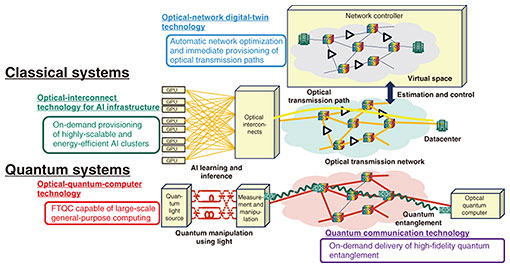
NIL is promoting R&D to enhance the functionality and added value of IOWN, which began service in March 2023. We have developed the core technologies for OTN Anywhere model-B, an evolved version of OTN Anywhere, which is an optical transport network (OTN) device that freely controls communication latency in Layer-1 networks supporting the All-Photonics Network (APN) IOWN 1.0 service. Compatible with general-purpose interfaces, such as HDMI (high-definition multimedia interface) and USB (universal serial bus), OTN Anywhere model-B features functions for microsecond-precision measurement and adjustment of latency. We have completed technical development of an 800G version of our digital signal processor (DSP) using ultra-high-capacity digital-coherent optical transmission technology and are preparing to apply it practically. We have established the core technologies for the 1.6T version and began full-scale development. Regarding optical-network digital-twin technology, we established quality-estimation technologies for transceivers and transmission paths and are advancing technological development toward practical application of these technologies. Our R&D of the core technologies for increasing capacity, distance, and coverage of IOWN are introduced as follows. Regarding underwater acoustic communication technology, we are establishing modulation/demodulation signal-processing technology and multi-site reception technology to provide a higher-quality communication area across the oceans and conducting R&D to implement a variety of use cases concerning these technologies. Regarding scalable optical-transport network technology, we are pursuing R&D in two directions. One direction is space-division-multiplexing (SDM) optical transmission. We have achieved 3000-km-class amplified and repeated transmission via 12 cores by using a multicore fiber that contains multiple cores in a single optical fiber. The other direction is ultra-wideband wavelength-division multiplexing (WDM). We have significantly expanded the conventional C-band and L-band optical-communication wavelength bands and demonstrated long-distance, high-capacity communication using the S+C+L+U+X bands (the “X band” was named by NTT). Our R&D that will create new value for the future is introduced as follows. Regarding free-space optical communication technology, we have demonstrated wavefront-compensation technology, which, compared with conventional technology, is over-ten-times more resistant to atmospheric turbulence near the Earth’s surface during the daytime (when communications are susceptible to the effects of atmospheric turbulence). To expand use cases, we have begun R&D on communication between ships at sea (up to 10 km apart). Regarding quantum communication technology, we have established synchronization-control technology for stabilizing photon detection and distributing photon pairs and have begun building a platform for experiments on quantum entanglement to advance R&D toward establishing a quantum-entanglement generation system. In the following sections, the cutting-edge technologies being developed at NIL are introduced under three categories: frontier-communication technology, wave-propagation technology, and transport-innovation technology. 2. Frontier-communication technologyAn overview of frontier-communication technology is presented in Fig. 2. Ultra-high-speed calculations will be achieved through the use of AI platforms and optical quantum computers. These computing resources will be interconnected and coordinated over a wide area by means of optical-network digital twins and quantum communications. Such an integrated computing and networking environment will enable the rapid solution of complex problems that were previously infeasible to calculate within a realistic timeframe. As a result, significant advance can be expected in diverse fields, including materials development, drug discovery, and global environmental analysis, thereby contributing to the resolution of various social challenges.
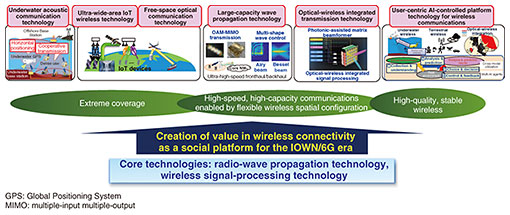
2.1 Optical-network digital-twin technologyTo maximize the performance of the IOWN APN, it is essential to develop technologies that enable accurate assessment of optical transmission path conditions and automated optimization of equipment settings. Optical-network digital twins visualize optical network equipment based on the physical characteristics of light propagation and replicate real-world network behavior with high fidelity in a virtual space. By applying the results of the digital-twin simulations to network design and control the optical network, it becomes possible to automatically optimize the transmission mode (modulation method, baud rate, and error-correction method) of transmitters and receivers as well as the gain setting of relay optical amplifiers. This optical-network digital-twin technology enables fully autonomous operation of optical networks without the human intervention. Consequently, high-speed, flexible optical transmission paths can be provided on demand between datacenters. This optical-network design and control technology significantly expands the capabilities and service potential of the IOWN APN [1]. 2.2 Optical-interconnect technology for AI infrastructureWe are researching and developing optical-interconnect technology that provides higher speed, improved energy efficiency, and enhanced scalability for AI cluster networks, which serve as critical datacenter infrastructure supporting large-scale AI learning and inference workloads. Conventional electrical-switch-based networks face inherent limitations in terms of scalability and power consumption, and multi-tenant operation, which required for efficient sharing of graphics processing unit (GPU) platforms, remains challenging. By introducing optical circuit switch (OCS) technology, it becomes possible to deploy optical interconnects capable of supporting terabit-class AI infrastructure. Our goal is to simultaneously achieve on-demand provisioning of AI clusters and secure multi-tenant operation while reducing power consumption by 90% and dramatically increasing overall network scale. 2.3 Optical-quantum-computer technologyWe are conducting integrated research on optical quantum computers (continuous-variable quantum computing) by combining the device, control, and software technologies cultivated through optical communications. Optical quantum computers have the following characteristics: capability for high-speed operation at room temperature and atmospheric pressure with low power consumption, suitability for generating large-scale quantum entanglement, and scalability through time-division multiplexing. These characteristics promise both energy savings and massive scale. Building on the world-leading quantum-light source, which NTT laboratories have been researching and developing for many years in the optical-communication domain, and pioneering research on quantum software for other types of quantum computing, we aim to realize a fault-tolerant quantum computer (FTQC) capable of large-scale general-purpose computing. By promoting application development and standardization through industry-academia collaboration and community building and by building an ecosystem with partners, we are accelerating the social implementation of quantum technology. We thus aim to contribute to resolving social issues in a wide range of fields including new materials development, drug discovery, and the global environment. 2.4 Quantum communication technologyWe are researching and developing quantum communication technologies for transmitting quantum information between quantum computers. Specifically, we are developing a single-photon quantum-entanglement-distribution system that enables stable, long-distance, high-speed transmission of entanglement resources. This system supports the generation of multiple quantum entanglements and their real-time distribution to multiple locations. In addition, we are developing a quantum-measurement device that supports high-speed single-photon transmission. We have begun researching quantum-node-configuration technologies that support multiple modes and enable on-demand interconnection of heterogeneous quantum computers. In the future, we aim to establish a quantum-network infrastructure capable of interconnecting multiple quantum computers and exponentially expand overall computational capacity. 3. Wave-propagation technologyWe are developing wave-propagation technologies that will become a social infrastructure in the IOWN/6G era (Fig. 3). Using underwater acoustic communication technology, ultra-wide-area Internet of Things (IoT) wireless technology, and free-space optical communication technology, we aim to achieve ultra-extended coverage by expanding communication areas beyond land to the sea, space, and sky. We are also developing ultra-high-speed, large-capacity transmission that will dramatically improve communication speeds by using large-capacity wave propagation technology and optical-wireless integrated transmission technology. We have also been developing user-centric AI-controlled platform technology for wireless communications, which can optimally control communication areas and ensure high-quality, stable wireless transmission by understanding and predicting the wireless environment.
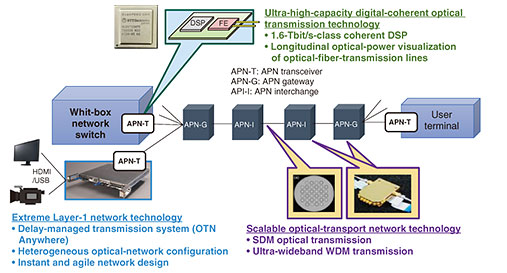
3.1 Underwater acoustic communication technologyAs a result of extending ultra-wideband coverage into underwater areas, which had been unexplored for mobile communications systems, expectations are rising for improved operational efficiency through communications in industrial fields such as development of seabed resources, construction of port facilities, and inspection of marine facilities. By implementing 1-Mbit/s-class underwater acoustic communication technology, we have experimentally demonstrated the world’s first fully remotely controlled underwater drone and are studying its application to maintenance work on undersea communications cables. We are currently collaborating with various industrial partners to apply this technology to a variety of tasks on a demonstration basis as well as developing technologies, such as underwater acoustic positioning and wide-area communications networks that link multiple base stations. 3.2 Ultra-wide-area IoT wireless technologyWe are developing the fundamental technology of an ultra-wide-area IoT wireless platform that collects IoT data via common terrestrial low-power-wide-area terminals without using satellite-specific equipment or frequencies. We aim to achieve global-scale sensing with an ultra-high-coverage communications platform in areas that cannot be reached by terrestrial networks such as mountainous regions and oceans. 3.3 Free-space optical communication technologyTo establish a new communications infrastructure technology that will enable the provision of ultra-high-speed wireless links for mobile devices in locations where laying optical fiber is difficult, we are researching free-space optical communication technology. High-efficiency fiber coupling using wavefront-compensation technology—to address the atmospheric turbulence that occurs during atmospheric propagation—will enable stable, ultra-high-capacity transmission. In the future, we aim to apply this technology to rapid restoration of temporary networks in the event of disasters. 3.4 Large-capacity wave propagation technologyWe are developing terabit-class wireless transmission technologies for fronthaul, backhaul, and wireless access in the IOWN/6G era. We have demonstrated 140-Gbit/s real-time, high-capacity wireless transmission—at the world’s highest speed in the millimeter-wave band—by using orbital angular momentum (OAM) multiplexing transmission [2]. Regarding multi-shape wireless, we aim to implement interference-free, high-capacity wireless transmission by forming a flexible wireless space by generating, combining, and controlling Airy beams and Bessel beams, which have distinctive radio-wave trajectories. 3.5 Optical-wireless integrated transmission technologyWireless systems for IOWN/6G are expected to use high-frequency bands above the millimeter-wave band. To compensate for propagation loss in these high-frequency bands, it is thought that wireless beamforming using ultra-large-scale array antennas (with thousands to tens of thousands of elements) will be necessary. As a component technology that will contribute to this necessity, we are developing technology that uses optical-signal-processing technology to multiplex and process multiple signals by using optical wavelengths in a way that simultaneously generates multiple beams with ultra-large-scale array antennas. 3.6 User-centric AI-controlled platform technology for wireless communicationsRegarding wireless communications using high-frequency radio waves, acoustic waves, or light, even slight changes in the propagation environment can affect communication quality. We are thus developing technology for collecting multimodal information about the wireless environment (e.g., wave propagation and physical space information) and for analyzing and predicting the state of the wireless environment within a virtual space. This technology enables the virtual space to act as a proactive control system for the future environment, thereby meeting users’ needs and desires. 4. Transport-innovation technologyWe are researching and developing transport-innovation technologies that will further improve the added value and capacity of the APN, which is the foundational network for the IOWN concept (Fig. 4). To implement an innovative optical network, we are conducting a wide range of research, from basic research to practical development, on both networking technology and optical-transmission technology. Our current R&D focuses on the three priority themes: (1) extreme Layer-1 network technologies that will add new value to users and operators; (2) ultra-high-capacity digital-coherent optical transmission technologies that will enable high-capacity optical paths with low power consumption, and (3) scalable optical-transport network technologies that will efficiently accommodate the massive amount of communications traffic of the future.
4.1 Extreme Layer-1 network technology (OTN Anywhere)By creating elemental technologies that add value to users and operators in Layer-1 networks, we aim to contribute to the advancement of APN services and expansion of use cases, thus promote the widespread adoption of the APN. We are currently researching and developing technologies that will revolutionize the user experience by providing new value-added functions via high-capacity, low-latency Layer-1 communication paths. These functions include delay-managed transmission system (OTN Anywhere) that measures and controls network latency with nanosecond precision; heterogeneous optical-network-configuration technology that enables the provision of seamless communication paths even in networks where various communication standards coexist; and instantaneous, agile, network-design technology that instantly provides communication paths in response to service orders while taking into account the usage status of network resources. 4.2 Ultra-high-capacity digital-coherent optical transmission technology (coherent DSP)We aim to develop ultra-high-capacity digital-coherent optical transmission technology, providing the high capacity, low power consumption, and long reach required for building the APN. Ultra-high-capacity digital-coherent optical transmission is rapidly expanding into application areas other than traditional long-distance networks for telecommunications carriers. These application areas include datacenter interconnects for short-distance networks. We are researching and developing technology that uses digital signal processing to monitor the status of optical-fiber transmission paths end-to-end and flexibly change transmission methods and compensation processing to establish optimal optical paths for each application area [3]. We are also developing a key device for implementing ultra-high-capacity digital-coherent optical transmission called a 1.6-Tbit/s-class coherent DSP. 4.3 Scalable optical-transport network technologyWe aim to establish scalable optical-transport network technology capable of accommodating the ever-increasing demand for communications traffic driven by the spread of high-speed mobile access and AI services while also expanding transmission capacity. To implement petabit-class optical networks, we are developing innovative SDM optical transmission technologies and ultra-wideband WDM. Regarding SDM optical transmission technologies, we are cultivating the spatial degree of freedom in optical fiber, such as cores and spatial modes, and have successfully demonstrated the world’s first long-distance optical transmission experiment of over 7000 km using a 12-core optical fiber [4]. Regarding ultra-wideband WDM, we are researching and developing technologies such as wavelength-band expansion using inter-channel stimulated Raman scattering as well as an ultra-wideband optical repeater covering the S to X bands. With these technologies, we have demonstrated 160-Tbit/s long-distance optically amplified transmission over 1000 km by using the world’s largest optical bandwidth of 27 THz [5]. By integrating these technologies, we aim to implement future ultra-high-capacity optical networks. 5. ConclusionWe gave an overview of the initiatives concerning cutting-edge technology for IOWN/6G being undertaken at NIL. We are developing transmission technologies and providing high added value by using light, quantum light, radio waves, and acoustic waves. By providing these technologies, we will contribute to continuous business creation of corporations through differentiated technologies that can be put into practical use within a few years and game-changing innovative technologies. References
|
|||||||||||