|
|||||||||||||||||||||||||||||||||||||||
|
|
|||||||||||||||||||||||||||||||||||||||
|
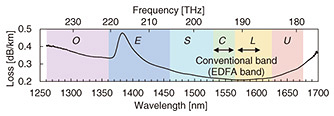
Feature Articles: High-value-added Transmission Technologies through the Convergence of Optical and Wireless Technologies for IOWN/6G Vol. 24, No. 2, pp. 24–30, Feb. 2026. https://doi.org/10.53829/ntr202602fa2 Ultra-wideband, High-capacity Inline-amplified Optical Transmission Using Extremely Long Wavelength Band (X-band)AbstractIn fiber-optic transmission systems, advancements in digital-signal-processing technology have resulted in spectral efficiency close to its theoretical limit. To achieve further capacity growth, it is essential to expand the transmission bandwidth used for wavelength-division multiplexing. This article explains a wavelength-band conversion technology using an optical parametric amplifier based on a periodically poled lithium niobate waveguide and the development of an extremely long wavelength band (X-band), enabled by effective utilization of stimulated Raman scattering in optical fibers. It also describes an ultra-wideband, high-capacity transmission experiment involving a 27-THz-signal bandwidth over the S+C+L+U+X bands. Keywords: ultra-wideband transmission, optical parametric amplification and wavelength-band conversion, periodically poled lithium niobate  1. IntroductionFiber-optic networks form the backbone of the communication infrastructure that supports our modern data-driven society. In optical core networks, wavelength-division multiplexing (WDM) signals, where different wavelengths are used for each transmission channel, are transmitted over hundreds of kilometers using optical amplification repeaters based on erbium-doped fiber amplifiers (EDFAs). In the 2010s, the introduction of digital coherent technology significantly improved spectral efficiency, enabling 10-Tbit/s-class transmission systems [1]. However, advancements in digital-signal-processing techniques, such as coding and error correction, have pushed spectral efficiency close to the theoretical Shannon limit. Therefore, expanding the transmission bandwidth for WDM has become crucial for further capacity increase [2]. The C-band or L-band, each offering a 4-THz WDM bandwidth within the amplification band of EDFAs, has traditionally been used. The development of C+L-band multi-band transmission systems combining these two bands to achieve 10-THz-class signal bandwidth has progressed [3]. At the research level, ultra-wideband (UWB) transmission systems using three or more bands are being explored. Figure 1 shows an example of the transmission-loss spectrum of a typical optical fiber (standard single-mode fiber) across optical telecommunication wavelength bands. The C+L-bands exhibit the lowest loss, while shorter wavelengths suffer from Rayleigh scattering and longer wavelengths from the absorption characteristic of silica-core fibers. The S-band, located on the short-wavelength side of the C-band, is the next low-loss wavelength resource. There are many reports on UWB transmission experiments using the S-band, and NTT has demonstrated 1000-km transmission exceeding 100 Tbit/s using an 18-THz S+C+L-band WDM signal [4]. One challenge in implementing UWB transmission systems is the need to develop transmission equipment, such as transceivers and optical amplifiers, compatible with additional wavelength bands. For the U-band, located on the longer-wavelength side of the L-band, implementing narrow-linewidth lasers, high-speed photodetectors, and rare-earth-doped fiber amplifiers such as EDFAs, for high-quality coherent transmission is difficult.
To address this challenge, we have been investigating WDM bandwidth expansion using optical parametric amplifiers (OPAs) based on periodically poled lithium niobate (PPLN)*1 waveguides. PPLN waveguide devices have been researched and developed for over 20 years at NTT laboratories [5, 6]. PPLN-based OPAs offer a wide amplification bandwidth and enable all-optical wavelength-band conversion by using idler light generated at a different wavelength during amplification. This capability allows for efficient amplification and inter-band conversion between new wavelength bands (such as S or U) and existing bands (C+L). This function enables current transmission equipment to handle WDM signals in new bands without the need of developing additional transmission equipment [7, 8]. Using this approach, we have studied an inline-amplification-repeater configuration that applies current EDFAs to WDM signals in new bands, referred to as the OPA/EDFA hybrid repeater. We developed hybrid repeaters for the S- and U-bands and demonstrated 1000-km inline-amplified transmission of the UWB WDM signal spanning 22 THz across the S+C+L+U bands [9]. We also developed an OPA/EDFA hybrid repeater supporting extremely long wavelengths beyond the U-band and applied it to long-haul transmission experiments. The definitions of each telecommunication wavelength band shown in Fig. 1 are based on the ITU-T (International Telecommunication Union - Telecommunication Standardization Sector) standards and conventionally extend up to the U-band. We have proposed newly defining the X-band for wavelengths up to 1702 nm and using it for data transmission [10].
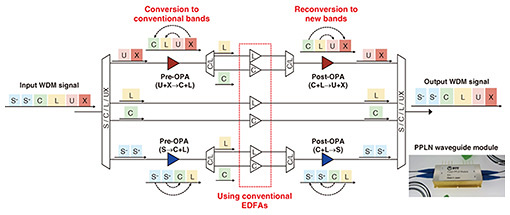
2. PPLN-based OPA/EDFA hybrid repeaterFigure 2 shows the configuration of our developed OPA/EDFA hybrid repeater. When a WDM signal spanning the S+C+L+U+X bands is input, it is first separated into individual wavelength bands with a WDM coupler. The C-band and L-band signals are then amplified using EDFAs in the conventional manner. The S-band signal and U+X-band signals are converted to the C+L-bands with pre-OPAs designed with degenerate frequencies*2 between each respective band and the C+L-bands [11, 12]. After conversion, the signals are split into C- and L-band components and amplified with EDFAs dedicated to each band. The short- and long-wavelength bands extended from the L-band through wavelength conversion are referred to as the S−-band and U-band, respectively, while the bands extended from the C-band are referred to as the S+-band and X-band. After amplification, the signals are reconverted to the S-band or U+X-band by subsequent post-OPAs then combined again by using a WDM coupler. This configuration enables the use of current EDFAs to achieve wideband inline amplification across new wavelength bands.
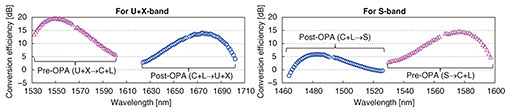
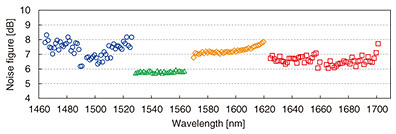
The requirements for an OPA include a wide conversion bandwidth exceeding 8 THz to cover the entire S-band and U+X-bands. To ensure sufficient quality of transmission for wideband WDM signals, it is essential to minimize the overall noise figure of the repeater and achieve high output power to transmit many wavelength channels with adequate optical power. Optical parametric amplification exploits nonlinear optical effects in highly nonlinear media. While configurations using third-order nonlinear effects in highly nonlinear optical fibers are often used, those based on second-order nonlinear effects in PPLN waveguides offer the advantage of low signal degradation caused by unwanted nonlinear interactions between channels. This feature allows for simultaneous achievement of wideband wavelength conversion and high optical output exceeding 20 dBm, making the PPLN-based OPA suitable for application in amplification repeaters. Figure 3 shows the wavelength-band conversion-efficiency spectra of the PPLN-based OPAs used in the following experiment. Positive conversion efficiency is achieved across most wavelengths, indicating that amplification gain is obtained during wavelength-band conversion. To minimize the noise figure of the repeater, the conversion efficiency at the input side (pre-OPA) is particularly important. Each pre-OPA achieves high conversion efficiency across a wide bandwidth exceeding 8 THz. Figure 4 shows the measured noise figure of the amplification repeater. Thanks to the low-noise characteristics and high conversion efficiency of our in-house PPLN waveguide devices, low-noise amplification comparable to that of the conventional C+L-bands can be achieved even for the S-, U-, and X-bands.
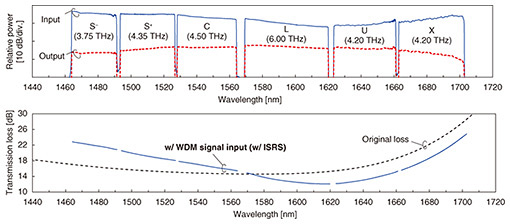
3. 27-THz 1040-km long-haul transmission experiment using ISRSAnother challenge in UWB WDM transmission is inter-channel stimulated Raman scattering (ISRS). This effect causes optical power transfer from shorter-wavelength channels to longer-wavelength channels during fiber transmission, resulting in a shift in the loss spectrum of the transmission fiber toward longer wavelengths compared with its original loss profile. Because ISRS depends on the bandwidth of the WDM signal and launch power of each channel, it complicates transmission design. In this experiment, however, we actively leveraged ISRS to enable high-speed signal transmission extending into the X-band. Conventional optical-telecommunication wavelength bands have been defined on the basis of the loss spectrum of silica-based optical fibers. The U-band has typically been considered the longest-wavelength band with usable low loss, and wavelengths beyond 1675 nm were thought unsuitable for data transmission, so they were not defined as telecommunication bands. We observed that when ISRS is considered in multi-band transmission, the transmission loss at around 1700 nm becomes comparable to that at the S-band. On the basis of this observation, we propose extending the usable wavelength range of optical telecommunication bands to the X-band beyond conventional definitions. Figure 5 shows the optical spectra of the WDM signal used in this experiment before and after transmission and transmission loss. The transmission line was an 80-km standard single-mode fiber, corresponding to the typical repeater spacing in terrestrial core networks. Assuming a channel spacing of 150 GHz, the number of channels and bandwidths for each band were as follows: S-band: 54 channels (8.1 THz), C-band: 30 channels (4.5 THz), L-band: 40 channels (6.0 THz), U-band: 28 channels (4.2 THz), and X-band: 28 channels (4.2 THz), for a total of 180 channels spanning 27 THz.
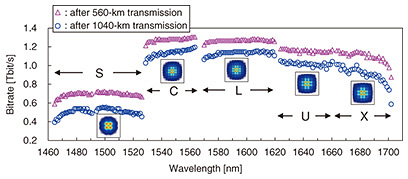
Signal quality in optical fiber transmission is determined by the balance between noise introduced from amplification repeaters and nonlinear distortion that increases with launch power. Therefore, achieving optimal performance requires optimization of launch conditions of the WDM signal, such as per-band launch power and spectral tilt. However, experimentally optimizing these conditions becomes increasingly difficult as the signal bandwidth increases and ISRS intensifies, requiring an enormous number of measurements. To address this issue, research has focused on extending Gaussian noise models to UWB scenarios, enabling fast simulation of quality-of-transmission including nonlinear distortion effects. In this experiment, we optimized launch conditions on the basis of a wideband Gaussian noise model that accounts for ISRS [13, 14]. By transmitting WDM signals under optimized conditions, ISRS shifted the lowest-loss region toward the boundary between the L- and U-bands. Transmission loss at both ends of the optical spectrum also became comparable, confirming that ISRS can be exploited to extend the low-loss region into the X-band. The total fiber launch power was 26.5 dBm (approximately 450 mW). By applying our OPA/EDFA hybrid repeater to an 80-km-span recirculating transmission system*3, we conducted long-haul inline-amplified transmission of the 27-THz WDM signal. As test signals, we used 144-Gbaud probabilistically constellation shaping quadrature-amplitude-modulation signals. Figure 6 shows the measured net bitrates*4 for all 180 channels after 560- and 1040-km transmission. The total net capacity reached 189.5 Tbit/s after 560 km and 160.2 Tbit/s after 1040 km. Notably, terabit-per-second-class high-speed transmission was achieved even in the X-band, demonstrating its viability for optical communications.
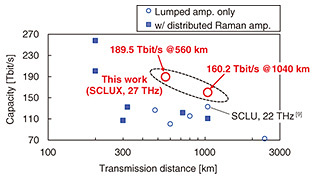
Figure 7 summarizes examples of UWB single-mode fiber transmission with repeater spacings of 80 km or more in terms of transmission capacity and distance. Our results set a record for maximum transmission capacity over distances exceeding 500 and 1000 km. In UWB transmission, distributed Raman amplification*5 is often applied to mitigate excessive loss in short-wavelength bands caused by ISRS. However, we achieved high-capacity, long-haul transmission using only lumped amplification by effectively designing ISRS within the WDM signal. The 27-THz transmission bandwidth represents the widest ever demonstrated in inline-amplified transmission experiments.
4. ConclusionIn this experiment discussed in this article, we demonstrated high-capacity, long-haul transmission using a 27-THz signal bandwidth—more than six times wider than the conventional 4-THz bandwidth. By applying this technology, it is possible to achieve further capacity expansion in optical core networks while using the current fiber infrastructure. Part of this work was supported by commissioned research (JPJ012368C04501) and the grant program (JPJ012368G60101) from the National Institute of Information and Communications Technology (NICT), Japan. References
|
|||||||||||||||||||||||||||||||||||||||