|
|||||||||||||||||||
|
|
|||||||||||||||||||
|
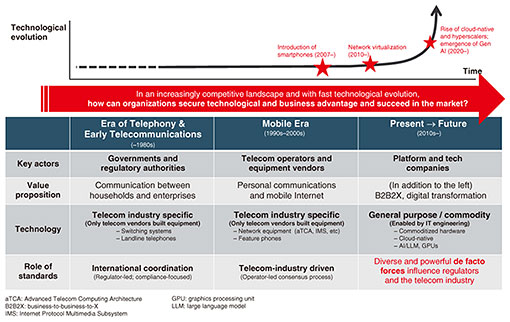
Global Standardization Activities Vol. 24, No. 2, pp. 45–48, Feb. 2026. https://doi.org/10.53829/ntr202602gls From De Jure to De Facto: Reframing Standardization Strategies in an Implementation-driven EraAbstractStandardization in telecommunications is undergoing a profound transition from institution-driven de jure processes to implementation-led de facto models. Cloud-native architectures, the heightened impact of hyperscalers, and accelerating pace of technological evolution continue to restructure communication infrastructures. As we approach the 6G (sixth-generation mobile communications network) era, cross-industry collaboration and implementation capability will become indispensable strategic foundations. This article analyzes the driving forces behind this transformation and identifies emerging challenges for standardization. Keywords: standardization, de jure, de facto  1. Evolving strategic dynamics of standardizationHistorically, telecommunications standards were formulated within formal institutional frameworks such as the International Telecommunication Union (ITU) and the 3rd Generation Partnership Project (3GPP). Operators and vendors from various countries contributed to specification development through internationally coordinated processes. However, rapid advancements in cloud and software technologies have shifted the focus of standardization from institutional arrangements to implementation and operational reality. Participation in 3GPP has diversified dramatically, with numerous vendors and new entrants contributing increasingly—reflecting a broader redistribution of influence in standardization ecosystems [1]. This shift signals that implementation capability and the speed of market deployment are now directly tied to negotiation power in standardization. The Internet Engineering Task Force (IETF) represents a hybrid model between de jure and de facto approaches. Guided by its informal maxim, “Rough Consensus and Running Code,” the IETF emphasizes functioning implementations as a prerequisite for consensus formation [2]. This pragmatic, community-driven approach differs from both government-led processes and unilateral corporate standard setting and has become a hallmark of implementation-centric methodology. As shown in Fig. 1, recent industry dynamics—such as the rise of smartphones, network virtualization, cloud-native architectures, and the global emergence of generative AI (artificial intelligence)—have intensified competition and reshaped power relations among telecommunications stakeholders. In this environment, securing technological and business advantage increasingly requires redefined standardization strategies.
2. The rise of implementation-led standardizationMultiple cases now illustrate how implementation precedes and subsequently guides formal standardization. Kubernetes®, initially developed as an open-source cloud-native application-orchestration platform, has significantly impacted network function virtualization (NFV) platforms [3] and O-RAN architectural developments. Similarly, SpaceX’s Starlink® system—implemented before any formal standardization—has catalyzed international discussions surrounding non-terrestrial networks (NTNs) [4]. The O-RAN Alliance provides another significant example. Founded in 2018 by major telecom operators, the alliance promotes intelligent, open, and virtualized radio access networks (RANs). Alongside specification development, it conducts open-source implementation efforts within the O-RAN Software Community under the Linux Foundation [5]. This dual-track approach operationalizes the IETF ethos—rapid iteration grounded in working code—thus accelerating standardization through real-world validation. In such contexts, documentation is no longer the endpoint of standardization. Proving feasibility through implementation and fostering an ecosystem are instead integral components of the process—a major departure from traditional approaches. 3. Cloud-native transformation and shifts in architectural controlThe proliferation of cloud-native technologies and the entry of hyperscalers into the telecommunications domain are driving significant architectural realignments. Hyperscalers such as AWS®, Google Cloud®, and Microsoft Azure® now deliver services that encompass functions historically designed by telecom operators, including network virtualization, data analytics, and AI inference [6]. The focus of standardization is thus shifting from protocol-level interoperability to shared data models, APIs (application programming interfaces), implementation models, and operational ecosystems. In the 5G (fifth-generation mobile communications network) era and beyond, NFV tightly coupled with cloud architectures has expanded standardization discussions to include software architecture and service-deployment models. Standardization is thus transforming into a form of platform design—one that spans the entire lifecycle of service operation. Hyperscalers and IT (information technology) solutions companies increasingly shape de facto standards, often in collaboration with open-source communities. Consequently, operators and vendors must accelerate cloud transformation and adopt agile, implementation-driven approaches to remain influential in standardization activities. 4. Emerging challenges for 6G standardizationThe 6G vision includes AI-native networking, In-Network Computing, Ambient IoT (Internet of Things), and expanded NTN capabilities, requiring collaboration across telecommunications, cloud computing, semiconductor, and AI industries. Thus, 6G standardization is expected to function more explicitly as ecosystem design rather than mere technical specification development. There has been momentum. In 2023, ITU Radiocommunication Sector (ITU-R) adopted the International Mobile Telecommunications (IMT)-2030 development framework as a formal recommendation, establishing the basis for future 6G systems [7]. Over the next several years, candidate technologies will undergo evaluation, with finalization targeted around 2030. Within 3GPP, Release 18 has initiated the transition toward 6G, and the completion of Release 19 has accelerated the introduction of 6G-oriented features in Release 20 and beyond [8]. Stakeholder diversity continues to grow, with increasing participation from vertical industries such as automotive and IoT, as well as emerging technology firms, all contributing to workshops and study sessions. Parallel to ITU and 3GPP activities, the Institute of Electrical and Electronics Engineers (IEEE)’s Future Networks initiative has advanced the International Network Generations Roadmap (INGR), updated annually across 15 technical domains, providing a forward-looking view toward 6G evolution [9]. In North America, Europe, and Japan, industry alliances, such as the Next G Alliance, Next Generation Mobile Networks Alliance (NGMN), and XG Mobile Promotion Forum (XGMF), are also formulating 6G technology frameworks, contributing additional perspectives to the global discussion. These multilayered activities indicate that 6G standardization will require not only technological assessment but also integration of diverse viewpoints across industries. Challenges such as the limited return on investment of 5G in some countries further underscore the need for standardization processes that explicitly take into account business feasibility and societal implementation. Thus, 6G standardization must evolve from a static documentation process into an iterative value-creation framework grounded in prototyping, implementation feedback, and market validation. 5. Implications for organizations and standardization professionalsAs standardization becomes increasingly complex, the expertise required has broadened. Beyond mastery of communication protocols and network control, knowledge of cloud architectures, open-source development practices, and data governance has become essential. Standardization professionals must not only possess technical specialization but also demonstrate the ability to lead cross-domain collaboration and bridge the gap between implementation and specification development. Organizations should therefore establish cross-functional structures integrating development, operations, business strategy, and standardization units. Human-resource development must extend beyond negotiation and language skills to include experience in open-source ecosystems, project management, and implementation-driven design. Such skills will be indispensable for organizations seeking international leadership in the 6G era. 6. Conclusion: Toward a strategic reinterpretation of standardizationWhile de jure standardization remains fundamental for ensuring interoperability and fair competition, de facto dynamics have become highly influential in today’s technological landscape. Standardization is increasingly being redefined as a strategic instrument that integrates technology, market evolution, and policy considerations. Outcomes of standardization now materialize not only in documents but also in software implementations and their rate of adoption. In the 6G era, organizations capable of combining strong implementation capabilities with ecosystem leadership will be best positioned to shape global standards. To remain competitive, companies must embrace implementation-driven methodologies and actively engage in cross-industry collaborative frameworks, thus updating the very concept of standardization for the next generation of telecommunications. References
|
|||||||||||||||||||