|
|
|
|
|
|
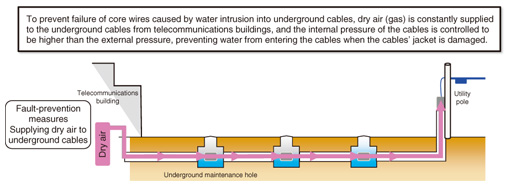
Practical Field Information about Telecommunication Technologies Vol. 24, No. 2, pp. 49–54, Feb. 2026. https://doi.org/10.53829/ntr202602pf1 Effectiveness of a Conduit-sealing Measure against Air Leakage from Conduit SectionsAbstractThis article introduces a measure for sealing the gap between an underground cable and conduit to prevent air leakage from conduit sections. The verification of the measure’s effectiveness in an on-site environment is also described. Keywords: underground conduit, air leakage, inflatable stop valve  1. BackgroundThe cables that provide telecommunications services are laid in underground tunnels, conduits, and maintenance holes as well as carried above ground using utility poles. To prevent failure of the core wires of a metal cable laid in an underground conduit due to intrusion of water, dry air is constantly injected into the cable from a telecommunications building to keep the pressure inside the cable higher than that outside the cable. This prevents water from entering the cable (Fig. 1).
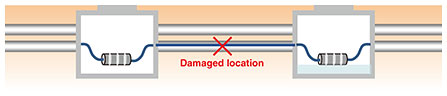
A remote monitoring system constantly monitors the pressures in the cable and conduit, and if a pressure-drop alarm is issued, a search for the air leak is activated, and any damage found in the cable jacket or cable-connection points (hereafter referred to as “closures”) inside the maintenance holes will be repaired. Gas cylinders are also set up in the maintenance holes close to the point where the pressure is dropping, and the dry-air supply to the cable is replenished. However, when air leakage occurs in a section of the conduit (Fig. 2), repair work cannot be easily carried out, so the cable must be replaced, and the cost of this cable-replacement work as well as the operational cost of replacing gas cylinders are a significant burden. Considering such costs, Technical Assistance and Support Center, NTT EAST (TASC) investigated a measure for sealing the conduit in a manner that can easily prevent air leaks from conduit sections and verified the effectiveness of the measure in an on-site environment. This article introduces this measure and the verification results.
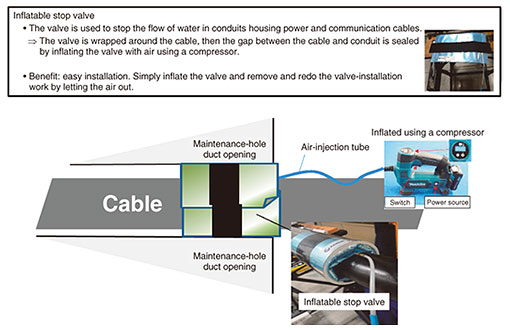
2. Overview of measure for sealing conduitsTo seal a conduit in which a cable is laid, it is necessary to effectively seal the gap between the cable and conduit inlet. Initially, we considered using a foam water-stop material, which reacts with water to expand and fill the gap and thereby achieve a watertight seal. However, once the foam expands and hardens at the conduit inlet, it is difficult to remove, making it difficult to reinstall the foam or cable. When the gap between the cable and conduit is narrow, it is difficult to insert the foam in the short time it takes for it to harden, which poses a challenge to workability. Considering the above issues, we decided to adopt an inflatable stop valve, which is easy to remove and can efficiently fill the gap by inflating the valve with air. Inflatable stop valves are used to stop the flow of water in underground conduits housing power and communication cables (Fig. 3). Their key features are described as follows.
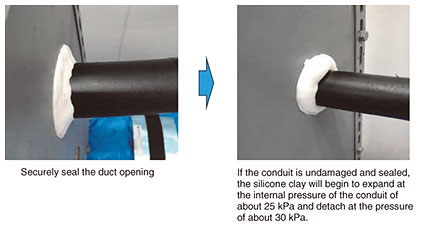
(1) High water-tightness performance The valve is designed to withstand a certain level of water pressure (maximum water pressure: 0.05 MPa) exerted by groundwater, backflow during heavy rain, and so on, thus preventing water from entering the conduit. Its high water tightness enables it to contain air leakage from inside the cable within the conduit. (2) Flexible structure The main body of the valve is a tube form with a foam-rubber seal covering its outer periphery. This seal flexibly fits the shape of the cable or conduit, so it can accommodate slight irregularities and deformations. This feature ensures a tight seal even when the valve is encasing cables of different diameters or multiple cables. (3) Easy installation By injecting air into the valve using a compressor, the tube is expanded and seals the gap between the cable and conduit. Special tools or adhesives are not required, and the valve can be installed in a short time. The sealing force can also be fine-tuned by adjusting the air pressure applied using the compressor. (4) Reusability and maintainability The inflatable stop valve is easy to remove, reinstall, and position and can also be reused after periodic inspections and replacement of cables. 3. Conditions suitable for application of conduit-sealing measure(1) The conduit is undamaged The inflatable stop valve provides a high level of airtightness by fitting tightly to the gap between the inner wall of the conduit and outer periphery of the cable. However, if the conduit is cracked, broken, deformed, or otherwise damaged, the valve may not fit tightly enough, and its airtightness may be reduced. Damage to the conduit can create air-leakage paths, allow soil and sand to enter the conduit, and cause structural deterioration, which can negatively affect the protective performance of the cable. Before sealing the valve, it is thus important to check for any damage inside the conduit by using a pipe camera or similar tool. If it is impractical to check using a pipe camera, another effective method is to simply evaluate the airtightness inside the conduit by filling the gap between the cable and conduit at the conduit inlet with silicone clay and checking for expansion of the clay (Fig. 4).
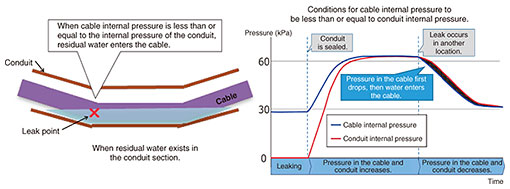
(2) No residual water exists in the conduit section When a section of a conduit is sealed, the pressure inside the conduit becomes higher than the pressure inside the cable (dry air) in that sealed section. If water remains in the conduit at that time, the pressure difference can cause the residual water to penetrate the cable from any point where the cable is damaged, which can cause problems such as poor insulation or short circuits in the core wires of the cable (Fig. 5). Before the conduit is sealed, it is therefore important to check the condition inside the maintenance holes and determine whether water remains in them.
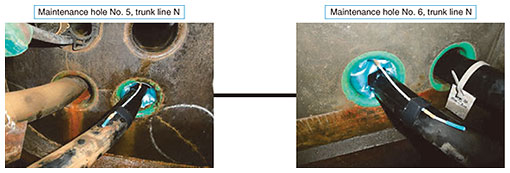
(3) Adequate space exists between the cable and conduit When air is injected into the inflatable stop valve, the valve expands to a certain thickness, and that expansion seals the gap between the cable and conduit in a manner that creates water tightness. However, if the gap between the cable and conduit is insufficient, the valve cannot be correctly fitted in the gap. Even after the valve is expanded, sufficient pressure will not be applied, and water tightness will be insufficient. To avoid such a risk, it is important to accurately measure the difference between the inner diameter of the conduit and outer diameter of the cable in advance and select an inflatable stop valve with the appropriate size. 4. Verification of the measure’s effectiveness in an on-site environment4.1 On-site environmentWe verified the effectiveness of the inflatable stop valve in an on-site environment where dry air was leaking from a section of the conduit between maintenance holes Nos. 5 and 6 in trunk line N, where a 250-m-long cable (0.65-4ST) was laid (Fig. 6).
The pressure of the compressed air (supplied from the telecommunications building) in the cable in question was 44.1 kPa but decreased to 26.7 to 29.2 kPa in the section of trunk line N between maintenance holes Nos. 5 and 6 (Fig. 7).
Without the dry-air supply from the gas cylinders, the air pressure in the cable could not be maintained normally (minimum-pressure guideline: 29.4 kPa), so gas cylinders were installed on the upstream side (trunk line N, maintenance hole No. 2) and downstream side (trunk line S, maintenance hole No. 52), and the gas cylinders were replaced about twice a week. 4.2 Details of verificationAfter confirming that the conduit was airtight (i.e., the silicone clay packed into the duct opening expanded) and that no water was residual inside the conduit (water had not flooded through the duct opening), we carried out the following.
4.3 Results of verificationAfter installing the inflatable stop valves, we observed that the pressure in the section of trunk line N between maintenance holes Nos. 5 and 6 gradually increased from 26.7 to 29.2 kPa. Therefore, to confirm whether the pressure would stabilize without the air supply from the gas cylinders, the gas cylinders were temporarily removed, and we confirmed that the pressure increased to, and stabilized at, 40.8 kPa (Fig. 9).
5. ConclusionThrough on-site verification, we confirmed that by installing inflatable stop valves in a section of a conduit leaking dry air, the pressure decreased by the leakage could be increased. The pressure also stabilized without the need for additional air supply from the gas cylinders, so it became possible to remove the gas cylinders, thus reduce the costs of replacement work, etc. Considering these findings, we conclude that the proposed conduit-sealing measure, i.e., using inflatable stop valves, can effectively prevent air leakage from conduit sections as long as the applicable circumstances are met. TASC will continue contributing to solving on-site problems through technical support for those involved in the maintenance and operation of telecommunication facilities. |