|
|||||||||||||||||||
|
|
|||||||||||||||||||
        |
Feature Articles: Research and Development toward Sustainable Infrastructure Vol. 24, No. 5, pp. 40–46, May 2026. https://doi.org/10.53829/ntr202605fa5 R&D on Telecommunications Infrastructure and Its Expansion to Social InfrastructureAbstractNTT Access Network Service Systems Laboratories conducts research and development (R&D) on telecommunications infrastructure. Its Civil Systems Project focuses on elucidating material- and structure-based deterioration mechanisms, seismic countermeasures, disaster-damage prediction, and artificial-intelligence-based inspection and maintenance technologies. This expertise has also recently been applied to social infrastructure to develop technologies that enhance the efficiency and sophistication of maintenance management. This article outlines the evolution of R&D in telecommunications infrastructure and introduces technologies, including image-based diagnostics, disaster prediction, and early anomaly detection using synthetic aperture radar satellites. Keywords: infrastructure, AI, resilience
1. IntroductionTelecommunications networks are supported not only by information and communications equipment and communication media (e.g., switching systems, transmission devices, and optical fiber) but also by infrastructure facilities that house and support them. Underground facilities that support telecommunications equipment, such as cable tunnels*1, maintenance holes (MHs), and conduits, are particularly exposed to external environments over long periods and are not easily replaced. These facilities must therefore achieve a long service life and high reliability, as they are expected to remain in service for extended periods and need to be continuously maintained after construction. In maintenance operations, deterioration must be determined and responded to appropriately for communication services to be stably provided. From a resilience perspective (i.e., maintaining functionality of equipment and enabling rapid recovery of operations even during major disruptions such as disasters), advanced maintenance operations based on condition assessment and prediction are increasingly required.
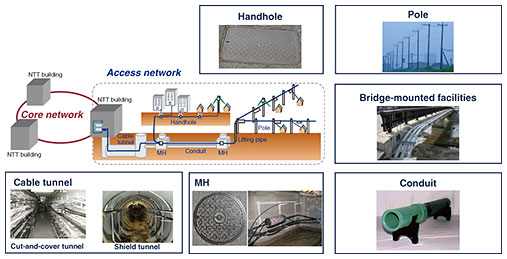
2. Telecommunications infrastructure facilities and R&D initiativesFigure 1 shows examples of NTT’s telecommunications infrastructure facilities. In telecommunications networks, the access (last-mile) network connects user terminals and buildings to telecommunications carriers’ facilities to provide communications services. The Civil Systems Project conducts research and development (R&D) on cable tunnels, MHs, conduits, and bridge-mounted facilities.
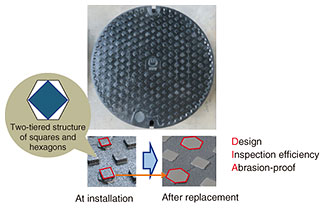
In the 1970s and 1980s, R&D focused primarily on product development and open-cut construction methods. Following the Great Hanshin-Awaji Earthquake in 1995, emphasis shifted to improving seismic performance and ensuring earthquake resistance. As facilities age, the focus has moved toward methods to efficiently and sustainably maintain and manage them [1]. At NTT, R&D on infrastructure supporting safe and secure telecommunications is conducted in an integrated manner, from materials and structural studies to design, construction, and maintenance. This includes not only developing new products and structures but also analyzing the condition of facilities after long-term use and feeding the results back to improve subsequent designs. As a recent example of product development, we introduce the development of an iron MH cover. 3. Tapered DIAmond Iron Cover: Design improvements and enhanced maintainabilityIron MH covers provide access to underground telecommunications and infrastructure facilities while serving as exposed ground-level components that ensure safety against traffic loads and third-party impacts. The Tapered DIAmond Iron Cover is an example of an improved product designed for easier inspection and enhanced wear resistance [2]. Figure 2 shows its appearance and improvements. The surface pattern consists of a two-stage configuration combining different shapes (square and hexagonal).
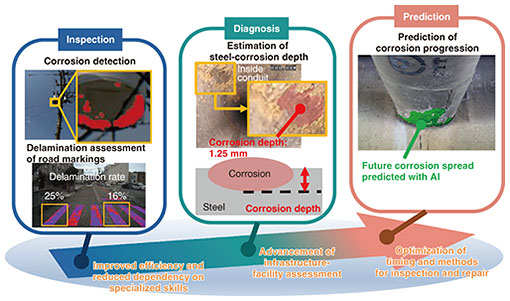
As wear progresses, the pattern transitions from square to hexagonal. This design enables inspectors to visually assess wear conditions without measuring remaining groove depth, thus facilitating camera-based inspections and simplifying and accelerating maintenance operations. Optimized pattern placement enables sand and other wear-causing particles to be efficiently discharged, enhancing wear resistance and extending the replacement cycle to approximately three times that of the previous design. Not only product and construction costs but also lifecycle maintenance costs are considered. By analyzing wear mechanisms and feeding the results back into new designs, we strengthen telecommunications infrastructure facilities for long-term management. R&D on infrastructure facilities spans a wide range of fields, from fundamental technologies in materials and structures to construction, long-term maintenance, and disaster countermeasures. The next section introduces inspection and diagnostic technologies used in maintenance management. 4. Inspection and diagnostic technologies in maintenance managementMaintenance management has traditionally relied on periodic inspections, visual confirmation of cracks and rust, and repair or replacement decisions based on inspectors’ reports. However, this approach can result in variations among inspectors, and similar visible deterioration may have different causes and progression rates, making deterioration difficult to accurately judge solely on the basis of experience. To address this challenge, it is essential not only to treat deterioration as a “phenomenon” but also focus on its mechanisms, i.e., why it occurs and under what conditions it progresses. Past cases and inspection results indicate that material properties, environmental conditions, and structural characteristics interact, and deterioration progresses over time. Organizing these factors and understanding them as mechanisms is the first step toward predicting deterioration and optimizing maintenance operations. Image-based technologies for diagnosing facility deterioration is introduced in the next subsection. 4.1 Image-based deterioration diagnosis and estimationVisual inspection accounts for many diagnostic items in maintenance. Artificial intelligence (AI)-based image diagnostic technologies are rapidly being introduced that extract and evaluate cracks and deformations from captured images, improving inspection efficiency. Inspection data are collected using digital cameras, aggregated, and diagnosed collectively, thus improving operational efficiency. In addition to efficiency, AI-based diagnostics reduce variability among inspectors. Digitizing inspection data also allows inspection histories to be accumulated, enabling long-term changes to be analyzed, diagnostic accuracy to be improved, and future deterioration to be predicted. We have recently established a technology that predicts the progression of steel corrosion several years into the future on the basis of digital images of infrastructure facilities, such as road bridges. Figure 3 illustrates our AI-based approach to inspection, diagnosis, and deterioration prediction. This corrosion prediction technology has evolved through long-term research, including extracting inspection targets, quantifying deteriorated areas, evaluating correlations between corrosion areas and steel-thickness loss, and estimating corrosion expansion over time. By training the model with images of corroded facilities together with environmental data from their installation sites, the technology can generate predicted images that visualize the future spread of corrosion from actual photographs, providing a new approach to infrastructure inspection [3]. Verification using telecommunications conduit facilities attached to road bridges demonstrated that the technology can predict the increase in corrosion area several years ahead with an average error of less than 10% (9.9%).
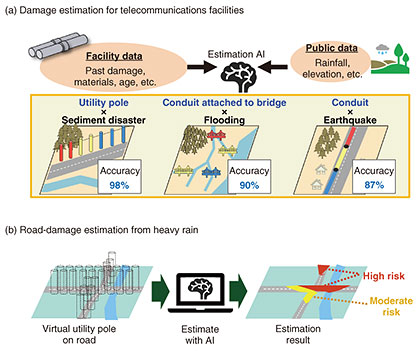
A key challenge in practical AI image diagnostics lies in mismatches between real-world environmental variability and training data. Accuracy errors can be caused by differences in lighting, contamination, camera angles, and deterioration patterns. AI learns visual correlations rather than causal mechanisms, sometimes leading to misclassification due to backgrounds. Because deterioration is typically classified along a continuous and often ambiguous scale, variations in labeling can also reduce diagnostic accuracy. Appropriate segmentation of key deterioration areas and correlation analysis with quantitative data such as steel-thickness loss have led to highly accurate analysis and prediction in our research. In our approach, deterioration is not viewed merely as cracks, corrosion, or other observable symptoms. We investigate the underlying causes, such as material properties, structural characteristics, and environmental exposure, and analyze how these factors interact over time. This mechanism-based understanding enables more accurate prediction of future damage and more effective maintenance planning. 5. Expansion of telecommunications infrastructure technologies to social infrastructureSocial infrastructure facilities, e.g., bridges, roads, tunnels, water and sewage systems, are aging, and serious accidents, such as tunnel collapses and road failures, are increasing. By 2045, maintenance costs are projected to be approximately 40% higher than in FY2018, while the working-age population will be significantly lower. Infrastructure maintenance is thus becoming increasingly challenging [4]. Frequent large-scale disasters, such as major earthquakes and heavy rainfall, make it urgently necessary to maintain infrastructure efficiently and accurately using limited resources. Social infrastructure shares many similarities with telecommunications infrastructure, as both consist of materials that deteriorate over time such as concrete, steel, and resin. Seismic measures, disaster prediction, and inspection technologies all rely on analyzing structural characteristics, material properties, and external forces. Therefore, knowledge accumulated in telecommunications infrastructure, particularly deterioration assessment and data analysis, can be applied to social infrastructure. The following subsections introduce disaster prediction and early anomaly detection initiatives. 5.1 Disaster prediction technology based on facility dataEfficiently renewing and reinforcing vast facilities using limited resources requires rational prioritization. At NTT, we have analyzed damage trends in facilities—particularly conduits—on the basis of past disasters, such as the Great Hanshin-Awaji Earthquake, and have advanced related R&D. By integrating past damage cases with ground condition and structural data, we have developed technology to estimate the degree of facility impact during large-scale disasters such as earthquakes and heavy rainfall. This enables high-risk facilities to be pre-identified, countermeasures to be prioritized, and recovery planning to be improved. As shown in Fig. 4 [5], using long-accumulated inspection data from damaged facilities, we successfully built an AI model that evaluates heavy rainfall-induced damage risk for telecommunications poles with approximately 98% accuracy (Fig. 4(a)). Furthermore, applying virtual pole placement data on maps enables area-based road risk to be assessed (Fig. 4(b)). Even without detailed field surveys or road-specific data, this model can quickly estimate nationwide road damage risk during heavy rainfall, including areas without hazard maps.
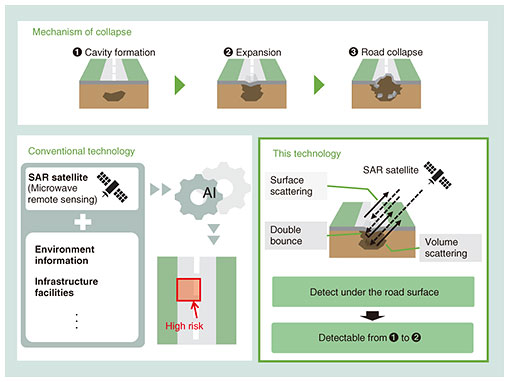
This technology contributes to evacuation and logistics route planning and pre-disaster mitigation strategies. 5.2 Early detection of underground cavities using satellite dataObserving wide areas is essential for maintaining social infrastructure. One promising technology is using satellite data, as shown in Fig. 5.
Conventional synthetic aperture radar (SAR)*2 satellite monitoring detects surface deformation and subsidence. In contrast, NTT has demonstrated a method of detecting subsurface ground changes before surface manifestation by focusing on scattering characteristics and polarization components of radio waves penetrating asphalt [6]. By analyzing time-series satellite data, cavity progression can be tracked. This enables precursors to road collapses to be detected before surface damage becomes visible. Underground cavities have traditionally been identified via ground-penetrating radar inspections. Applying this satellite-based technology enables wide areas to be efficiently screened, significantly reducing inspection costs and labor. Future efforts will combine satellite data with ground and underground inspection data, as well as NTT’s vibration-based ground monitoring using existing optical fiber networks, to detect early signs of road collapse and contribute to safer social infrastructure.
6. ConclusionThis article outlined R&D targeting telecommunications infrastructure—from understanding deterioration mechanisms to seismic measures, disaster prediction, AI-based inspection, and maintenance, and satellite-based wide-area observation technologies. Because telecommunications infrastructure shares many characteristics with roads, bridges, and water systems, knowledge of deterioration assessment and data-driven prediction cultivated in telecommunications has valuable applications for social infrastructure. Since social infrastructure is maintained separately by national and local governments and private entities, collaboration is essential for overall optimization and efficiency. By combining cooperative initiatives with predictive technologies on the basis of facility data and wide-area continuous monitoring methods, infrastructure maintenance can be further rationalized and advanced. We will continue to accelerate these R&D efforts, supporting telecommunications infrastructure while contributing technologies and expertise to social infrastructure fields facing similar challenges, thus helping to solve broader societal issues. References
|
||||||||||||||||||