|
|||
|
|
|||
        |
Global Standardization Activities Vol. 24, No. 6, pp. 72–75, June 2026. https://doi.org/10.53829/ntr202606gls Recent Trends in Optical Fiber and Cable Technologies within IEC TC86AbstractThe International Electrotechnical Commission (IEC) Technical Committee 86 (TC86) is the standardization body responsible for developing international standards related to optical fiber communications. This article provides an overview of the standardization activities conducted in IEC TC86, with particular focus on optical fiber and cable technologies that have been discussed in recent meetings as well as their future directions. Emphasis is placed on emerging topics reflecting technological advances and market demands and on how these discussions contribute to the establishment of international standards that ensure performance, quality, and interoperability of optical fiber products and systems. Keywords: IEC, multicore fiber, standardization
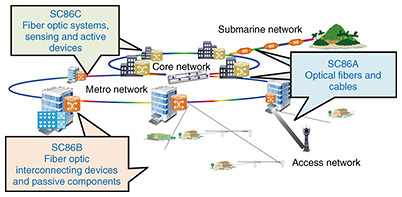
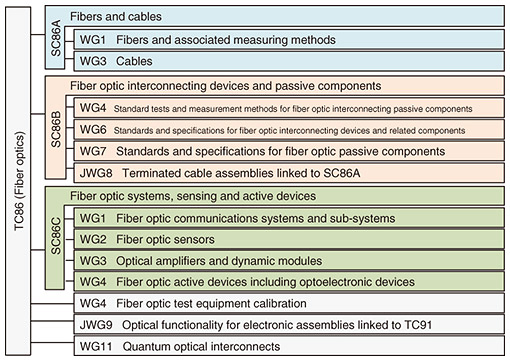
1. Optical fiber and cable standards in IECThe International Electrotechnical Commission (IEC) is an organization that develops international standards and technical specifications across all fields of electrical and electronic technologies. In addition to defining product specifications, the IEC provides conformity assurance for standards from the perspectives of safety and quality. Within the IEC, technical committees (TCs) are established for each technical field, where detailed discussions on the development, revision, and content of international standards are conducted. The specifications and test methods for optical products used in optical communication systems fall under the responsibility of TC86. NTT conducts research and development on optical communication systems and examines related technical specifications. Because international standards have a significant impact on equipment procurement and interface specifications, NTT actively participates in the standardization activities of IEC TC86. On the basis of communication networks and product specifications deployed in Japan, NTT contributes proposals and reviews standard documents to ensure quality and interoperability in international standards. In parallel, requirements for optical fiber and cable standards in public telecommunication network systems are discussed within International Telecommunication Union - Telecommunication Sector (ITU-T), particularly in Study Group 15. NTT plays an active role in these activities as well. While the IEC focuses mainly on procurement specifications and consistency with international standards for optical products, ITU-T addresses interoperability and system-level requirements. Both organizations closely collaborate to advance global standardization. Within the IEC, TC86 is responsible for fiber optics technologies. Its scope includes standards related to optical fibers and cables, optical connectors, optical fiber systems used with communication equipment, modules, and devices. These standards cover terminology, characteristics and test methods, structural configurations, interfaces, and optical, environmental, and mechanical requirements. Figure 1 illustrates the technical fields under TC86, and Figure 2 shows its organizational structure. TC86 consists of three subcommittees (SCs) with decision-making authority: SC86A (optical fibers and cables), SC86B (fiber optic interconnecting devices and passive components), and SC86C (fiber optic systems, sensing and active devices). TC86 also manages 13 working groups (WGs) that handle detailed discussions for specific technical areas. Each WG prepares proposals for new standards or revisions and drafts documents, while publication and work plans are approved at the SC level.
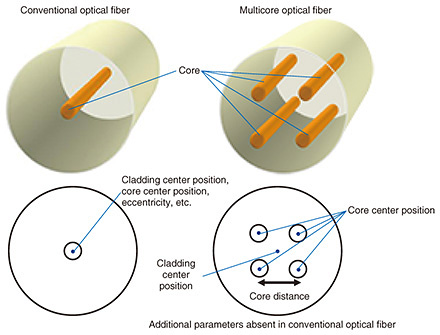
2. Standardization trends for multicore optical fibersWithin the fiber optics field managed by IEC TC86, standardization activities related to multicore optical fibers and their interconnection components have intensified, driven in part by the rapidly growing demand for optical fibers and cables in datacenter applications. In SC86A, which oversees optical fiber and cable standardization, proposals and reviews are currently underway concerning the standardization of measurement methods for geometric parameters and crosstalk in multicore optical fibers. Figure 3 shows structural examples of conventional optical fibers and multicore optical fibers along with examples of structural parameters. Conventional optical fibers contain a single light-guiding core located at the center of a glass cladding. In contrast, multicore optical fibers incorporate multiple cores, such as two or four, within a cross-section of the same overall diameter as a conventional fiber. This configuration enables an increase in transmission capacity per fiber without requiring additional installation space. However, for widespread adoption and practical deployment, standardized measurement methods are essential for accurately evaluating transmission performance.
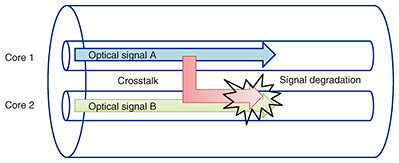
In particular, measurement techniques for geometric parameters—such as core positions and spacing—and for crosstalk, which is used to evaluate signal leakage between cores, represent new technical domains that did not exist for conventional optical fibers. Establishing common industry-wide criteria is therefore critical to ensuring appropriate quality control and product interoperability. Geometric parameter measurement forms the basis for confirming whether multiple cores are positioned with the required accuracy in terms of location, spacing, and shape. While conventional optical fibers required only simple measurements, such as core diameter and cladding diameter, the performance of multicore optical fibers is strongly impacted by core position deviations and variations in inter-core distance. It is thus necessary to standardize which parameters are measured, the required measurement accuracy, and the measurement conditions across the industry. Once standardized methods are established, discrepancies among manufacturers’ measurement results can be minimized, enabling equipment vendors and network operators to select products with confidence. Crosstalk measurement is another essential technique unique to multicore optical fibers, enabling quantitative evaluation of inter-core interference. Figure 4 illustrates the concept of crosstalk, which is a performance metric absent in conventional optical fibers, requiring entirely new measurement methodologies. Without standardization of parameters such as wavelength bands, input conditions, measurement length, and evaluation methods (time-domain or frequency-domain), performance values would vary by manufacturer, making direct comparison difficult. Standardized crosstalk-measurement methods are therefore critical not only for quality assurance of optical fibers but also for compatibility with communication equipment designed for multicore optical fiber operation.
In summary, to properly understand the performance of multicore optical fibers and provide reliable products across the industry, it is essential to internationally standardize two new evaluation technologies: geometric parameter measurement and crosstalk measurement. Harmonized measurement methods will enhance product compatibility and efficiency across research, development, manufacturing, and operation stages, supporting the stable deployment of multicore optical fibers as a core technology for future high-capacity communication infrastructures. 3. Japan’s role in multicore optical fiber standardizationJapan has demonstrated international leadership in both the research and development and standardization of multicore optical fiber technologies. Universities, research institutes, and companies in Japan have engaged in fundamental research and applied technology development from an early stage, resulting in globally leading achievements in areas such as core arrangement design, transmission experiments, and measurement techniques. These strengths have been widely disseminated through international conferences and academic forums, earning high recognition and influencing the direction of international standardization discussions. The close collaboration between academia and industry for advancing theory, experimentation, and product development in an integrated manner represents a distinctive strength of Japan. Against this backdrop, Japan continues to play a central role, both technically and institutionally, in establishing and standardizing measurement methods that underpin multicore optical fiber performance evaluation. Japan will continue to actively promote research, development, and standardization activities in cooperation with the international community, contributing to the development of next-generation high-capacity communication infrastructures. |
||