1. Overview of TSAG meeting
The second meeting of the Telecommunication Standardization Advisory Group (TSAG) in the International Telecommunication Union - Telecommunication Standardization Sector (ITU-T) for the 2025–2028 study period was held from January 26 to 30, 2026, in Geneva, Switzerland. A total of 308 experts from around the world (209 on-site and 99 online) gathered to engage in strategic discussions for the full-scale launch of the new study period. From Japan, representatives from the Ministry of Internal Affairs and Communications, along with major vendors, carriers, and research institutes (e.g., NEC, National Institute of Standards and Technology (NICT), NTT, KDDI, Hitachi, OKI), participated in discussions regarding the improvement of working methods and organizational efficiency.
2. TSAG management structure
At the beginning of the meeting, Ms. Aminata Drame (Senegal) was appointed as a new vice-chair on the basis of the consensus within the African region. From Japan, Ms. Miho Naganuma (NEC) attended and led discussions in her capacity as vice-chair. Mr. Shigeru Miyake (Japan) provided a liaison report regarding ISO/IEC (International Organization for Standardization/International Electrotechnical Commission) Joint Technical Committee 1, delivering Japan’s perspectives on clarifying the division of roles with other organizations in areas such as digital product passports, the metaverse, and smart cities.
3. Key decisions and discussion status
Crucial determinations and agreements were reached during this meeting, which will significantly impact the future efficiency of ITU-T.
(1) Fundamental improvement of working methods (Working Party on Working Methods, Collaboration, Engagement and Strategic Planning (WP1)/Rapporteur Group on Working Methods (RG-WM))
- Revision of Recommendation A.1: A draft revision to enhance the working efficiency of Study Groups (SGs) was determined.
- New Recommendation A.19: New rules for the appointment and operations of registration authorities were established.
- Revision of remote participation guidelines (Recommendation A.Sup4): Guidelines for hybrid meetings were agreed upon to further encourage participation from developing countries.
(2) Industry engagement and strategy (WP1/RG on Industry Engagement and Strategic and Operational Planning (RG-IES))
- Visualization of success stories: Schemes for collecting and publishing success stories demonstrating the business impact of standardization were discussed, with continued requests for cooperation sent to each SG.
- Leveraging the CxO Roundtable: Results from the CxO meeting held in Munich (November 2025) were shared, and process improvements were advanced to rapidly reflect industry needs.
(3) Restructuring and reorganization of Joint Coordination Activities (JCAs) (WP on Work Programme, Restructuring and Thematic Resolutions (WP2)/RG on Work Programme and Restructuring, SG Work and SG Coordination (RG-WPR))
- Under the banner of “Eliminating Duplication and Increasing Efficiency,” existing coordination mechanisms were boldly reorganized.
- Abolition of Joint Correspondence Groups (JCGs): It was decided to close the JCGs on IoT Security (JCG-IoTSec) and Trust (JCG-Trust), integrating them into existing SG-to-SG coordination mechanisms.
- Transition of JCAs:
- JCA-IdM (Identity Management), JCA-QKDN (Quantum Key Distribution Network), and JCA-VHC (Verifiable Health Credentials) will transition their work to SG17 by the next meeting.
- JCA-AHF (Accessibility and Human Factors) will move to SG21, and JCA-IoT, DT, SSC&C (Internet of Things, Digital Twins, and Smart Sustainable Cities and Communities) will move to SG20 by the end of the study period.
- For the parent group of JCA-QKDN, Mr. Kaoru Kenyoshi (NICT) from Japan was nominated as a new vice-chair.
- Strengthening JCA-AI (Artificial Intelligence): The name and terms of reference were updated as a JCA under the direct control of TSAG, reinforcing its role as the “control tower” for AI standardization.
(4) Others
- Digital transformation (DX) (RG on Sustainable Digital Transformation (RG-DT)): Liaison statements were approved to implement WTSA (World Telecommunication Standardization Assembly) Resolution 58 (DX promotion) and Resolution 86 (Regional DX).
- Human rights and standardization: Results of a survey on human rights considerations in the standardization process were reported. On the basis of contributions from various countries, including Japan, the implementation of training programs is being considered.
4. Future outlook
The third TSAG meeting is scheduled for February 1–5, 2027, in Geneva. In the interim, groups such as RG-IES and RG-WM plan to hold five Rapporteur Group Meetings (RGMs) each online to advance the final approval of the A-series Recommendations and deepen specific DX gap analyses. Japan is expected to contribute at the practical level, including exercising leadership in JCA-QKDN and responding to Member State Consultations for the approval of new AI security work items (e.g., Questions 16/17) in SG17.
5. Overview of IEW
As a specific initiative of TSAG RG-IES, the “ITU-T Industry Engagement Workshop (IEW) 2026: Making industry successful through standardization” was held on March 27, 2026, at the European Telecommunications Standards Institute (ETSI) Headquarters in Sophia Antipolis, France. The objective of this workshop was to examine how ITU-T can rapidly reflect the needs of an industry undergoing accelerated DX and support corporate business success through standardization.
The event brought together Mr. Seizo Onoe, director of the ITU Telecommunication Standardization Bureau (TSB), ETSI executives, and experts from major global operators, vendors, and research institutes (Photo 1). Representatives from NTT, NTT DOCOMO, and the Telecommunication Technology Committee (TTC) spoke at the event, highlighting Japan’s presence and contributions.
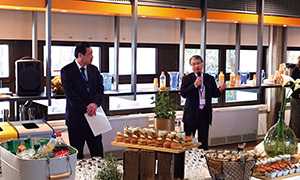
Photo 1. Greetings from ITU TSB Director Seizo Onoe (right).
6. IEW management and keynote speeches
(1) Opening: The workshop was opened by Mr. Scott Mansfield (Ericsson, Canada), rapporteur for RG-IES. He stated that adapting the standardization process to the speed of technological innovation is key to protecting industry investment and expanding global markets.
(2) Keynote speeches: Following a speech by the director of the ITU TSB, two keynotes were delivered.
- Mr. Jan Ellsberger (director-general, ETSI) emphasized that standardization is a strategic foundation for economic growth and requires faster, more flexible evolution linked with software and interoperability testing.
- Dr. Christian Hoymann (Ericsson, Germany) defined standardization not merely as technical specification but as a business strategy for ecosystem building, key to market competitiveness and investment protection.
7. Session discussions
(1) Session 1: Transforming ITU-T’s Focus to Digital Technologies
- Chair: Mr. Dao Tian (ZTE)
- Key points: Mr. David Boswarthick (ETSI) advocated for “lightweight standardization” that does not hinder innovation. Mr. Weiqiang Cheng (China Mobile) noted the importance of rapid standards for AI datacenter networks. Mr. Arnaud Taddei (Broadcom) emphasized security standards in global supply chains.
(2) Session 2: Industry Use of Standards and Success Stories
- Chair: Mr. Hiroshi Yamamoto (NTT)
- Key points: Mr. Hideki Nishizawa (NTT) introduced standardization of disaggregated optical systems in collaboration with external bodies such as Telecom Infra Project. Mr. Vince Ferretti (Corning) emphasized the role of physical layer standards in market fairness. Mr. Hideyuki Iwata (TTC) introduced the scheme of how Japan’s domestic activities support global business success via ITU-T. Mr. Uwe Baeder (Rohde & Schwarz) stressed that standardization in measurement technology is vital for fair competition.
(3) Session 3: Interplay between Standardization and Open-source
- Chair: Mr. Julien Maisonneuve (Nokia)
- Key points: Mr. Masafumi Masuda (NTT DOCOMO) discussed the benefits of open source software (OSS) in Open RAN (radio access network) commercial deployment. Ms. Debora Comparin (Thales) addressed the complementary relationship between OSS and standards. Mr. Mustapha Tagredj (Orange) and Ms. Silvia Almagia (ETSI) emphasized that code-based specification and rapid prototyping improve the quality and adoption of standards.
(4) Session 4: Summary, Results, and Next Steps
- The workshop concluded with a panel discussion reaffirming the contribution of international standards to cost reduction and the creation of new industries while acknowledging the need to evolve how the industry finds value in technical domains (Photo 2).
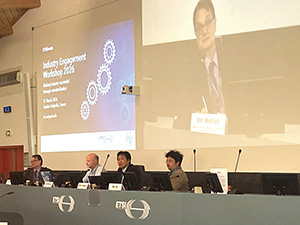
Photo 2. Scene from the IEW session.
8. Planned future actions
On the basis of the “ITU-T Standards Success Story” collection scheme, we will organize domestic best practices and propose them to the next TSAG/RG-IES. Following the trends in OSS utilization discussed in Session 3, we will also examine the future of software collaboration within domestic standardization committees.
9. Conclusion
Both the TSAG meeting and IEW demonstrated that ITU-T is driving a transformation toward becoming an agile organization directly linked to industry business success, moving beyond just technical specification. Progress will be reviewed at the third TSAG meeting in February 2027, with multiple interim RGMs scheduled in the lead-up.
 |
- Hiroshi Yamamoto
- Director, Head of Standardization Office, R&D Planning Department, NTT, Inc.
He received a B.S. and M.S. in information and computer science from Waseda University, Tokyo, in 1999 and 2001. In 2001, he joined NTT, where he has been involved in research and development (R&D) in the field of communications quality and traffic, and network architecture, as well as in international standardization activities. Since 2015, he has served as the company’s primary USA liaison, representing the company in collaboration with various U.S.-based standardization organizations, such as Telecommunications Industry Association (TIA), Alliance for Telecommunications Industry Solutions (ATIS), Broadband Forum, Mobile Ecosystem Forum (MEF), and Institute of Electrical and Electronics Engineers (IEEE), as well as OSS organizations such as the Linux Foundation, and contributing to the widespread dissemination of the company’s R&D results worldwide. He has also been active in and contributed to research funding, such as obtaining R&D funds in the quantum field from the National Science Foundation (NSF).
In 2023, he was appointed director, head of the Standardization Office, which oversees all NTT Group standardization planning and activities, and has been involved in the overall management of the group’s international standardization activities. He has also served in various international standardization roles both in Japan and overseas, including as a member of Information and Communications Council ITU Division, chair of Asia-Pacific Telecommunity (APT) WTSA WG1, member of the Japan Industrial Standards Committee (JISC) Electronics Technical Committee and Information Technology Technical Committee, member of the IEC High Level Correspondence Committee and Market Strategy Board Correspondence Committee, chair of the TTC IOWN GF Technical Committee, and leader of the International Cooperation Advisory Group.
|
 |
- Tomoko Inoue
- Senior Manager, Standardization Office, R&D Planning Department, NTT, Inc.
She received a B.A. in literature from Ritsumeikan University, Kyoto, in 2003 and an M.A. in informatics from Kyoto University in 2005. She joined NTT WEST in 2005 and worked on the maintenance and operation of core networks and application services. She moved to NTT Information Sharing Platform Laboratories (which later became NTT Software Innovation Center) in 2011, where she conducted research on network virtualization technologies collaborating with cloud resources, cloud infrastructure (infrastructure as a service) development, and OpenStack community activities. She was then seconded to the Tokyo Organizing Committee of the Olympic and Paralympic Games, where she contributed as the head of venue IT equipment allocation planning and operations. After returning to NTT, she was engaged in business development in location technology and AI robotics. She is currently engaged in supporting international standardization activities and formulating related strategies for the NTT Group.
|
 |
- Kota Kodai
- Senior Manager, Standardization Office, R&D Planning Department, NTT, Inc.
He received a B.E. in civil engineering in 2005 and Master of Informatics in social informatics in 2007 from Kyoto University. He joined NTT DOCOMO in 2007, where he was engaged in mobile network deployment. In August 2023, he transferred to NTT. From October 2023 to September 2025, he was seconded to the TSB of the ITU, where he worked on International Numbering Resources (INR) related activities. He returned to NTT in October 2025, where he is currently engaged in supporting the NTT Group’s standardization activities.
|