|
|||||||
|
|
|||||||
|
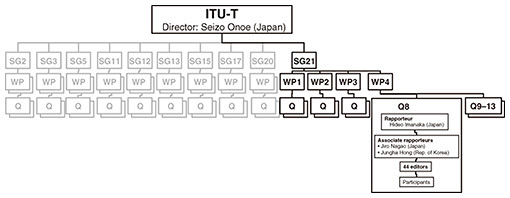
Global Standardization Activities Vol. 24, No. 8, pp. 32–35, Aug. 2026. https://doi.org/10.53829/ntr202608gls Recent Activities of ITU-T Study Group 21 (Technologies for Multimedia, Content Delivery and Cable Television)AbstractInterim meetings of the International Telecommunication Union - Telecommunication Standardization Sector (ITU-T) Study Group 21 Working Parties 1, 2, and 4 and their Questions were held from 16 to 20 March 2026 in Geneva, Switzerland. This article summarizes the meetings and introduces newly consented recommendations, especially ITU-T Recommendation H.430.9 on first-person transfer immersive live experience. Keywords: ITU-T SG21, ITU-T Recommendation H.430.9, first-person transfer immersive live experience  1. ITU-T Study Group 21The International Telecommunication Union - Telecommunication Standardization Sector (ITU-T) Study Group (SG) 21 (Technologies for multimedia, content delivery and cable television) was formed through the consolidation of the former SG16 (Multimedia and related digital technologies) and former SG9 (Broadband cable and TV). It is responsible for studies relating to multimedia technologies, capabilities, systems, applications, and services for existing and future networks, including Internet Protocol (IP)-based and cable-based networks [1]. Figure 1 shows the structure of ITU-T, focusing on SG21. ITU-T has been headed by Mr. Seizo Onoe (Japan) since 2023 and consists of 10 SGs. An SG is further divided into Working Parties (WPs) and Questions (Qs). One of the authors (Dr. Nagao) serves as an associate rapporteur for Q8 WP4.
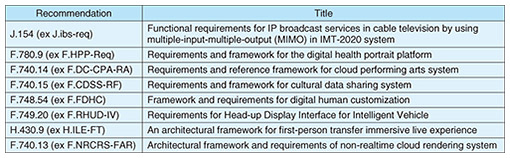
2. SG21 WPs 1, 2, and 4 interim meetingsInterim meetings of ITU-T SG21 WPs 1, 2, and 4 and their Qs were held from 16 to 20 March 2026 in Geneva, Switzerland. A total of 150 participants from 22 countries attended the meetings, and 12 draft recommendations were agreed to consent. Table 1 shows the list of consented draft recommendations. Among them, NTT DOCOMO and NTT have actively contributed to ITU-T Recommendation H.430.9 (ex H.ILE-FT) “An architectural framework for first-person transfer immersive live experience.” A brief summary is given in the following section.
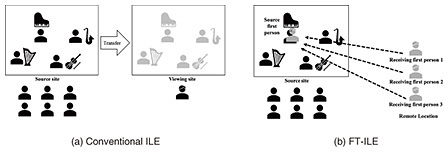
3. ITU-T Recommendation H.430.9NTT Group has actively contributed to the ITU-T global standardization activity on immersive live experience (ILE) since the initial ILE recommendations, H.430.1, H.430.2, and H.430.3. ILE enables people to experience remote events with a strong sense of reality in real time, as if it were happening right in front of them. Following the initial recommendations, NTT Group has also contributed to the standardization of transport protocols for ILE using MPEG media transport (H.430.4), reference models for ILE presentation environments (H.430.5), and transmission of haptic information for ILE (H.430.6). The newly consented ITU-T Recommendation H.430.9 specifies first-person transfer ILE (FT-ILE). The conventional ILE recommendations specify a form of ILE where the user experiences the event as an audience member. FT-ILE, on the other hand, addresses a form of ILE where the user can experience the sensations felt by the performers (e.g., the athlete in a competition or the pianist in a concert). Taking a piano concert as an example, the user of conventional ILE can watch the concert as an audience member, whereas the user of FT-ILE can see the piano keyboard or the score from the viewpoint of the pianist, as if they were the pianist. By incorporating the haptic technologies specified in H.430.6, the user may also experience the sensations in the fingers striking the piano keys. Figure 2 shows the difference between conventional ILE and FT-ILE.
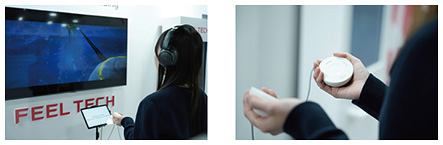
Furthermore, H.430.9 specifies a function to adjust to the individual differences of sensitivity. For example, haptic signals of the same physical strength may be too strong for someone and too weak for another. Adjusting to an individual’s sensitivity helps people share the same sensation. Figure 3 shows an application of FT-ILE, which was demonstrated as a proof of concept of FT-ILE implemented by NTT DOCOMO in collaboration with a movie production and distribution company [2]. The user can feel more immersed, as if they were the characters in a movie by experiencing pre-recorded vibrations through the hemispherical haptic devices while watching the movie. In this application, the physical strength of the vibration was adjusted to the sensitivity of each user.
4. Future prospectsMany draft recommendations on ILE are currently under study at Q8 SG21, including H.ILE-AR, to promote mobility, collaboration, and interaction of ILE, and H.ILE-3DIT, to achieve ILE using three-dimensional models; more work items are expected to be initiated. Additional use cases of FT-ILE are also being studied by Human Augmentation Consortium, whose white paper is available online [3]. We expect the world to become more strongly connected and deeper mutual understanding to be fostered by the development and global standardization of ILE technologies, which can help people feel events at remote locations closer and with stronger reality, contributing to the ITU vision of “Connecting the world and beyond.” References
|
|||||||