|
|||||||||||||||||||||||||||
|
|
|||||||||||||||||||||||||||
|
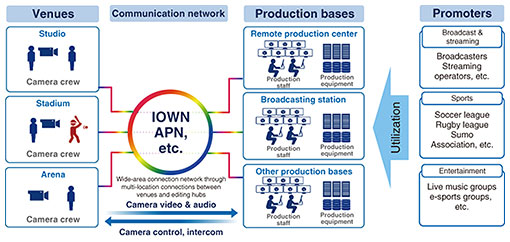
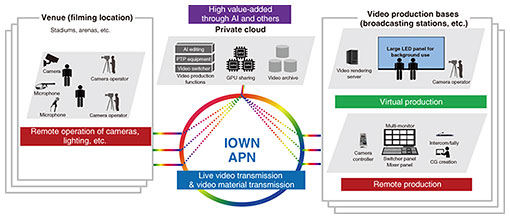
Feature Articles: Remote Media Production Using the IOWN APN IOWN-related Technologies in Video ProductionAbstractWith the advancement of various broadcast video production methods, such as remote and virtual production, there is a growing demand for communication environments capable of transmitting large volumes of data such as video and audio to remote locations with low latency. In this article, we focus on IOWN (Innovative Optical and Wireless Network)-related technologies, centered on the All-Photonics Network, and explain how to support digital transformation in video production. Keywords: remote media production, media over IP, video production DX  1. Challenges in video production and remote media productionIn video production for sports and music events, it is necessary to switch between and compose footage shot with multiple cameras, add computer graphics (CG) effects, and adjust and integrate audio. For these processes, it was necessary to place equipment, such as video switchers*1 and audio mixers*2, inside relay vehicles*3 near the filming site or in prefabricated areas, and dispatch a large number of production staff to the filming site. For video production businesses, such as broadcasting stations, introducing and maintaining these relay vehicles is a significant cost burden, and the shortage of video and audio engineers due to population decline needs to be addressed. Therefore, balancing cost control with a high-quality production system has become a major challenge. Connecting a remote filming location (venue) with a production base, such as a sub control room*4 in broadcasting stations, via communication networks (e.g., the Innovative Optical and Wireless Network (IOWN) All-Photonics Network (APN)) addresses these challenges. This enables production to be carried out remotely without the need of sending some or all the production equipment or staff to the filming location. In other words, an efficient and flexible video production system that is not limited to the location of the production base becomes possible. This method of producing videos from a location away from the filming location is called remote media production or remote production (Fig. 1).
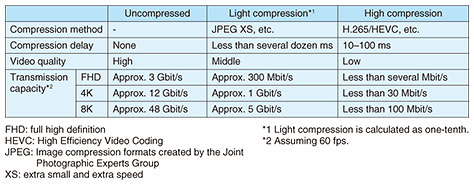
2. Features of IOWN-related technologies in remote media productionSince the announcement of IOWN in 2019, research and development, product commercialization, and practical application related to IOWN have steadily progressed. In 2023, the first commercial service using IOWN APN technology was launched by NTT EAST and NTT WEST. NTT Communications (now NTT DOCOMO BUSINESS) then launched a service connecting over 70 datacenters nationwide with large capacity and low latency. In the initial phase, “IOWN 1.0,” efforts were made to achieve next-generation network infrastructure with large capacity and low latency using optical communication technology centered around the IOWN APN. The IOWN APN is being explored in a wide range of fields, including high-speed transmission of large-capacity video, telemedicine, and remote monitoring and control of manufacturing sites. Enabling low-latency and high-quality communication that was difficult to achieve with conventional networks contributes to improving operational efficiency and the creation of new value. By leveraging the features of these IOWN-related technologies in remote media production, it is possible to achieve not only traditional video material transmission or single-camera video relays but also simultaneous transmission of multiple-camera footage and production at remote locations, with quality equal to or greater than that of on-site relay vehicles. Remote media production using the IOWN APN has the following three features. 2.1 Feature 1: Large capacity, low latencyAdvanced production environments simultaneously handle numerous video signals, such as large-scale sporting events where videos filmed with dozens of cameras are switched in real time, live music shows mixing hundreds of audio sources, and three-dimensional volumetric video production. Therefore, a communication environment for transmitting many videos and audio is required. By using the IOWN APN, which can achieve high-speed transmission from 10 to 800 Gbit/s or even higher, multiple-camera footage can be transmitted to remote production sites without compression or with light compression, with minimal image quality degradation or delay. With large-capacity, low-latency stable communication, real-time production equivalent to on-site production can be achieved remotely. For intercom calls with on-site staff, audio mixing, and remote operation of video-related devices, relatively small communication capacity is required, but extremely low latency is necessary. The IOWN APN can handle not only communication with strict low-latency requirements such as communication and remote operation but also diverse traffic, including large-capacity video transmission. This makes it ideal for ensuring a high-quality and stable environment required for remote media production (Table 1).
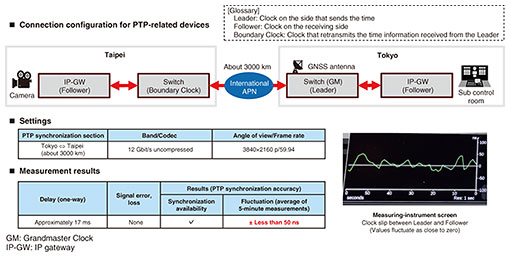
2.2 Feature 2: Stable time synchronizationIn environments such as remote media production where video production occurs between locations, high-precision time synchronization between video devices is crucial. In on-site production within the same studio or relay vehicle, high-precision time synchronization is executed between devices. Therefore, a production environment free from delays and inconsistencies in video and audio production is achieved by matching timing frame by frame. To achieve equivalent production quality between remote sites, the Precision Time Protocol (PTP)*5 is used. To attain high-precision PTP time synchronization between remote locations, PTP time synchronization signals must be circulated between the locations. A representative source of time synchronization is clock information*6 obtained from satellites via a global navigation satellite system (GNSS) antenna*7. Depending on the location, however, it is difficult to secure an antenna environment with favorable conditions for communication with satellites, and communication with satellites can be unstable due to weather conditions. Security issues such as spoofing*8 and jamming*9 have also become concerns. Using the IOWN APN, which has no transmission-delay fluctuations, is an effective solution for PTP time-synchronization signal transmission between sites. In conventional networks, such fluctuations between sites have been a challenge for stable transmission of PTP time signals. By using the IOWN APN, however, fluctuations can be minimized, enabling a stable transmission environment by establishing PTP lock*10 in a short time or without PTP unlock. PTP time synchronization requires a transmission environment that satisfies fluctuations of less than 1 microsecond (μs), and in environments with fluctuations exceeding this, maintaining stable synchronization becomes difficult. The IOWN APN connection demonstration conducted in 2025 over a long distance of about 3000 km between Japan and Taiwan achieved extremely high stability with a fluctuation of less than 50 nanoseconds (ns), successfully maintaining synchronization (Fig. 2).
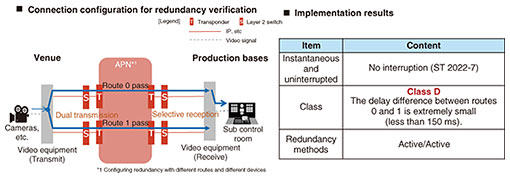
2.3 Feature 3: High-quality redundancyThe unwavering feature of the IOWN APN is also used in path redundancy. On the two-route APN path, simultaneous transmission and reception through both routes can be carried out using video equipment compatible with ST 2022-7*11 of SMPTE (Society of Motion Picture and Television Engineers), a broadcasting industry standard. On the receiving side, the IOWN APN compares packets from each route and selectively receives normal packets, ensuring transmission quality. Even if packet loss occurs in video equipment, the receiving side absorbs the delay differences in the packet layer, enabling switching without video loss or interruptions. We have confirmed redundancy with the IOWN APN between remote sites, achieving Class D (delay difference of 150 ms), equivalent to a local site. The IOWN APN thus enables the construction of an uninterrupted environment with buffering*12 equivalent to the environment at the same site (Fig. 3). Even between different paths with delay differences exceeding 150 ms, IOWN’s delay adjustment technology can converge the difference within 150 ms. This ensures an extremely high-quality inter-site communication environment and enables users to conduct operations without being aware of the presence of remote sites, creating an environment equivalent to installing equipment within the same site.
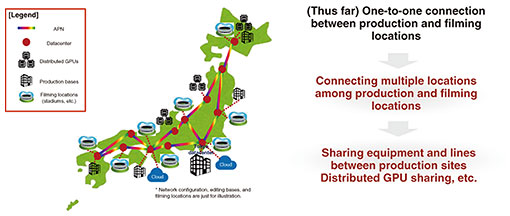
3. Development toward further digital transformation in video productionIn remote media production, there are many stadiums and arenas connected from production bases. Since the connection destination changes according to the music or sporting event, a flexible change in the IOWN APN’s connection destination is required. When broadcasting events, users should be allowed to use the IOWN APN only for the minimum period necessary for broadcast time and pre- and post-broadcast preparations, thus reducing facility and line usage fees. In IOWN, development of optical-path switching technologies is underway, and flexible connections between sites are expected. In “IOWN 2.0,” the scope of opticalization has been expanded to include computing domains such as servers, and development is underway for artificial intelligence (AI) computing platforms*13 that enable resource sharing of graphics processing units (GPUs) and other resources between sites. This is expected to further advance automation and efficiency, including large-scale video-data processing across sites and real-time video processing using AI (Fig. 4).
Functions and equipment related to video data, video production, and editing can be consolidated at a private cloud hub and similar facilities. By using AI-powered editing technology for example, CG expression can be sophisticated and slow-motion playback and video assistant referees in sports broadcasts can also be advanced and automated. By sharing such advanced systems at the hub, it is possible to reduce capital investment while improving utilization. For relatively small video production operators such as local stations, it becomes easier to use the latest production equipment and functions by connecting to systems consolidated via the IOWN APN. We position the entire initiative to improve video production efficiency and high value-added use, including sharing video production functions through the IOWN APN and AI computing platforms, as “video production digital transformation (DX).” Alongside the deployment of use cases, we will continue advancing and demonstrating a platform for video production DX (Fig. 5).
|
|||||||||||||||||||||||||||