|
|||||||||||||||||||
|
|
|||||||||||||||||||
|
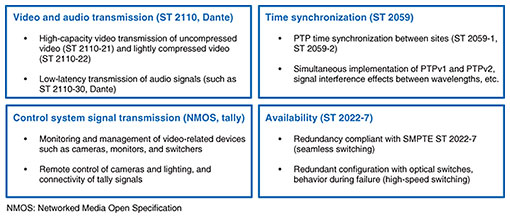
Feature Articles: Remote Media Production Using the IOWN APN Efforts in Commercial Deployment of Remote Media Production Using the IOWN APNAbstractWe have thus far used IOWN (Innovative Optical and Wireless Network) technologies to conduct technology demonstrations and business feasibility verification for the commercial deployment of remote media production, and its use in commercial events has been progressing. In addition to an early technology demonstration, we introduce representative cases of collaboration between NTT research laboratories and operating companies, such as application to live broadcasts of music events and large-scale sporting events, facility sharing at Expo 2025 Osaka, Kansai, Japan, and the use of distributed graphics processing units. Keywords: remote media production, media over IP, video production DX  1. Early technology demonstration effortsTo commercially deploy Innovative Optical and Wireless Network (IOWN)-related technologies, including the All-Photonics Network (APN) in remote media production, it is necessary to steadily demonstrate their applicability to various use cases in video production. Through technology demonstrations and business feasibility verification, the operational feasibility and economic rationality for commercial use are confirmed, then full-scale commercial deployment and social implementation by business entities are anticipated. In commercial deployment, horizontal expansion to related organizations in similar fields is also anticipated. Research and development organizations will continuously conduct technology demonstrations aimed at creating further added value. This will enhance efforts and lead to the promotion of digital transformation (DX) across the entire video production field. The standards formulated by Society of Motion Picture and Television Engineers (SMPTE)*1, a widely recognized international standardization organization in the broadcasting industry, are used for achieving high interoperability among video and audio equipment and systems produced by different manufacturers. SMPTE has established various standards for video, audio, and device control signals based on the Internet Protocol (IP). With these standards, it becomes possible to achieve unified communication and control even between different devices. Since the IOWN APN supports multi-protocol transmission, combining it with these SMPTE standards allows for flexible and high-quality connections of various production equipment. Specifically, SMPTE established standards such as ST 2110 for IP transmission of video and audio, ST 2059 for time synchronization, and ST 2022-7 for redundant transmission. In the early technology demonstration conducted by NTT laboratories in 2024, in addition to these SMPTE standards, general commercial technologies and protocols widely used as de facto standards were also covered, and the applicability and operation verification of the IOWN APN for each was conducted. Through comparisons with conventional networks, the advantages of the IOWN APN in terms of low latency and stability were confirmed (Fig. 1).
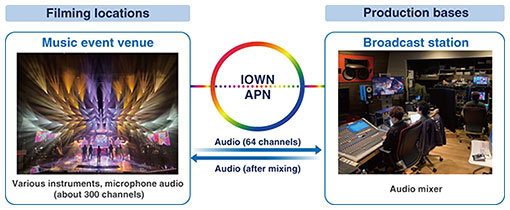
2. Initiatives for business feasibility verificationEfforts to use high-capacity, low-latency transmission technologies for producing videos at remote locations had been promoted by broadcasters. However, limitations such as network capacity and latency have hindered widespread commercial application. For remote media production, IOWN APN’s large-capacity, low-latency transmission enables video switching and audio mixing, real-time coordination of signals and audio with filming locations using tally*2 and intercoms, and high-precision time synchronization between devices at each site. This enables integrated exchange of diverse signals. We evaluated whether the operational and quality requirements of various business use cases can be met through business feasibility verification. 2.1 Remote audio production for large-scale music eventsAt the initial stage of IOWN APN service, we started with the initiative to transmit audio over long distances without compression and with low latency as a use case that could leverage its low-latency features. In 2023, for example, NTT EAST conducted the “Future Music Concert,” which connected four locations, including Tokyo and Osaka, to demonstrate remote ensembles. With a round-trip latency of about 8 milliseconds (ms) between Tokyo and Osaka, the conductor and orchestra performed classical music at different venues, as well as piano duets between different venues. The first large-scale commercial use for terrestrial live music programs was a remote audio production in the live music program “Japan Record Awards”*3 at the end of 2024. Since large-scale music events require handling a large volume of audio signals, it was necessary to deploy many production staff and equipment such as audio relay vehicles and their built-in audio mixers at the event venue, which had been challenging until the previous year. Previously, audio mixing of about 300 channels was carried out using multiple audio relay vehicles parked in parking lots at the event venue. In the 2024 event, 64 of these channels were switched to remote production and carried out in a sub control room within a remote broadcasting station. It has thus become possible to conduct audio production and achieve a quality of audio mixing equivalent to that of conventional audio relay vehicles in an excellent environment in terms of acoustics, air conditioning, and workspace (Fig. 2).
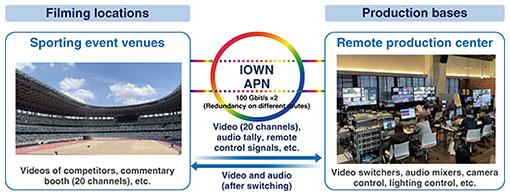
We used Dante*4, a representative standard for real-time transmission of uncompressed audio signals via IP, as the audio protocol. By using the IOWN APN, we achieved low-latency transmission of about 5.6 ms for a round trip over the approximately 30-km route from the sub control room equipped with the audio mixer to the music hall where the actual event took place. This latency does not affect human perception and ensures operability equivalent to on-site mixing. Regarding the time synchronization protocol Precision Time Protocol (PTP) used in remote audio production, high-precision time synchronization has been achieved in an environment where different versions coexist, such as PTP used in Dante and PTP used in video transmission of SMPTE ST 2110. The remote audio production for music programs during this live broadcast was used for the following year’s live broadcast, continuing efforts to more flexibly distribute audio mixing between the event venue and remote site. 2.2 Remote video production for large-scale performing arts and sporting eventsTo use the IOWN APN for video transmission, a new performance called “Cho Kabuki,” which fuses traditional performing arts with the latest digital technology, was staged in 2025 by connecting two locations in Japan and Taiwan via the IOWN APN, enabling performers to appear simultaneously on both stages. In 2026, at the Tokyo Girls Collection hosted by NTT DOCOMO, IG Arena in Nagoya City and Yokohama BUNTAI in Yokohama City were connected to enable real-time collaborations among idol units dispersed at the two venues. It showed that the application scope of remote video production using the IOWN APN in the entertainment sector is also expanding to use cases that require higher real-time performance. At NTT R&D FORUM 2024, we successfully demonstrated switching of 38 channels of real-time studio camera footage for the terrestrial live broadcast program “Hiruobi”*5 as a large-scale remote production demonstration in the video industry. For the large-scale terrestrial live broadcast of a sporting event held in 2025, a remote production center equipped with the largest remote production capabilities ever for live broadcasting at the time was established. An integrated remote production environment was achieved using a 100-Gbit/s IOWN APN, including real-time video switching and audio mixing with 20 channels of uncompressed video signals, intercoms and tally, and remote control of cameras and lighting equipment that require real-time and stable operation (Fig. 3).
To ensure high reliability in live broadcasting, this initiative adopted a seamless switching method using SMPTE ST 2022-7-compatible equipment, connecting event venues and the remote production center with the IOWN APN via completely different routes. The delay difference between the two paths was 60 ms, and we confirmed that seamless operation is possible while maintaining stability without fluctuations. This was only possible thanks to the low latency and unwavering characteristics of both paths. On the basis of these results, we confirmed that all or part of the video production and switching process, which had previously been done only on-site at large-scale events, could be replaced with operation and control from a remote production center, enabling collaboration between the two sites. The potential to reduce operational costs such as labor, transportation, setup, and equipment transportation was also confirmed. This demonstrated that remote production is a practical and effective method even in environments requiring high quality, such as terrestrial live broadcasting of large-scale sporting events.
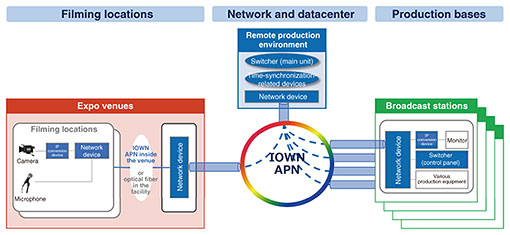
3. Initiatives to enhance added value3.1 Facility-sharing remote media production at Expo 2025 Osaka, Kansai, JapanCommercial use of remote production of audio and video had been progressing in use cases requiring extremely high quality, such as terrestrial live broadcast programs. However, investment in network environment and production equipment, as well as the burden of equipment operation costs, remained challenging. To address these challenges, an approach was considered called “facility sharing,” which provides the necessary network environment for remote production and equipment compatible with standard specifications such as SMPTE as a common platform and allows for multiple broadcasters to jointly use these facilities. A concrete initiative was the joint demonstration at Expo 2025 Osaka, Kansai, Japan, which connected the Expo venue and multiple Osaka-based broadcasting stations via a private cloud datacenter. In this demonstration, NTT’s datacenter located in Osaka City was positioned as a collaborative media hub, and a private cloud environment was built at that location. We also provided video switchers and PTP Grandmaster Clock*6 functions for time synchronization as common functions, creating an environment where broadcasters could use these functions. Each broadcaster was able to use the equipment and functions of the datacenter to produce live broadcast programs using multiple-camera footage for events held at the Expo venues (Fig. 4).
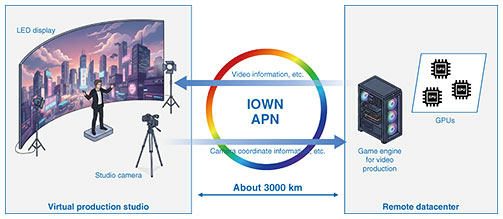
Through this demonstration, in addition to the feasibility of remote audio and video production previously confirmed, it was also confirmed that the shared equipment can flexibly accommodate changes in connection destinations and adapt to the diverse program production requirements of broadcasting stations. Although this switching was manual, automating switching and introducing controller functions such as schedulers enables multiple companies to share the necessary resources more flexibly, potentially leading to optimized equipment investment and maintenance costs for broadcasters. 3.2 Demonstration of distributed GPU utilization in virtual productionOne example of the development of remote media production and facility sharing thus far is the use of distributed graphics processing units (GPUs) in virtual production*7. GPUs used for video production have been installed within the same site, but in this initiative, these GPUs were consolidated on a common platform placed at a remote location and connected via the IOWN APN, which covers a long distance (about 3000 km) equivalent to the length of Japan. We also achieved real-time transmission of various data necessary for video production, such as time synchronization of the game engine*8 and coordinate information for cameras and lighting (Fig. 5). We thus confirmed a low-latency round trip time of about 84 ms between the camera and light-emitting diode (LED) background display, ensuring quality and operability equivalent to that of using GPUs in studios.
On the technical side, the IOWN APN’s low-latency, unwavering inter-site connections enabled high-precision time synchronization between game engines, and uncompressed video transmission compliant with SMPTE ST 2110 was achieved via GPU memory with low latency. The server infrastructure for game engines for video production is equipped with a composable disaggregated infrastructure (CDI)*9 that centrally manages and flexibly allocates multiple GPUs. This demonstrated scalability by flexibly allocating GPU resources according to the scale of LED displays, video pixel count, and advanced frame rates.
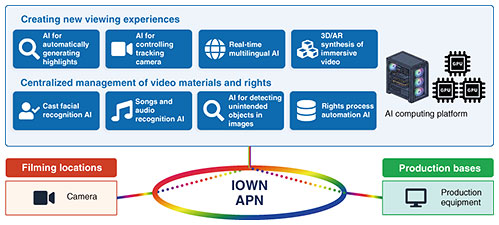
4. Toward future advancement and automationThrough the early technology demonstration, business feasibility verification, and commercial use, remote media production exhibited operational efficiency improvements at the commercial level of large-scale live broadcasting, thus addressing future shortages of skilled technicians. The potential for equipment-cost reduction through facility sharing was also demonstrated. By deploying these technologies and systems as a common industry platform, productivity improvements across the entire video production industry are expected. Beyond productivity improvements, however, there is a growing demand to create new viewing experiences through high added value in video production, and the application of artificial intelligence (AI) technologies is expected to enable this. For example, AI-powered automatic generation of highlights at sporting and music events, support for real-time multilingual subtitles, and the generation of immersive videos using three-dimensional (3D) and augmented reality (AR) technologies lead to the creation of new viewing experiences. The automatic generation of advanced metadata and the streamlining of rights processing will promote the utilization of past video works, and AI technology is expected to be used in these use cases (Fig. 6).
|
|||||||||||||||||||