|
|||||||||
|
|
|||||||||
|
Feature Articles: Remote Media Production Using the IOWN APN Advancing the Global Expansion of IOWN through the IOWN Global ForumAbstractThis article presents the IOWN Global Forum’s initiatives related to remote media production for the broadcasting industry, covering the entire process from challenge identification and use case development to proof-of-concept implementation and publication of evaluation results. It specifically focuses on the activities at the Use Case Working Group and Reference Implementation Model Task Force. Keywords: IOWN Global Forum, remote media production, video production DX  1. Establishment and development of IOWN Global ForumThe Innovative Optical and Wireless Network (IOWN) initiative seeks to create new social value through advanced networking and computing infrastructure featuring ultra-low latency, high-capacity transmission, and low power consumption. To advance this vision, the IOWN Global Forum (IOWN GF) [1] was established in January 2020 by Intel, Sony, and NTT as its founding members. As of April 2026, more than 170 companies and organizations have joined the Forum. IOWN GF is an international forum comprising telecommunications operators, information and communication technology vendors, enterprises, and research institutions. In addition to developing use cases and defining technical specifications and architectures, the Forum promotes the real-world deployment of IOWN technologies and solutions. A key characteristic of IOWN GF is its end-to-end approach, addressing not only individual technologies but also the broader ecosystem encompassing networks, computing, data, and applications. Within IOWN GF, technology and use case development activities are primarily conducted by the Use Case Working Group (UC-WG), the Technology Working Group (T-WG), and the Task Forces (TFs) established under these working groups. The UC-WG defines use cases that demonstrate the value of IOWN and identifies their significance and application domains. The T-WG, in turn, studies and develops the technologies and architecture required to implement these use cases. Within the TFs, specific requirements are identified, implementation approaches are examined, and technical validations are conducted on the basis of Work Items and Study Items defined under the direction of the T-WG and UC-WG. A distinguishing feature of IOWN GF is the close collaboration between the UC-WG and T-WG, enabling the systematic identification of required technologies from a use case-driven perspective. Under this framework, IOWN GF promotes the materialization and real-world deployment of IOWN by developing and publishing a range of deliverables, including Use Case documents, proof-of-concept (PoC) References, PoC Reports, and other technical documents. Therefore, IOWN GF provides an integrated framework that advances technology development and validation in a use case-driven manner. 2. Development of remote media production use cases in the Reference Implementation Model TFDetailed studies on remote media production use cases [2] are being conducted primarily within the Reference Implementation Model TF (RIM-TF), which operates under the UC-WG. The objective of the RIM-TF is to develop and evaluate RIMs that leverage the architectures and technologies proposed by IOWN GF while satisfying use case requirements and balancing technical feasibility with economic viability. Through its evaluation activities, the RIM-TF identifies potential technical challenges and improvement opportunities, thus contributing to the further enhancement of the architectures and technical specifications developed within IOWN GF. In addition to remote media production, which is considered a promising candidate for early real-world deployment, the RIM-TF is investigating multiple use cases, including early adoption use cases such as financial services, construction, and green computing for generative artificial intelligence (AI) and large language models (LLMs) using remote graphics processing unit (GPU) resources, as well as future-looking use cases envisioned for deployment around 2030. Each use case is managed as a Work Item within the RIM-TF, where participating companies collaboratively identify requirements and challenges and examine potential implementation models. The RIM-TF produces a series of deliverables in a phased manner, including:
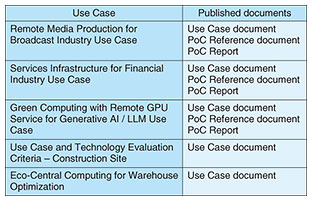
By providing these deliverables, the RIM-TF enables stakeholders to develop a shared understanding of the use case and its requirements, thus supporting implementation-oriented studies and development activities. For remote media production and other use cases, these deliverables are published not only within IOWN GF but also to the broader community, accelerating the global deployment and adoption of IOWN technologies and solutions (Table 1).
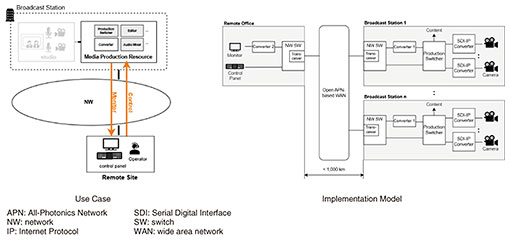
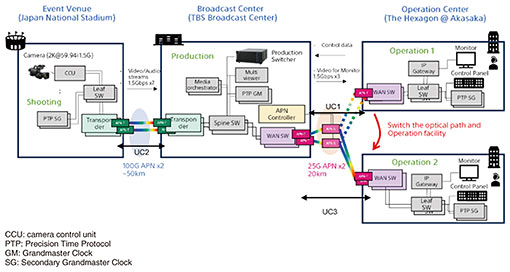
3. PoC demonstration and evaluation resultIn the remote media production domain, use cases have been defined on the basis of three distinct configuration patterns. This PoC was conducted in a real-world environment using the validation scenarios and evaluation configurations defined in the PoC Reference document, which were derived from the requirements and RIMs specified in the Use Case and RIM documents [3]. This enabled the assessment of both technical performance and the proposed value under conditions representative of actual operational deployment. 3.1 Use Case 1 (UC#1): Media Production from Remote Site(1) Overview UC#1 enables operators located at a remote office to remotely control production equipment at a broadcasting station, supporting a more flexible production workflow and improved workforce utilization by reducing geographical constraints (Fig. 1).
(2) Evaluation items (defined in the PoC Reference document) For UC#1, the following items are evaluated:
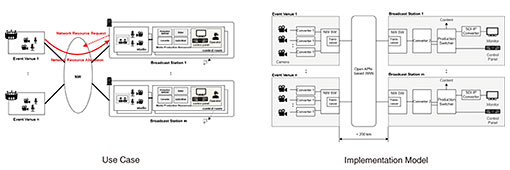
The latency between the event venue and remote office is evaluated as (T1 + T2). (3) PoC Report In the PoC Report [4], the latency requirement for UC#1 is defined as the latency between the event venue and remote office (T1 + T2) is less than 16.6 ms. On the basis of the measured results obtained in the PoC, latency values were converted according to the distance conditions defined for the use case. The round-trip latency for a distance of 1000 km, corresponding to UC#1, was estimated at 11.06 ms, demonstrating compliance with the required latency threshold of 16.6 ms. For availability evaluation, the PoC Report specifies an evaluation framework using a redundant network configuration between the broadcast center and operation center and evaluating the occurrence of video and audio frame drops as well as the continuity and responsiveness of control operations under single-path failure conditions. 3.2 Use Case 2 (UC#2): Network Resource Sharing(1) Overview UC#2 aims to enable more cost-efficient media production than conventional approaches by provisioning the required network resources on demand between the event venue and broadcast station and transmitting multiple video streams with high quality (Fig. 2).
(2) Evaluation items (defined in the PoC Reference document) For UC#2, the following items are evaluated:
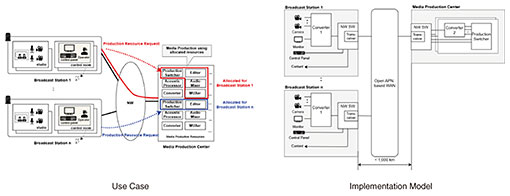
The latency between the event venue and broadcast station is evaluated as T1. (3) PoC Report In the PoC Report, the latency requirement for UC#2 is defined as the latency between the event venue and broadcast station (T1) is less than 16.6 ms. On the basis of the measured results obtained in the PoC, the latency was extrapolated according to the distance conditions defined for the use case. The latency for a distance of 200 km, corresponding to UC#2, was estimated to be 1.11 ms, confirming that the use case requirement of less than 16.6 ms was satisfied. 3.3 Use Case 3 (UC#3): Media Production Resource Sharing(1) Overview UC#3 aims to improve both capital investment efficiency and operational efficiency by consolidating production equipment at a media production center and enabling its shared use by multiple broadcasting sites (Fig. 3).
(2) Evaluation items (defined in the PoC Reference document) For UC#3, the following items are evaluated:
The latency between the broadcast station and media production center is evaluated using two measurement intervals, (T1 + T2) and (T3 + T4), both of which are defined as the end-to-end latency between the broadcast station and media production center. (3) PoC Report In the PoC Report, the latency requirement for UC#3 is defined as the latency between the broadcast station and media production center (T1 + T2 and T3 + T4) is less than 16.6 ms. On the basis of the measured results obtained in the PoC, latency values were extrapolated according to the distance conditions defined for the use case. The round-trip latency for a distance of 1000 km, corresponding to UC#3, was estimated to be 11.06 ms, demonstrating compliance with the required latency threshold of 16.6 ms. For availability evaluation, the PoC adopted a configuration using a 25G dense wavelength division multiplexing (DWDM) tunable transceiver (25G APN (All-Photonics Network)-T) based on intensity modulation direct detection technology. By combining this with the APN-S, a splitter equipped with DWDM filters for wavelength switching, the configuration enables switchover of the operational site (operation center), thus enhancing service continuity and operational resilience. The PoC Report describes a mechanism in which the APN Controller (APN-C) controls wavelength switching and transmission on/off operations of the APN-T, while the APN-S passively executes data-plane switching. In this PoC, SMPTE (Society of Motion Picture and Television Engineers) ST 2022-7 seamless protection switching was applied over redundant transmission paths, and media quality and control-system behavior were evaluated under intentionally induced single-path failure conditions. The results confirm that no video distortion or visual artifacts occurred, no audio interruptions were observed, and control functions continued to operate normally even in the event of a single-path failure. Path-switchover testing using the APN-C was conducted for UC#3. On the basis of the timing definitions specified in the PoC Report—TS1 (switchover initiation), TS2 (link-up notification), TS3 (video restoration), and TS3’ (control-system recognition)—the switchover times of the optical, media, and control layers were evaluated. The measured switchover times were 8.354 s on average for the APN layer, 18.3 s for the media layer, and 103 s for the control layer. These results indicate that network destinations can be switched in a controlled and predictable manner, enabling flexible reconfiguration based on operational requirements. The switchover-time evaluation was conducted using the framework defined in the PoC Report, where the optical-layer switchover time was measured as the interval between TS1 and TS2, with corresponding measurements conducted for the media and control layers. Overall, the PoC demonstrated not only the latency performance of the IOWN APN but also the technical feasibility of remote media production incorporating path redundancy and operational switchover capabilities through a combination of the 25G DWDM tunable transceiver (25G APN-T), APN-S, and APN-C (Fig. 4).
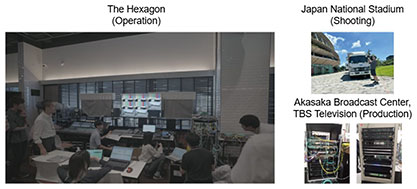
This PoC was conducted as a collaborative effort among multiple IOWN GF member organizations, which contributed their respective expertise, technologies, and facilities. Participants acknowledged in the PoC Report included Sony Group, TBS Television (Tokyo Broadcasting System Television), TBS ACT, Sumitomo Electric Industries, and the NTT Group (Fig. 5).
4. Future outlook and initiatives toward real-world deploymentThe remote media production PoC conducted by IOWN GF partners successfully validated the key technical requirements and architectural components required for the target use cases. By reproducing, in a real-world environment, the configurations defined in the PoC Reference document and evaluating both network performance and the impact on production operations, the PoC demonstrated the feasibility of remote media production use cases enabled by IOWN technologies. These use cases have thus progressed beyond the stages of conceptual study and technical validation and are now moving toward practical deployment. At the same time, achieving large-scale deployment and commercialization requires not only technical feasibility but also quantitative evidence of economic benefits and deployment effectiveness. Building on the findings obtained through this PoC, further studies are underway to evaluate economic viability on the basis of equipment configurations and operational models, as well as to visualize the value of the remote media production approach through comparisons with conventional production methods. These efforts are expected to provide useful guidance for deployment planning and investment decision-making. Leveraging the outcomes of the PoC activities conducted to date, IOWN GF will continue to advance studies on remote media production and other use cases from integrating technical, operational, and business perspectives. Through these efforts, the Forum aims to accelerate both value creation and real-world deployment enabled by IOWN technologies. References
|
|||||||||