|
|||||||
|
|
|||||||
        |
Global Standardization Activities Report on the 38th Asia-Pacific Telecommunity Standardization Program Forum (ASTAP-38)AbstractThe 38th Asia-Pacific Telecommunity (APT) Standardization Program Forum (ASTAP-38) was held from April 20 to 24, 2026, in Bangkok, Thailand, in an in-person format. Similar to last year’s event, a hybrid participation format was prepared specifically for the industry workshop and plenary sessions. A total of 148 experts from 18 APT member countries and various organizations attended the forum. In addition to the regular standardization discussions, an industry workshop focusing on artificial intelligence and emerging technologies was held to share recent initiatives from the industrial sector. This article reports the outline and major outcomes of ASTAP-38. Keywords: international standard, ASTAP, ITU-T
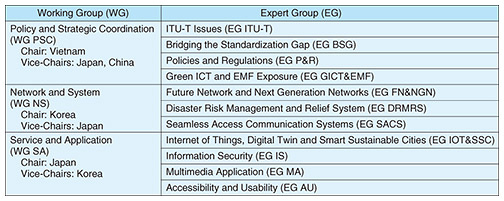
1. Overview and structure of ASTAPThe international organization Asia-Pacific Telecommunity (APT) was established in 1979 to promote information and communication technology (ICT) development and regional policy coordination in the Asia-Pacific region and currently counts 38 countries as affiliates. In 1998, APT established the APT Standardization Program (ASTAP) as its standardization sector. Since its inception, ASTAP forums have been held once or twice a year. Its two main objectives are to construct a harmonized discussion scheme in the Asia-Pacific region and effectively propose the region’s perspectives and policies to international standards. The overall meeting structure of ASTAP-38 consisted of the industry workshop on the first day, followed by a four-day schedule that included opening and closing plenaries, individual Working Group (WG) and Expert Group (EG) meetings, an ad hoc meeting on future directions, and the Head of Delegation (HoD) meeting. The meeting structure of ASTAP is composed of WGs and EGs, where multiple EGs report to three major WGs (Table 1).
1.1 WG Policy and Strategic CoordinationWG Policy and Strategic Coordination (PSC) investigates and shares member policies and strategies with respect to telecommunication technology. It comprises the following four EGs:
1.2 WG Network and SystemWG Network and System (NS) comprises the following three EGs:
1.3 WG Service and ApplicationWG Service and Application (SA) handles services and applications through the following four EGs:
1.4 Other meetingsThe following special sessions were also convened during the forum:
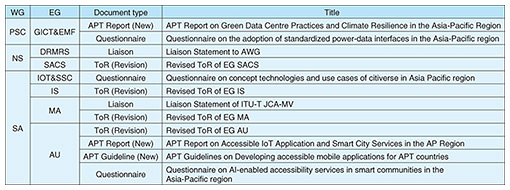
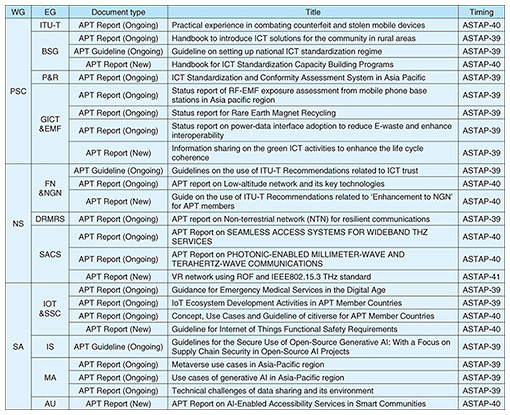
2. Major outcomes of ASTAP-38 and action plans for ASTAP-39In each EG, following the approval of the agenda, reviews of liaisons and deliberations on contributions and work plans were conducted. In WG PSC, EG ITU-T shared reports on recent ITU-T Study Group (SG) discussions (SG11, SG2, SG3, SG5, SG15) and reviewed a liaison statement from ITU-T SG11. In EG BSG, South Korea proposed a Capacity Building Program and Japan reported on a Training Course, with plans laid out to develop a handbook toward ASTAP-40. EG P&R discussed progress reports, input documents, and strategy updates. EG GICT&EMF processed four work items; a questionnaire on “the adoption of standardized power-data interfaces in the Asia-Pacific region” and a new APT Report on “Green Data Center Practices and Climate Resilience in the Asia-Pacific Region” were submitted and approved at the plenary. In WG NS, EG FN&NGN discussed South Korea’s draft guidelines regarding “the use of ITU-T Recommendations related to ICT trust” (the final report is scheduled for approval at ASTAP-39) and a new work item titled “Guide on the use of ITU-T Recommendations related to ‘Enhancement to NGN’ for APT members.” EG DRMRS discussed an ongoing report on “Non-terrestrial network (NTN) for Resilient Communications,” and a liaison statement to the APT Wireless Group (AWG) was approved at the plenary. EG SACS discussed a report and working documents on “Seamless Access Systems for Wideband THz Services,” as well as an initial survey regarding virtual reality (VR) networks using radio over fiber (RoF) and IEEE 802.15.3 THz standards. The revised Terms of Reference (ToR) for EG SACS was approved at the plenary. In WG SA, EG IOT&SSC secured plenary approval for a questionnaire on the concepts, technologies, and use cases of the citiverse in the Asia-Pacific region, while EG IS achieved approval for its revised ToR. EG MA gained approval for a Liaison Statement to ITU-T Joint Coordination Activity on Metaverse Standardization (JCA-MV) and its revised ToR. EG AU successfully passed its revised ToR, along with two final documents: report on “Accessible IoT Application and Smart City Services in the AP Region” and guidelines on “Developing accessible mobile applications for APT countries.” Its questionnaire on “AI-enabled accessibility services in smart communities in the Asia-Pacific region” was also approved. Major outcomes of the above sessions are shown in Table 2 and study items of ASTAP-39 are listed in Table 3. Since ASTAP-39 marks the start of a new term under a newly appointed leadership, each WG and EG is scheduled to review its ToR moving forward.
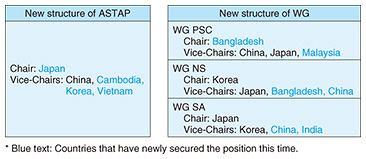
During the ad hoc group discussions on the future direction of ASTAP, several member countries expressed strong support for establishing EG on Emerging Technology Strategy to strengthen ASTAP’s strategic capability in dealing with emerging technologies. However, Japan voiced concerns regarding operational efficiency, work scope, resource constraints, and potential duplication with current groups, proposing instead that the mandates of current groups be expanded. A separate proposal suggested that the body should function as a high-level analysis and advisory organ. In conclusion, while broad support was achieved for enhancing strategic capabilities, a final consensus on the specific structural approach remains to be reached. Regarding general organizational restructuring, participants agreed on its necessity to improve technical responsiveness, efficiency, and inclusiveness, but concluded that further discussions are required under the incoming leadership. Regarding the election of the next ASTAP leadership, candidates selected at the HoD meeting were unanimously approved at the plenary (Table 4). Consequently, Mr. Hideyuki Iwata, executive director of the Telecommunication Technology Committee (TTC) of Japan, was elected as the next chair of ASTAP. To ensure balanced regional representation and encourage participation from developing countries, the number of ASTAP vice-chairs was expanded to four, with representatives approved from China, Cambodia, South Korea, and Vietnam. To facilitate coordination among relevant nations, it was agreed to appoint three vice-chairs for each WG. The new leadership team was officially appointed at the plenary for a three-year term.
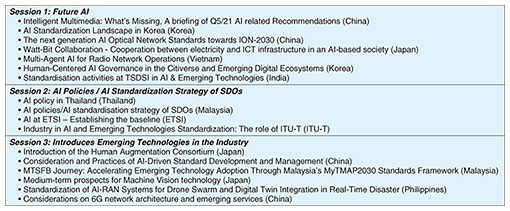
3. Industry workshopOn the first day of the forum (April 20), an industry workshop titled “Industry Workshop on AI and Emerging Technologies” was successfully convened (Table 5). A total of 17 experts served as speakers, representing eight nations—Japan, China, India, South Korea, Malaysia, the Philippines, Thailand, and Vietnam—as well as the European Telecommunications Standards Institute (ETSI) and ITU. The workshop attracted 81 on-site participants and 50 remote participants.
The primary themes focused on rapid advancements in fields such as Embodied AI, AI-native networks, 6G (6th-generation mobile communication systems), human-centric governance, and green datacenters. The discussions underscored the critical importance of interoperability, high reliability, and sustainable development. Speakers strongly emphasized the necessity of aligning technical innovations with policy and standardization activities, strengthening collaboration across industry, government, and standardization organizations, and elevating emerging advanced initiatives into formal international standards. 4. Future scheduleASTAP-39 is scheduled to be held in 2027, with the exact dates and venue to be determined in the coming months. The next forum is expected to follow a similar format to ASTAP-38, featuring a specialized industry workshop alongside the core standardization sessions. References
|
||||||