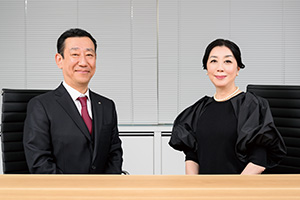
From studies on paper to technology used in society
—One year has passed since you assumed the role of head of technology planning. What are your impressions when you look back on this past year?
Since assuming the current role in June 2025, I have focused on the challenge of how to enhance the capabilities of the entire NTT Group through the power of technology. Although I had previously been with the Technology Planning Department, the scope of its work has expanded significantly—encompassing not only networks but also artificial intelligence (AI), information technology (IT), and security—and I feel that the Department itself must continue to evolve accordingly.
The role of the NTT holding company is to tackle challenges that are difficult for operating companies to resolve on their own and to chart a course that looks toward the near future. It also has a vital mission to share this strategic direction with, and guide, NTT Group companies such as NTT EAST, NTT WEST, NTT DOCOMO, and NTT DATA, each of which possesses its own distinct strengths and roles. While this work demands a vast amount of energy, it is indispensable for maximizing the Group’s collective capabilities. As head of technology planning, I view my own role as ensuring that new technologies—such as the Innovative Optical and Wireless Network (IOWN) and AI—do not merely remain research outcomes but are implemented in society. Consequently, since assuming this position, I have focused my efforts on implementation of IOWN and promotion of AI utilization, working to turn technologies studied on paper into technologies that are actually used in society.
—You have a major responsibility to navigate the transitional phase of implementing research findings in society. Would you tell us about the technological areas you are currently focusing on?
My primary focus right now is implementation of IOWN and utilization of AI. As I mentioned earlier, IOWN is at a critical juncture as it transitions from the research phase to the implementation phase, and we are currently rolling out the All-Photonics Network nationwide and developing an AI computing platform. We also have our sights set on the future implementation of AIOWN, an AI-native infrastructure built on IOWN. For AI, we are emphasizing both its implementation within our internal operations and the establishment of AI governance. We are moving beyond the level of simply using generative AI for convenience; specifically, we are developing AI agents and data-utilization infrastructure to transform our business processes, quality, and the value that we deliver to our customers.
The focus on these technologies stems from the rapid adoption of AI across society. Fully utilizing AI requires not only the AI itself but also the supporting infrastructure—networks, datacenters, and computing platforms. Early in my career, I engaged in research and development (R&D) of optical access networks. Back then, too, I continued to make upfront investments even as my supervisors and those around me questioned whether they would truly generate value. I believe the situation with AI and IOWN today is much the same. For the Technology Planning Department, it is crucial to develop the necessary future infrastructure ahead of time while simultaneously considering how it will be used. I view the role required of the Technology Planning Department—and by extension, NTT—as implementing these technologies by linking infrastructure development with actual applications.
Transforming technology into societal value while valuing relationships of trust
—I believe that people have high expectations for NTT to help build the future of society. What kind of capabilities are required of the Technology Planning Department?
I believe that the Technology Planning Department should not only create superior technologies but also possess the ability to translate those technologies into value for society and the business. Competition in the AI era does not depend on the merits of individual technologies; instead, it depends on the ability to combine diverse technologies, such as AI, networks, IT, and energy, to generate value through an ecosystem. Therefore, the Department must possess the capability to understand research outcomes and promote their implementation in society through collaboration with operating companies and partners.
Another crucial role of the Department involves not only addressing immediate challenges but also identifying major future issues—the so-called “Big Rocks”—and working toward resolving them. I believe that the Technology Planning Department must remain an organization that implements technology rather than one that merely discusses it.
In my efforts to make that organization a reality, a mindset that I personally cherish is, first and foremost, the practice of listening to others. I believe that understanding the thoughts, challenges, and future aspirations of our frontline teams and operating companies is the essential first step toward transformation. I also make a conscious effort to cultivate not only knowledge but also the insight to see through the essence of matters and the courage of conviction to make decisive moves. The role of the NTT holding company is to shape the future. By connecting people with people and technology with business, I aim to accelerate real-world implementation and drive transformation across the entire NTT Group.
—How did you cultivate your stance of connecting people and technology throughout your career at NTT?
I joined NTT in 1990 and began my career in the field, where I engaged in the construction and maintenance of telecommunications facilities. Since then, I have expanded the scope of my activities to encompass R&D concerning optical access networks, international standardization, telecommunications policy, corporate planning, network operations, promotion of digital transformation, international business, and, currently, promotion of AI utilization.
Through experiences such as pursuing an MBA at the National University of Singapore, being posted to the Center for Strategic and International Studies in the United States, and managing operations in Vietnam, I cultivated the ability to view matters from a broad perspective—encompassing not only technology but also economics, society, and international affairs. I was also involved in restoring telecommunications services following the Great East Japan Earthquake, which reaffirmed my understanding of telecommunications as vital social infrastructure supporting people’s lives. Looking back over those experiences, I see my career as a continuous series of experiences bridging different worlds—spanning the field and the laboratory, technology and management, and Japan and the international arena.
Along the way, I learned the importance of building trusting relationships and the necessity of continuously honing my strengths. When I was younger, there were times when I rushed ahead with initiatives that I deemed necessary and was told by my supervisors that I had gone too far. Those experiences taught me that work cannot be completed within my own domain alone; I learned the importance of proceeding with an understanding of the other party’s perspective.
For example, in Vietnam, I socialized with local colleagues and their families, together with my own family, to become familiar with local business customs, and in Singapore, I took up debating to build my English skills, engaging in repeated discussions with people of diverse values and cultural backgrounds. Through these experiences, I realized the importance of first listening to others and making an effort to understand their perspectives. I continue to work on transforming technology into societal value while placing great importance on building relationships based on trust.
Looking beyond immediate challenges to the future that lies ahead
—You have accumulated a wide range of experiences—both professionally and personally—across Japan and abroad. Although summing it up in a single phrase may be difficult, would you tell us what you value most as a leader?
As a leader, I make it a priority to look beyond immediate challenges and keep the future in sight. The role of the Technology Planning Department extends beyond addressing day-to-day issues; that is, it involves identifying themes of critical importance to the future NTT Group and society at large and charting a course toward their resolution. To fulfill this role, it is essential to possess the abilities to pose the right questions and to carry strategy through to implementation, and to keep refining one’s knowledge, insight, and courage of conviction. In terms of mobilizing the organization, I place great importance—as I have often emphasized—on listening to others sincerely. I believe that the first step toward transformation is to listen to the challenges and aspirations of those on the front lines and within our operating companies and to move forward by building empathy.
Going forward, the Technology Planning Department will need to adopt an even broader perspective. As AI is increasingly used across various sectors of society, the role of designing the entire social infrastructure—encompassing networks, AI, IT, energy, and security—will become crucial. I would like to build the social foundation that will support the AI era by advancing IOWN into the implementation phase and subsequently realizing AIOWN. By continuously transforming itself and implementing technologies in society, the Technology Planning Department will contribute to resolving societal issues both in Japan and around the world.
—Would you like to share a message with engineers, the members of the Technology Planning Department, and partners?
To engineers, I would say: first, hone your own expertise thoroughly. I believe that regardless of the era, it is crucial to be clear about the area in which you can generate value. That said, possessing technical skills alone does not create value. Those skills only become meaningful when they are put to use and prove useful in society or at customer sites. That is why I encourage you not only to understand technology but also to take on the challenge of implementing it and transforming it into value. Precisely because these are times of rapid change, I hope you will keep refining your expertise while becoming professionals who can flexibly adapt to new environments.
I also urge the members of the Technology Planning Department to commit fully to real-world implementation of technology. Translating research findings and fundamental technologies into tangible value requires working hard alongside a wide range of stakeholders. That experience will undoubtedly serve as an asset for the future. To our partners, I want to emphasize that in the era of AI, no single company can generate value on its own. We are entering an era in which value is created within a global ecosystem by pooling our respective strengths. We will keep an open mindset, keep learning, and keep implementing technology in society, and we look forward to working alongside you to address the challenges facing society.