|
|||||||||||
|
|
|||||||||||
        |
Feature Articles: NTT Research 2.0 NTT Research 2.0: Bringing Silicon Valley Spirit to the NTT GroupAbstractSilicon Valley offers many examples of startups emerging from fundamental research at universities and other academic institutions. Over the past seven years, NTT Research has produced potentially impactful technologies through its fundamental research activities in Silicon Valley. Transformative advancements, such as those in artificial intelligence, are reshaping society, underscoring the need to revisit research priorities in step with a changing world. In this article, we present a perspective on how NTT Research can contribute to the continued growth of the NTT Group over the next decade. Keywords: NTT Research 2.0, Silicon Valley, commercialization of research
1. IntroductionIn 2026, NTT Research marked its seventh anniversary. It was founded in July 2019 with a small team of just over a dozen researchers, guided by a policy of focusing on fundamental research in three areas: photonic quantum computing, the theoretical foundations of cryptography, and the Bio Digital Twin for medical applications. It was established to demonstrate the world-class research and development (R&D) capabilities and technological expertise of the NTT Group through top-level fundamental research while enhancing the Group’s technology brand globally. Over the past seven years, the number of researchers has grown to 56, and the organization has achieved significant results, including numerous publications in prestigious academic journals, such as Nature and Science, and many more presentations at leading international conferences. These sustained research efforts have begun to yield not only technologies with near-term commercial potential but also research directions increasingly aligned with national projects and other initiatives aimed at creating long-term societal value. Silicon Valley, where NTT Research is located, offers a culture and ecosystem for building businesses from the outcomes of fundamental research conducted at universities and national laboratories. Building on this environment, it is working to further accelerate its fundamental research activities, and expanding its scope to include the commercialization of technologies derived from its fundamental research leveraging the Silicon Valley ecosystem. New business opportunities through participating in national projects are also being explored. Through these initiatives, NTT Research aims to evolve into “NTT Research 2.0.” 2. Achievements over seven yearsOne of our key performance indicators at NTT Research is the publication of high-quality papers, which we define as contributions to the academic community. We evaluate the quality of papers on the basis of the impact factor, a metric that generally indicates how frequently a paper is cited by others. Papers published in journals with an impact factor of 5.0 and above are highly regarded among researchers in related fields and are classified as high-impact papers. On the basis of this criterion, we have set a goal of publishing at least one high-impact paper per researcher per year (Table 1).
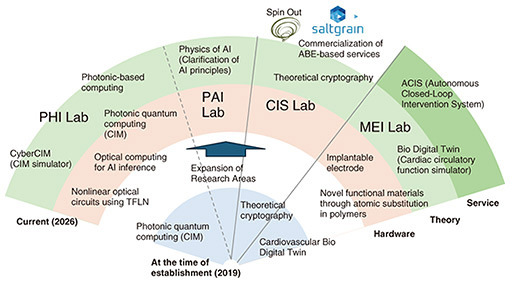
Over the seven-year period from July 2019 through March 2026, we have published a total of 467 high-impact papers. These include five papers in Nature, one in Science, and 26 in Nature branded journals, all of which are widely regarded as among the world’s most prestigious scientific publications. In some fields, presentations at leading international conferences play an equal or more important role than journal publications in establishing a strong academic presence. This is particularly true in areas such as the theoretical foundations of cryptography and artificial intelligence (AI). In cryptography, NTT Research has presented numerous papers at premier international conferences, such as Crypto and Eurocrypt, and is significantly outperforming many peer institutions worldwide and establishing itself as a world-leading research organization in the field. Similarly, in AI, NTT Research has maintained a strong presence at major machine learning conferences, including NeurIPS (Conference on Neural Information Processing Systems), ICML (International Conference on Machine Learning), and ICLR (International Conference on Learning Representations), where we have been demonstrating unique research results around AI phenomena from the fundamental research point of view. To sustain and further strengthen these achievements, we have placed strong emphasis on recruiting outstanding researchers from around the world. Like leading U.S. research universities such as Stanford University and the Massachusetts Institute of Technology, which attract exceptional talents globally, we have also built a team consisting of researchers from different parts of the world. NTT Research has grown into an international research institute, with approximately 30% of its researchers from the United States, 20% from Europe and the Middle East, 20% from Japan, and 30% from other regions including Asia (excluding Japan) and Oceania. With regard to intellectual property, over the past seven years, NTT Research has filed 143 patent applications, 41 of which have been granted. 3. Future directions in fundamental researchWhen it was established in 2019, NTT Research initially focused on three research areas: photonic quantum computing, the theoretical foundations of cryptography, and the Cardiovascular Bio Digital Twin for medical applications. As shown in Fig. 1, the scope of research has since expanded significantly, now encompassing a wide range of activities—from hardware-oriented research, such as the exploration of new materials, to software-oriented research in areas such as AI and healthcare.
In the field of photonic quantum computing, NTT Research is advancing the development of photonic large-scale integrated circuits (LSIs), in which optical circuits are integrated onto thin films that guide light, replacing conventional optical systems composed of lenses. Just as classical computers became practical through the transition from vacuum tubes to semiconductors—particularly LSIs on silicon wafers—this approach is expected to improve the scalability and practicality of photonic computing technologies. This approach supports the development of photonic quantum computers as well as optical computing technologies capable of accelerating inference process in large language models (LLMs) while drastically reducing required power consumption. These are now regarded as high-priority research areas. One recent outcome is the development of programmable photonic devices that integrate multiple functions within a single optical component. This topic is discussed in detail in this collection of feature articles in this issue [1]. In response to the rapid advancement of AI, NTT Research is studying the mechanisms of AI and the dynamics of learning and inference processes. Rather than treating AI as a black box, this research aims to uncover its fundamental operating principles inside AI. The overarching goal is to identify approaches for how humans and AI can coexist and collaborate in the future through establishing trust and safety of AI. For the Cardiovascular Bio Digital Twin, NTT Research is advancing research on a cardiac circulatory function simulator as well as medical sensing devices capable of accurately measuring biological data that couples with the development of new materials to enable such devices. NTT Research continues to advance its R&D themes to meet the needs of society over the next five to ten years. As part of this journey, Tetsuomi Sogawa, former head of the NTT Science and Core Technology Laboratory Group, was appointed as director of the Physics & Informatics Laboratories (PHI Lab) at NTT Research in 2026. He succeeded Yoshihisa Yamamoto, who had led the research team over the previous seven years. 4. Message from the new director of PHI LabAt PHI Lab, we have built a strong foundation on the Coherent Ising Machine (CIM)*1 while accelerating research on novel photonic functional devices that combine thin-film lithium niobate (TFLN)—a promising platform for next-generation optical devices—with silicon photonics technology. The CIM is evolving from a standalone optimization machine into a broader platform for physical-system-based sampling, probabilistic search, generative modeling, and combinatorial optimization acceleration. In collaboration with NTT Basic Research Laboratories, we will continue pursuing the long-standing goal of developing an optical quantum neural network. We will also advance TFLN-based nonlinear integrated photonics technologies to address key AI-era challenges in computation, memory, communication, I/O, and power efficiency, including highly efficient multiply–accumulate (MAC) operations*2.
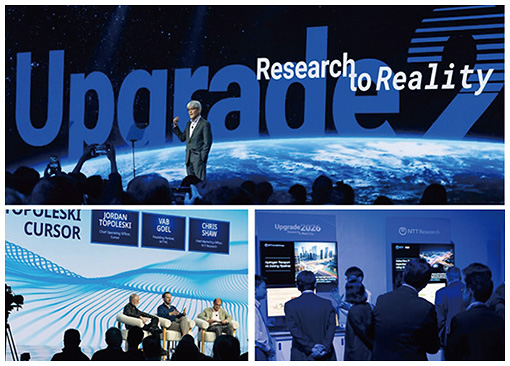
5. Initiatives of NTT Research 2.0One of the key objectives in establishing NTT Research was to strengthen the NTT Group’s presence in technology development. With this objective in mind, NTT Research has actively showcased the Group’s technological strengths—primarily to markets outside Japan—with not only the outcomes of its own research and development but also the NTT Group’s broader innovation activities and new services. These efforts have taken a variety of forms, including Upgrade, NTT Research’s flagship technology event (Fig. 2), organized in collaboration with NTT Group operating companies.
While such outreach and branding activities remain important, NTT Research’s work over the past seven years in fundamental research has also begun to generate technologies that have near-term potential for commercialization. Silicon Valley has long fostered a culture and ecosystem that nurtures business startups based on fundamental research originating from universities and national laboratories. The term “Silicon Valley” traces its origins to William Shockley, who invented the transistor at Bell Labs and later established Shockley Semiconductor Laboratory as a subsidiary of Beckman Instruments (now Beckman Coulter, a medical testing equipment company founded by Arnold Beckman, a former professor at the California Institute of Technology). Since then, the region has sustained a strong culture of translating new technologies into startup ventures. Although the mechanisms for launching startups have evolved—from corporate subsidiaries to an ecosystem fueled by venture capital—the underlying entrepreneurial spirit remains very much the same. Not every technology emerging from fundamental research is best brought to market immediately through a startup. In such cases, the more effective path is to advance these technologies through broader societal initiatives by participating in national projects aimed at addressing long-term societal needs. NTT Research’s work is also seen as contributing to such efforts. Looking ahead, NTT Research will continue to accelerate its fundamental research by attracting world-class researchers from around the world. Under the concept of “NTT Research 2.0,” it launched a new business strategy in 2026 encompassing both the commercialization of technologies within the Silicon Valley ecosystem and the near-term real-world deployment of research outcomes through national projects. To support commercialization, we have established a dedicated team called the Scale Academy. This team plays a central role in turning technologies originated at NTT Research into startup businesses. It does so by adding the functions needed to make core technologies market-ready and by identifying and cultivating the right business partners. The first commercialization initiative is the SaltGrainTM service based on attribute-based encryption (ABE) technology developed by the Cryptography & Information Security Laboratories (CIS Lab) at NTT Research. This service aims to enable both the secure handling of personal and confidential data and the facilitation of information sharing, such as in enterprise data exchange and AI agent-based learning, achieving a balance between data utilization and data protection. This initiative is also described in this issue [2]. Regarding government-sponsored projects, PHI Lab is collaborating with the National Institute of Advanced Industrial Science and Technology in Japan on a project to develop integrated photonic circuits on TFLN, enabling functions such as sensing and computation. The Medical & Health Informatics Laboratories (MEI Lab) plans to participate in U.S. national research projects in collaboration with institutions such as Boston Children’s Hospital, focusing on the development of ventricular assist devices for pediatric heart disease patients based on iPS (induced pluripotent stem) cell technology. 6. Looking ahead to the next 7 to 10 yearsFifteen years ago, AI was widely viewed as a concept that might one day enable machines to perform human-like intellectual tasks, but few could have imagined that by 2025 technologies including LLMs and generative AI would already have reached their current level of maturity. There are research areas in which progress still depends on steadily advancing fundamental science over many years to reach meaningful goals. We believe that NTT Research’s work encompasses both these dimensions. Building on the activities and experience of the past seven years, NTT Research is committed to continuing two reinforcing missions: 1) to lead the world in fundamental research that is responsive to the needs of the future society, and 2) to accelerate commercialization and real-world implementation of promising technologies generated from its fundamental research by leveraging Silicon Valley’s unique ecosystem. Through these activities, we are aiming to advance NTT’s presence in the global market as a technology leader. References
|
||||||||||