|
|
|
|
|
|
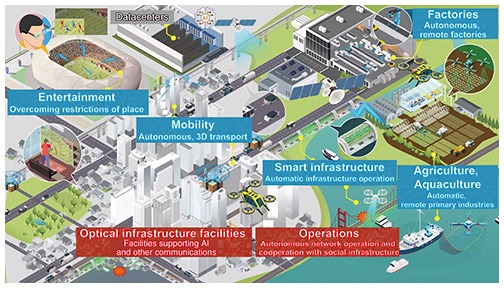
Feature Articles: Keynote Speeches and R&D on Access Networks Presented at Tsukuba Forum 2026 New Horizons Opened Up by Access Networks: Creating New Value and Contributing to a Sustainable SocietyAbstractWe at NTT Access Network Service Systems Laboratories conduct research and development on access networks connecting customers and NTT buildings. The environment surrounding access networks has been undergoing dramatic changes; therefore, we have been working tirelessly to create new value and contribute to a sustainable society. This article introduces our vision called “New Horizons Opened Up by Access Networks” and Tsukuba Forum 2026 that exhibited the latest technologies in the access field. Keywords: access network, IOWN, APN, Tsukuba Forum  1. IntroductionIn information and communication networks, access networks overseen by NTT Access Network Service Systems Laboratories play a vital role in establishing a contact point with customers and expanding the development of information and communication technologies. The growth of access networks in Japan has been remarkable. In optical communications, it has been 25 years since the launch of fiber to the home (FTTH) services in 2001, and the nationwide diffusion rate of FTTH is currently over 97%. In wireless communications, the population coverage rate of 5G (fifth-generation mobile communications system) services is now over 98%. In addition to providing a base for economic activities, access networks have become deeply embedded in the daily lives of individuals, and thus have become an essential social infrastructure. The environment surrounding access networks has been undergoing major changes; new forms of demand and new players have appeared, and advances in artificial intelligence (AI) and growing investments in AI-supporting datacenters have been astonishing. In a future in which the use of AI by every person will be commonplace, the role of access networks will also have to change. There is also the problem of aging infrastructure facilities and their maintenance and operation. As reflected by the sinkhole incident at an intersection in Yashio City, Saitama Prefecture in 2025, the aging of Japan’s infrastructure is becoming a pressing issue. Many infrastructure facilities, such as highway bridges and tunnels, built after Japan’s period of high economic growth will become more than 50 years old in 2040, and this holds true for NTT communications facilities as well. The working-age population of Japan is forecast to decrease by more than 30 million people by 2050, so the question arises as to how this aging social infrastructure will be maintained and operated. How best to respond to natural disasters such as torrential rains that have become increasingly severe is also an issue that cannot be ignored. Amid this ever-changing environment, I would like to introduce our vision called “New Horizons Opened Up by Access Networks” as a worldview that envisions how the access networks of the future will be used and what types of technologies will become important. 2. New Horizons Opened Up by Access NetworksFigure 1 shows a worldview encompassing a variety of use cases made possible by advances in access networks in the near future. At that time, linking with AI will become commonplace in all types of fields; factories will run autonomously, and primary industries will operate automatically and remotely. In the entertainment industry, services will be provided beyond restrictions of place, while in the field of mobility, transport will become increasingly three dimensional (3D) and autonomous. We also envision that operation of the social infrastructure will become automated to address the labor shortage issue. In this future society, optical infrastructure facilities and network operations supporting access networks will become increasingly important.
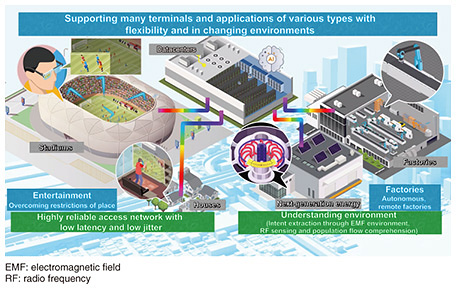
The linking of robots with physical AI in factories and the provision of new entertainment experiences will require flexible support of many and varied terminals and applications according to changes in the environment. Low-latency access networks and understanding the environment via sensing and other means will thus become important (Fig. 2).
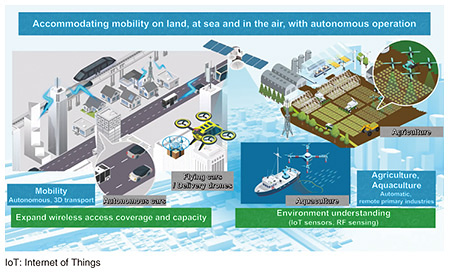
In mobility and primary industries, accommodation and autonomous operation of mobility everywhere on land, at sea, and in the air will become necessary. Expanded coverage and greater capacity of wireless communications and understanding of the environment through sensing will thus become important (Fig. 3).
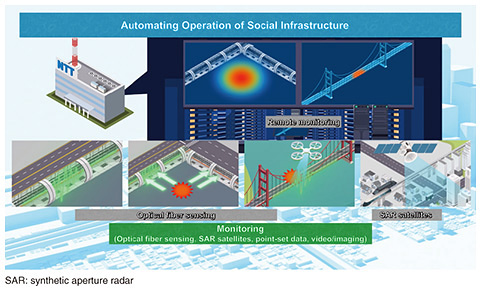
There is a need for automatic operation of the social infrastructure by automatically understanding current conditions and predicting and recovering from deterioration and failures. This will require optical fiber sensing and satellite monitoring as well as data integration and cooperative management (Fig. 4).
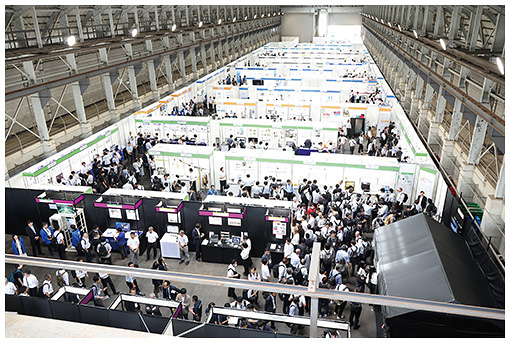
To make this future a reality, access networks will have to evolve into facilities supporting AI and other communications. In a world in which linking with AI is commonplace, communications facilities will become increasingly optimized by increasing communications capacity to meet demand, using ultra-parallel optical connections in datacenters, and expanding the All-Photonics Network including access networks, as well as by reducing the number of utility poles in step with the removal of metallic circuits and expanding wireless communications in rural areas. There is also a need for evolution not just in facilities but in operations. AI will be used to the maximum toward fully autonomous information and communications network operation that will be able to not only understand current conditions but also mount a response to problems. In the next section, I will introduce Tsukuba Forum 2026 that exhibited the latest technologies from NTT Access Network Service Systems Laboratories toward New Horizons Opened Up by Access Networks. 3. Tsukuba Forum 2026NTT Access Network Service Systems Laboratories hosts Tsukuba Forum every year in May at the Tsukuba Research and Development Center in Tsukuba City, Ibaraki Prefecture. The Tsukuba Forum was first launched in 1990 as an exhibition and technology exchange event introducing the latest technologies in access networks, so Tsukuba Forum 2026 marks the 36th time that it has been held. Thanks to many participants including NTT laboratories, NTT Group companies, and co-hosting organizations, the Tsukuba Forum has been increasing in scale every year, and in 2026, it hosted 113 exhibitors and 9367 visitors (Fig. 5).
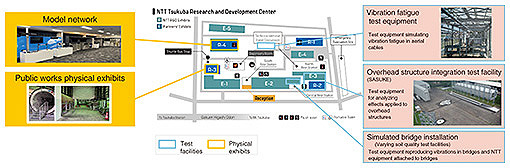
Under the theme of “New Horizons Opened Up by Access Networks: Creating New Value and Contributing to a Sustainable Society,” Tsukuba Forum 2026 exhibited the latest technologies in the field of access networks to make the future described above a reality. These technologies fell into five categories: optical communications, wireless communications, operations, telecom infrastructure, and social infrastructure. Project managers and group leaders of NTT Access Network Service Systems Laboratories introduce these latest technologies in this collection of feature articles in this issue. At Tsukuba Forum 2026, we hosted for the first time a tour of the test facilities at NTT Access Network Service Systems Laboratories so that visitors could see the large-scale test facilities that have come to support our research and development of cutting-edge technologies in access networks (Fig. 6). Regarding creating new value, we set up a corner called Social Infrastructure Technology Exhibits for promoting technology exchange and business creation across industries. A total of 13 companies including some from the NTT Group held exhibits here. Regarding contributing to a sustainable society, we set up a corner called Environment/Energy Exhibits for exhibiting the latest technologies such as laser wireless power transmission from NTT Space Environment and Energy Laboratories and products for achieving a sustainable society from eight co-hosting organizations.
4. ConclusionIn this article, I introduced our vision “New Horizons Opened Up by Access Networks” and Tsukuba Forum 2026 that exhibited the latest technologies in the field of access networks. NTT Access Network Service Systems Laboratories will continue to work on solving social problems and contributing to the creation of new business value through the research and implementation of advanced access network technologies. |