|
|||||||||||||||||||||||||
|
|
|||||||||||||||||||||||||
|
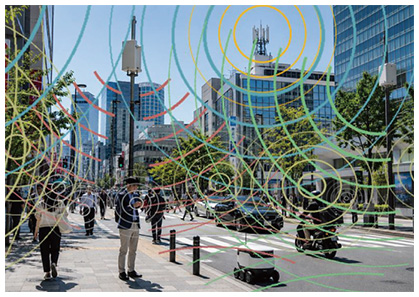
Feature Articles: Keynote Speeches and R&D on Access Networks Presented at Tsukuba Forum 2026 Wireless Access Technologies for Connect and SenseAbstractNTT Access Network Service Systems Laboratories is advancing research on Cradio®, a set of multi-radio proactive control technologies designed to provide seamless and reliable wireless communications in the 6G (sixth-generation mobile communications system) and IOWN (Innovative Optical and Wireless Network) era. This article presents the current status of research on CONNECT, which provides reliable wireless connectivity, and SENSE, which enables awareness of the surrounding physical environment through radio signals, both enabled by Cradio. It also introduces research and development technologies aimed at further advancing these capabilities. Together, these technologies have the potential to make future wireless access networks an adaptive infrastructure for both communications and awareness of the physical world. Keywords: wireless access, wireless communications, sensing  1. Wireless access in the 6G/IOWN eraWireless access has become widespread, and connecting to a network anytime and anywhere to use a wide range of applications is increasingly taken for granted. Even when applications such as social networking services and video streaming are used over wireless links, users can experience significant stress if the quality falls short of their expectations. Devices also have many wireless access options for network connectivity, including Wi-Fi*1, WiGig*2, Long Term Evolution (LTE)*3, and 5G*4. Within each wireless access system, an even wider range of design choices, including frequency, transmit power, and settings related to how bits are transmitted and received, affects wireless communications quality. As wireless access has spread, radio signals have become ever-present around us (Fig. 1). Because radio waves are invisible, it is difficult to see how these signals reach users. Are radio signals colliding and causing interference? Are frequency resources allocated appropriately for the distribution of users and traffic? A deep understanding of these invisible radio signals determines the quality of the connection, or CONNECT, between users and the network. Technologies for sophisticated wireless access design and control are therefore becoming essential to achieve and maintain CONNECT that meets users’ quality expectations. New initiatives are also emerging to use radio signals propagating through space across various frequency bands for purposes other than communications, as illustrated in Fig. 1. A new technology called Integrated Sensing and Communication (ISAC)*5 combines communications with environmental understanding, or SENSE, and has the potential to create new value from the radio signals around us.
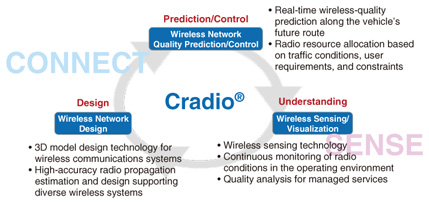
The Wireless Access Project at NTT Access Network Service Systems Laboratories has been developing Cradio®*6, a set of multi-radio proactive control technologies that supports CONNECT and enables SENSE. Figure 2 illustrates the concept of Cradio. Cradio is the collective name for a set of technologies developed to meet diverse use-case requirements, such as high capacity, high reliability, and low latency, across various wireless access environments. Its major functions comprise technologies that design wireless access for the environment in which it is used, technologies that predict and control wireless quality in response to wireless traffic and the movement of user devices, and technologies that understand the physical environment and devices using radio signals. This article introduces the design and prediction and control technologies for comfortable CONNECT and understanding technology that takes on the challenge of SENSE.
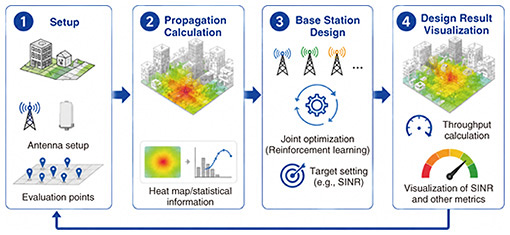
2. Research and development for CONNECTTo make wireless access something that can be used as a matter of course, one of the most important requirements is to establish legal and regulatory frameworks while maintaining international harmonization in the use of the radio spectrum, a public resource. Members of the Wireless Access Project hold leadership positions in working parties (WPs) of the International Telecommunication Union - Radiocommunication Sector (ITU-R), including WP 3K vice-chair, WP 3K-3 chair, and WP 5C WG 5C-4 chair. Through these roles, they contribute to the development of recommendations and reports that account for radio-wave propagation and enable comfortable use of wireless access within an internationally harmonized framework. A member of the project also serves as secretary for IEEE 802.11bn, the widely adopted wireless LAN standard expected to enter the market as Wi-Fi 8, and actively contributes to specification development. These activities support comfortable use of wireless access. 2.1 Design technologiesDesigning wireless access from a wide range of options while taking the radio environment into account is the first step toward comfortable CONNECT. Cradio’s multi-band wireless area design technology can generate design proposals for base-station placement and configuration to meet wireless-quality targets when wireless access is to be deployed in a given area. Figure 3 shows the basic flow of multiband wireless area design. To build a comfortable wireless access environment, basic settings for the site are prepared. These include a three-dimensional (3D) model of the deployment environment, settings such as the antennas and frequencies used by wireless base stations, and evaluation points that are prioritized within the communication area. On the basis of this information, radio-wave propagation can be calculated using ray-tracing technology, and heat maps and statistical information for the target environment can be visualized. Once target values are specified, base-station locations can be optimized through reinforcement learning, and a design plan can be produced. When equipment is shared across multiple bands, the design plan can select design values that are optimal across the bands, considering site locations, antenna angles, transmit power, and other parameters together. The resulting design can also be checked against target values using metrics such as throughput, enabling an assessment of whether it satisfies the quality required for the use case.
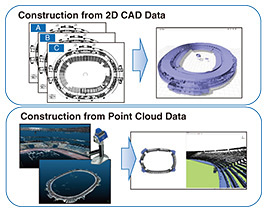
The 3D model of the usage environment, which would otherwise require substantial effort, can also be constructed at low cost using the 3D-model construction technology shown in Fig. 4. The technology has two major components. It can construct a 3D model after extracting only the necessary information from 2D computer-aided design (CAD) data or construct a 3D model from on-site positioning information using a simple point-cloud data acquisition system. Reducing the cost of preparing these basic settings makes it possible to respond rapidly to needs in a wide variety of environments.
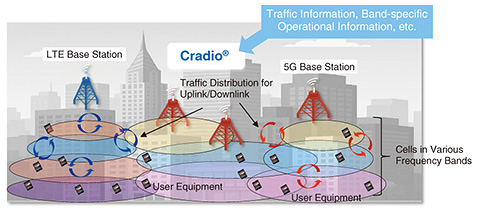
2.2 Control and prediction technologiesThis section introduces band-distribution technology and wireless-quality prediction technology as Cradio control and prediction technologies supporting CONNECT. Figure 5 illustrates band-distribution technology for mobile networks. In LTE and 5G, wireless communications are provided between base stations and terminals such as smartphones across various frequency bands. Wireless traffic exchanged with terminals continues to grow yearly. The amount of data exchanged through base stations changes dynamically according to location attributes, such as urban or suburban areas, and time attributes, such as commuting hours, weekends, and public holidays. The available frequencies act as transmission paths for these data. Unless downlink traffic from base stations to terminals and uplink traffic from terminals to base stations are distributed efficiently among the multiple frequency candidates available at a location, data can become concentrated on a particular path and degrade quality. The band-distribution technology therefore achieves efficient data delivery by controlling LTE and 5G radio frequencies and available bandwidth on the basis of experience derived from historical traffic information. This technology was presented at the IEEE 103rd Vehicular Technology Conference (VTC2026-Spring) in June 2026 [1].
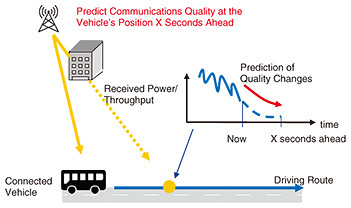
The wireless-quality prediction technology predicts in advance changes in wireless communications quality caused by vehicle movement for mobile terminals that require uninterrupted wireless access, such as autonomous vehicles, and enables proactive responses to those changes (Fig. 6). For example, this prediction technology can be used for proactive switching among multiple networks, proactive and dynamic control of video codecs for video transmission to remote operation centers, and vehicle motion control, such as acceleration, deceleration, or route changes, to avoid or mitigate degradation in communications quality. Wireless quality is predicted using a machine-learning model. Features input to the prediction model are generated from information such as received power and other radio-signal measurements, base-station identifiers, frequencies, and vehicle positions. In addition to generating machine-learning models through advance training for anticipated vehicle routes, we are evaluating performance on routes not used for training and working to improve model generalization. This wireless-quality prediction technology has contributed to autonomous driving field trials [2, 3].
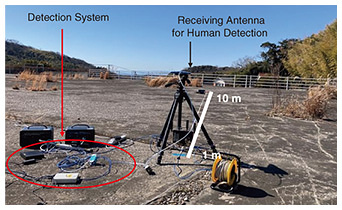
3. Taking on the challenge of SENSEISAC, which uses communications signals transmitted for wireless access for sensing as well, has attracted considerable attention. 3GPP, which develops wireless communications specifications for LTE, 5G, and 6G, identifies smart homes, smart transportation, unmanned aerial vehicles, smart cities, smart factories, smart health, and smart entertainment as representative ISAC use cases. ISAC is expected to expand into diverse fields [4]. The Wireless Access Project is also advancing sensing research and development to increase the added value of radio signals and connect the technology to future business opportunities. We are currently focusing on human-presence detection, an area of especially strong interest within ISAC, and conducting field trials under conditions representative of real-world environments. Figure 7 shows an experiment that detected human presence using LTE signals transmitted at multiple frequencies below 2 GHz by base stations on a commercial network [5]. In this experiment, reference signals transmitted from LTE base stations were observed for a fixed period, and the resulting data were input to a machine-learning model to estimate whether a person was present. Human presence was detected with an accuracy of at least 80%, confirming that radio signals obtained from existing communications infrastructure are also effective for sensing. In related field trials, we are also working to count pedestrians passing through a specific location by expanding the input features, including information on fluctuations in signal strength [6]. Our studies are thus moving beyond simply detecting the presence or absence of a person toward obtaining more detailed information about the physical environment, such as human movement and pedestrian flow. Going forward, we will establish fundamental technologies for converting information obtained through wireless communications into information that represents the states and changes of the physical world. In parallel, we will continue verification in real-world environments and study the creation of specific services and their implementation in society.
4. ConclusionThis article introduced CONNECT and SENSE research and development being pursued by the Wireless Access Project at NTT Access Network Service Systems Laboratories. CONNECT technologies support the foundation for comfortable mobile services, while SENSE technologies are being studied to create new value in fields beyond communications. We will continue our research and development so that future wireless access networks can become a foundation for new forms of connectivity and, beyond wireless access, a foundation for safe and secure social infrastructure. References
|
|||||||||||||||||||||||||