|
|||||||||||||||||||||||||||||
|
|
|||||||||||||||||||||||||||||
        |
Regular Articles High-efficiency InGaAsP Laser Power Converters for Optical Wireless Power TransmissionAbstractOptical wireless power transmission (OWPT) requires efficient and reliable receiver devices to improve end-to-end system efficiency. We developed a 1-cm2 single-junction InGaAsP (indium gallium arsenide phosphide) laser power converter optimized for 1064-nm laser illumination. By combining wavelength-matched absorption with a thick surface electrode that suppresses resistive loss under high-current operation, the device achieved 42% conversion efficiency at 4.0 W·cm−2. System-level estimates indicate that this efficiency could increase electrical output and reduce receiver area in long-distance OWPT. We also discuss electron-irradiation tolerance and laser-induced recovery as important reliability factors for space-related OWPT applications. Keywords: space solar power system, optical wireless power transmission, photovoltaic device
1. IntroductionOptical wireless power transmission (OWPT)*1 is promising for supplying electrical power to locations where wired power delivery is difficult or impractical [1]. Because optical beams can be transmitted over long distances and directed to compact receivers, OWPT is expected to contribute to applications such as unmanned aerial vehicles [2], high-altitude platform stations (HAPS)*2, remote-area power supply, and space solar power systems*3 [3]. In addition to terrestrial and aerial applications, OWPT is also being considered for space-related systems, including satellites and lunar surface infrastructure [4]. Laser-based OWPT using near-1000-nm-class light sources is particularly attractive because high-power fiber lasers are commercially mature and can provide high beam quality for long-distance transmission. For practical deployment, however, OWPT must achieve high end-to-end efficiency while maintaining stable operation under realistic propagation and receiver conditions. A recent field demonstration showed the potential of long-distance OWPT under severe atmospheric conditions. In this demonstration, a laser beam with an output power of 1035 W was transmitted over a distance of 1 km, and 152 W of electrical power was extracted from a silicon-based photovoltaic receiver panel, corresponding to a system-level transmission efficiency of 15% [5]. This result indicates that beam propagation, pointing, beam shaping, and receiver operation can be integrated into a practical high-power OWPT system. This demonstration also clarified that receiver-side photovoltaic conversion remains a key factor for further improving end-to-end efficiency. Therefore, improving the laser power converter (LPC)*4, which converts the received optical beam into electrical power [6], is one of the most direct means of increasing the usable electrical output of OWPT systems. Conventional silicon (Si) photovoltaic devices are mature and scalable and useful for demonstrating large-area receiver panels. However, Si is not necessarily the optimum material for high-efficiency conversion of 1000-nm-class laser light because the absorption coefficient is relatively small near this wavelength. Therefore, OWPT receivers based on 1000-nm-class lasers require materials and device structures specifically designed for monochromatic laser illumination, rather than a simple extension of conventional solar-cell designs. III-V compound semiconductors are promising for such laser-specific photovoltaic conversion because of their high absorption coefficients and tunable bandgaps. Indium gallium arsenide phosphide (InGaAsP) lattice-matched to indium phosphide (InP) is a particularly attractive material system for LPCs designed for 1000-nm-class laser illumination. These features motivate the development of InGaAsP LPCs optimized for high-intensity 1064-nm laser illumination. In space OWPT applications, LPCs may be exposed to energetic particles, including electrons and protons, which can introduce defects in the semiconductor and degrade carrier collection. Indium-phosphide-related materials are known to exhibit relatively high radiation tolerance compared with some other III-V compound photovoltaic material systems, making InGaAsP attractive for space-oriented OWPT receivers [7]. Because LPCs operate under high-intensity monochromatic illumination, however, their radiation tolerance should be evaluated under conditions close to actual OWPT operation, rather than only under conventional solar-cell measurement conditions. This article summarizes our recently published results on InGaAsP LPCs for high-efficiency and durable OWPT receivers [8, 9]. We first summarize the design concept of a 1064-nm InGaAsP LPC, with emphasis on suppressing resistive loss under high-intensity laser illumination [8]. We then briefly discuss radiation tolerance as an important reliability factor for extending OWPT from terrestrial demonstrations to space-related applications [9]. We thus show that material and device optimization of the receiver is essential for improving the total efficiency and reliability of future OWPT systems.
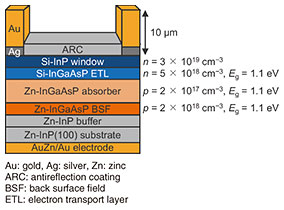
2. Enhancement of illumination tolerance in InGaAsP LPCs2.1 Device design for high-intensity 1000-nm-class laser illuminationFor long-distance OWPT using a 1000-nm-class laser, the receiver must convert high-power monochromatic light into electrical power with minimal loss. Under high-intensity laser illumination, the photocurrent density increases substantially, and even a small series resistance can cause a large voltage drop and output-power loss. Therefore, an LPC for OWPT must be designed not only to absorb the target wavelength efficiently but also suppress resistive loss during high-current operation. Figure 1 shows the device structure of the single-junction InGaAsP LPC designed for 1064-nm laser illumination. The LPC was fabricated on an InP substrate, and lattice-matched InGaAsP was used as the light-absorbing layer. The bandgap of the InGaAsP absorber was adjusted so that photons at 1064 nm could be efficiently converted into electrical energy. An InP window layer and InGaAsP emitter layer were introduced on the incident-light side, while an InGaAsP back-surface-field layer was placed on the rear side. This layer design is intended to promote carrier collection while reducing recombination loss in the absorber. An antireflection coating optimized for 1064 nm was also formed on the device surface to reduce optical reflection at the laser wavelength.
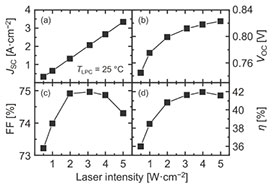
A key feature of this LPC is the use of a thick surface electrode. Under high-intensity laser illumination, the large photocurrent increases resistive loss in the surface electrode, which can reduce the fill factor (FF) and conversion efficiency (η). Increasing the electrode thickness suppresses this loss, although the electrode pattern must still balance low resistance with low optical shading. The LPC was also designed as a 1-cm2-class LPC, rather than a very small mm2-scale device, to evaluate current collection and electrode-resistance effects under conditions closer to those required for practical OWPT receiver panels. 2.2 Photovoltaic performance under high laser intensityThe high-illumination tolerance of the InGaAsP LPC was examined by measuring its device characteristics under 1064-nm laser illumination at different laser intensities (LIs). Figures 2(a)–(d) show the photovoltaic performance of the 1-cm2 InGaAsP LPC under 1064-nm laser illumination as a function of LI. The short-circuit current density (JSC) increased almost proportionally with LI. The external quantum efficiency (EQE) estimated from the JSC–LI relationship was 0.77–0.78 for LI = 0.5–5.0 W·cm−2. The EQE was calculated as EQE = (JSC/LI) × (hc/qλ), where h is the Planck constant, c is the speed of light, q is the elementary charge, and λ is the laser wavelength. These results indicate that the incident laser power was effectively converted into photocurrent over the measured intensity range. The open-circuit voltage (VOC) also increased with LI because of the increase in photogenerated carrier density. These trends confirm that the InGaAsP absorber and optical design are suitable for 1064-nm laser conversion. The FF is a particularly important parameter for evaluating high-intensity operation. Under strong laser illumination, the generated current becomes large, and the voltage loss caused by series resistance increases. If this loss is not sufficiently suppressed, the FF decreases and the η is limited even when the optical absorption and carrier collection are high. In this InGaAsP LPC, the thick surface electrode effectively suppressed the decrease in FF until LI = 3.0 W·cm−2. Therefore, the LPC maintained stable output under high-current operation and achieved a maximum η of 42% at a LI of 4.0 W·cm−2. These results indicate that the reduction in resistive loss is essential for improving the illumination tolerance of LPCs for OWPT.
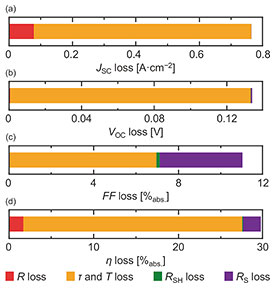
To clarify the origin of the remaining efficiency loss, the contribution of reflectance (R), carrier lifetime and transmittance (τ and T), shunt resistance (RSH), and series resistance (RS) was evaluated from the measured current density versus voltage (J–V) characteristics at LI = 4.0 W·cm−2, as shown in Figs. 3(a)–(d). In this analysis, we adopted a one-diode equivalent circuit model:  where Jph denotes photocurrent density, J0 reverse saturated current density, n ideal factor, kB the Boltzmann constant, and TLPC the LPC temperature. The theoretical limit at LI = 4.0 W·cm−2 was calculated on the basis of the Shockley-Queisser limit. The measured voltage includes not only the intrinsic voltage of the pn junction but also the voltage drops caused by current flow through the electrode, semiconductor layers, and contacts. This voltage drop becomes more significant as the current density increases. Therefore, the difference between the measured J–V curve and series-resistance-free behavior provides a direct indication of how much output power is lost through resistive components. The analysis showed that the ratio of RS loss in FF was 35% in total FF deviation from the theoretical limit (Fig. 3(c)); however, the ratio of RS loss in η was only 7% (Fig. 3(d)). These results suggest that the RS loss was greatly reduced by the thick surface electrode even in a 1-cm2-area device. To further enhance η, recombination of photogenerated carriers should be suppressed according to the one-diode-model-based analysis.
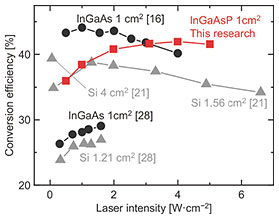
These results provide an important design guideline for practical receiver panels. When the incident laser power is increased to obtain higher electrical output, the photocurrent density also increases, and the allowable series of resistance becomes smaller. Therefore, electrode design, contact resistance, current-spreading layers, and interconnection structures must be optimized together. This 1-cm2 InGaAsP LPC shows that high efficiency can be achieved under high-intensity 1064-nm laser illumination when the device structure is designed to suppress resistive loss. This approach is directly relevant to long-distance OWPT systems, where the receiver must convert high optical power into electrical power efficiently and stably. 2.3 Benchmarking against other LPC technologiesThe performance of LPCs has been widely investigated using various semiconductor materials, laser wavelengths, device areas, and junction configurations. Therefore, benchmarking should be interpreted carefully. A direct comparison based only on the maximum η can be misleading because the output characteristics strongly depend on the laser wavelength, illumination intensity, device area, junction number, temperature, and current-collection design. Small-area LPCs tend to particularly show lower resistive loss, whereas larger-area LPCs are more relevant to practical OWPT receivers but are more strongly affected by current spreading and electrode resistance. For this reason, we focused on single-junction LPCs designed for 1064-nm laser illumination with a device area of 1 cm2 or larger. Under these conditions, Si and InGaAs have been mainly evaluated as receiver materials. A key difference among previously reported 1-cm2-class single-junction LPCs for 1064-nm lasers is the LI at which the maximum η is obtained. In conventional 1064-nm LPCs with a device area of 1 cm2 or larger, η typically reached maximum at approximately 1–2 W·cm−2 (Fig. 4). At higher LIs, the generated photocurrent increased, but the FF decreased because of enhanced RS loss. As a result, η no longer increased with LI, instead became limited by current extraction. In this InGaAsP LPC, the high-illumination tolerance was improved by suppressing the RS loss with a thick surface electrode. This design shifted the optimum operating point to a higher LI and enabled efficient operation up to LI = 4.0 W·cm−2. The LPC achieved a η of 42.0% and FF of 76.7% at LI = 4.0 W·cm−2. To the best of our knowledge, these values represent the highest reported performance for a single-junction LPC designed for 1064-nm laser illumination with an active area of 1 cm2 or larger. The important point is not only the absolute efficiency but also the fact that the maximum efficiency was obtained at a higher LI than in previous 1-cm2-class single-junction LPCs. These results indicate that reducing resistive loss is essential for extending the practical operating range of LPCs toward higher optical input power.
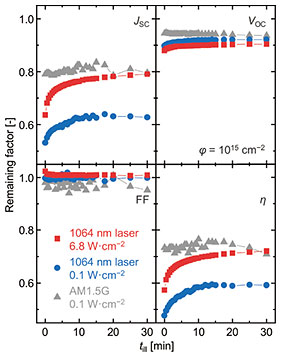
2.4 Potential impact on long-distance OWPT system efficiencyThe improvement in high-illumination tolerance has a direct implication for long-distance OWPT systems. In a practical OWPT link, increasing the incident optical power is effective in increasing the electrical output. However, this also increases the photocurrent generated in the receiver, making resistive loss more severe. Therefore, an LPC optimized only for low-intensity operation may not be suitable for high-power OWPT systems, even if it exhibits high η under moderate illumination. The InGaAsP LPC addresses this issue by maintaining high η under stronger 1064-nm laser illumination. The potential impact can be estimated by considering the recent 1-km OWPT demonstration using a Si-based photovoltaic receiver. The transmitted laser power was 1035 W, and the optical power received by the 60 cm × 60 cm receiver panel was 773 W [5]. The optical power used to evaluate the intrinsic photovoltaic conversion, after excluding losses associated with a module-level factor such as series/parallel interconnection, was 626 W [5]. If the receiver-side photovoltaic conversion were replaced with an InGaAsP LPC operating at 42% efficiency, the electrical output expected from the same 626 W of effective optical power would be approximately 263 W. This value is 1.73 times higher than the reported electrical output of 152 W. This simple estimate indicates that improving the receiver η can directly increase the usable electrical power without increasing the transmitted laser power. The high-illumination tolerance of the InGaAsP LPC can also reduce the required receiver area. In the 1-km demonstration, 773 W of optical power was received by a 60 cm × 60 cm panel, corresponding to an average optical intensity of approximately 0.21 W·cm−2 [5]. In contrast, the InGaAsP LPC maintained high efficiency at LI = 4.0 W·cm−2. If the same received optical power of 773 W could be accepted at this intensity, the required receiver area would be approximately 193 cm2, corresponding to a square receiver with a side length of approximately 14 cm. This represents an approximately 95% reduction in receiver area compared with a 60 cm × 60 cm panel. These estimates are intended to show the potential system-level benefit of high-illumination-tolerant LPCs, rather than to claim direct replacement of the receiver without additional design considerations. In practice, the receiver area, beam size, heat dissipation, optical alignment tolerance, series/parallel interconnection, and safety requirements must be designed together. In particular, concentrating the same optical power onto a smaller receiver increases the thermal load density, and the receiver panel must be designed to dissipate heat while maintaining stable electrical operation. Nevertheless, the estimate clearly shows that a high-efficiency InGaAsP LPC can contribute to both higher electrical output and smaller receiver size in long-distance OWPT systems. Therefore, the significance of the InGaAsP LPC is not limited to the device-level η. By maintaining high efficiency at a higher LI, the LPC can relax the tradeoff between output power and receiver size. This feature is especially important for mobile and space-related OWPT systems, where receiver area, weight, and thermal management capacity are strongly constrained. 3. Radiation tolerance for space-related OWPT applications3.1 Operation-relevant radiation evaluationThe previous section discussed how a high-efficiency InGaAsP LPC can improve receiver-side conversion in long-distance OWPT. For space-related OWPT, however, the receiver must also maintain this performance after exposure to energetic particles. We therefore evaluated the electron-irradiation tolerance of InGaAsP LPCs designed for 1064-nm laser illumination under operation-relevant conditions. The purpose of this evaluation was not only to quantify radiation-induced degradation but also to clarify how it appears under high-intensity monochromatic illumination, which is the actual operating condition of LPCs in OWPT systems. The InGaAsP LPCs with a device area of 0.06 cm2 were irradiated with 1-MeV electrons at a total electron fluence of 1 × 1015 cm−2, which is often used as an accelerated irradiation level corresponding to long-duration space exposure. Their photovoltaic characteristics were measured under 1064-nm laser illumination and under air mass 1.5 global (AM1.5G) illumination. By comparing these illumination conditions, we examined whether the radiation-induced performance loss evaluated under conventional solar-cell-like illumination differs from that observed under OWPT-relevant laser operation. In the evaluation, the LI was also varied to examine whether high-intensity laser illumination changes the apparent degradation behavior. This point is important because practical OWPT receivers are exposed to strong monochromatic light during operation, and the high carrier injection caused by laser illumination can impact recombination processes in the irradiated device. The LPCs were therefore characterized not only immediately after electron irradiation but also during continuous 1064-nm laser illumination, enabling the evaluation of both irradiation-induced degradation and laser-illumination-induced recovery. 3.2 Electron-irradiation degradation and laser-induced recoveryThe electron-irradiation evaluation showed that the performance of InGaAsP LPCs degraded after exposure to 1-MeV electrons. Figure 5 shows how the photovoltaic parameters changed after electron irradiation during continuous illumination. The values are expressed as remaining factors, and till = 0 min represents the initial measurement immediately after the onset of illumination. Electron irradiation mainly reduced JSC and η, indicating that the degradation was primarily caused by reduced carrier collection rather than by increased resistive loss. At till = 0 min, the decreases in JSC and η were larger under 1064-nm laser illumination than under AM1.5G illumination. This difference is explained by the EQE degradation in the long-wavelength region, where photons are absorbed deeper in the InGaAsP absorber. These results suggest that irradiation-induced defects increased recombination in the absorber and reduced the collection of carriers generated by 1064-nm light.
An important feature of LPC operation is that the LPC is continuously illuminated by high-intensity monochromatic laser light during power transmission. We therefore examined whether the irradiated InGaAsP LPC simply remained degraded or whether its performance changed during subsequent illumination. Under 1064-nm laser illumination at LI = 6.8 W·cm−2, the remaining factor of η at till = 0 min was 0.574, which was substantially lower than that under AM1.5G illumination. However, during continuous laser illumination, η gradually recovered and reached a remaining factor of 0.721 at till = 30 min. This value became comparable to the remaining factor under AM1.5G illumination after 30 min, which was approximately 0.71 and showed no meaningful recovery. The recovery of η followed the recovery of JSC: under high-intensity 1064-nm laser illumination, the remaining factor of JSC increased from 0.637 at till = 0 min to 0.791 at till = 30 min, whereas the JSC remaining factor under AM1.5G illumination changed only slightly from 0.791 to 0.796. These results indicate that the apparent radiation degradation of an LPC depends strongly on the illumination condition during operation, and that high-intensity 1064-nm laser illumination can partially recover electron-irradiation-induced performance loss. These results highlight the importance of operation-relevant radiation evaluation for OWPT receivers. If an LPC is evaluated only under conventional solar-cell illumination, the degradation and recovery behavior under actual laser-powered operation may be overlooked. For space-related OWPT systems, this means that radiation qualification should account for not only the accumulated particle fluence but also the wavelength, intensity, and duration of laser illumination during operation. The results also suggest that InGaAsP LPCs are promising for space-related OWPT because they combine high-efficiency 1064-nm conversion with the possibility of partial in-situ recovery under high-intensity laser operation. 4. ConclusionWe summarized our recent progress in InGaAsP LPCs for high-efficiency and durable OWPT receivers. A 1-km OWPT field demonstration showed the feasibility of high-power laser transmission and receiver operation while indicating that receiver-side photovoltaic conversion remains a key factor for improving end-to-end efficiency. To address this issue, we developed a 1-cm2-class single-junction InGaAsP LPC optimized for 1064-nm laser illumination. By combining wavelength-matched absorption with a thick surface electrode for suppressing resistive loss under high-current operation, the LPC achieved a η of 42% at LI = 4.0 W·cm−2. Benchmarking against previously reported 1064-nm single-junction LPCs with device areas of 1 cm2 or larger showed that this LPC shifted the optimum operating point to a higher LI than conventional LPCs, demonstrating improved high-illumination tolerance. A simple system-level estimate based on the 1-km OWPT demonstration suggests that such an LPC could increase the electrical output from 152 W to approximately 263 W for the same effective optical input and reduce the receiver area to approximately 14 cm × 14 cm if 773 W were received at LI = 4.0 W·cm−2. This improvement can contribute not only to higher electrical output from the same transmitted laser power but also to smaller and lighter receiver systems. Such features are important for expanding OWPT applications to areas where wired power delivery is difficult, ranging from ground-based applications, such as remote-area power supply and disaster-response systems, to aerial platforms such as unmanned aerial vehicles and HAPS, and eventually to space-related infrastructure. We also discussed electron-irradiation tolerance as a reliability factor for space-related OWPT. The irradiated InGaAsP LPC showed partial recovery under high-intensity 1064-nm laser illumination, indicating that radiation evaluation should be executed under conditions close to actual OWPT operation. Overall, these results indicate that optimizing the receiver material, electrode design, thermal management, and long-term reliability is essential for improving the efficiency and practicality of future OWPT systems. AcknowledgementsThe authors would like to thank the University of Miyazaki, the Chiba Institute of Technology, and the National Institute of Information and Communications Technology (NICT) for their cooperation in device fabrication. References
|
||||||||||||||||||||||||||||