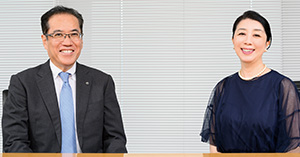
Standing close to communities and connecting technology with communities, people with cities, and the present with the future
—NTT Urban Solutions, Inc. has now entered its eighth year of operations. Would you introduce the company and the Group as a whole?
NTT Urban Solutions was established as an intermediate holding company responsible for the NTT Group’s real-estate and construction businesses. The NTT Group previously included NTT Urban Development, which promoted real-estate development, and NTT FACILITIES, which handled the design, construction, and maintenance of buildings and facilities. With those two companies as its core pillars, the NTT Urban Solutions Group was launched in 2019 with the aim of leveraging the NTT Group’s resources, such as information and communication technology (ICT), real estate, and energy and environmental technologies, to address community challenges and enhance the value of urban spaces. In 2021, it expanded to its current five-entity structure by adding NTT Urban Solutions Research Institute, which provides urban-development consulting, and NTT Urban Value Support, which handles building management and operations.
Now in its eighth year of operation, the NTT Urban Solutions Group is advancing initiatives that extend beyond the traditional boundaries of real estate. These initiatives include not only nationwide real-estate development, design, management, and operations but also the development of an artificial intelligence (AI)-based recommendation app called Personal Agent for Expo 2025 Osaka, Kansai, Japan, business expansion into datacenter engineering, and the development of an indicator to assess the non-energy benefits of energy-efficient buildings. The Group is also pursuing efforts to create a decarbonized society, and as of March 2026, we had achieved 100% renewable-energy usage (in net terms) across our entire portfolio of 273 properties in Japan and abroad.
—Would you tell us about the projects undertaken by the NTT Urban Solutions Group to date?
The NTT Group’s real-estate and construction business began with the construction and management of Group assets (focused on telephone-exchange facilities) and—after the privatization of NTT—expanded into areas such as land utilization centered on office-building development. The NTT Urban Solutions Group has developed a diverse portfolio of assets that includes offices, residences, hotels, commercial facilities, cultural and public facilities, educational and research facilities, and datacenters. While pursuing these developments, the Group has consistently prioritized urban development that reflects the unique character of NTT.
As an example of such developments, Urbannet Sendai-Chuo Building, which opened in 2024 on the site of the former NTT Sendai-Chuo Building, is an iconic project implemented through collaboration among the NTT Group, Sendai City, and Tohoku University. It houses YUI NOS, a hub for co-creation and community engagement, and promotes interaction and co-creation among a diverse range of talent through partnerships with entities such as NTT EAST’s Smart Innovation Lab and Sendai City’s Sendai Startup Studio.
Other notable examples include Patina Osaka, developed on the former site of the NTT WEST headquarters, and Naniwanomiya Ruins Park/nanoniwa, a project advanced as Osaka City’s first Park-PFI (private finance initiative). In conjunction with the opening of Expo 2025, this project attracted a hotel that enhances international competitiveness and helped generate vibrancy across Osaka’s east and west districts. Notably, Patina Osaka was ranked number one in the world—a first for a Japanese hotel—at the Travel + Leisure 2026 World’s Best Awards presented in July 2026.
Another example is HAROW, which opened in Miyazaki City in 2025. Located on the former site of NTT WEST’s Miyazaki Branch, between Miyazaki Station and the main downtown district, the project has boosted pedestrian flow and daily vibrancy in the city center, which had previously been in decline. By utilizing the Group’s corporate real-estate assets, the project developed a container-based commercial facility and renovated office space while keeping investment costs low, which earned high praise from the local community.
Operating across Japan and abroad, the NTT Urban Solutions Group strives to solve community challenges and create value by capitalizing on the history and culture nurtured by each region. We believe the true value of our urban development lies in connecting technology with communities, people with cities, and the present with the future.
—As exemplified by a press conference regarding NTT Hibiya Tower held late last year, the development of the Hibiya area is attracting a lot of attention.
The NTT Hibiya Tower project holds special significance for the NTT Group because the site once housed the headquarters of the former Nippon Telegraph and Telephone Public Corporation and NTT as well as the headquarters of the former NTT Communications. It is thus a location deeply intertwined with the history of the NTT Group and one that holds a very special place in our hearts.
With that historical significance in mind, we wanted to create a “building that symbolizes NTT” through this redevelopment project. The central theme of this project is “powered by the Innovative Optical and Wireless Network (IOWN).” At a press conference in December 2025, where I took the stage alongside NTT President Shimada, we unveiled the concept of “Photonics-Driven Urban Development powered by IOWN” and presented an overview of our urban-development plan, which brings together cutting-edge technologies, including IOWN, from the NTT Group.
By leveraging advanced technologies such as IOWN and AI, we will create new business environments that support global co-creation as well as next-generation lifestyles and entertainment experiences that fuse the physical and virtual worlds. At the same time, we aim to build a sustainable society by balancing energy efficiency and comfort. We will achieve this balance through innovative building design and the use of photonics-electronics convergence devices to drastically reduce power consumption and of AI to optimize energy consumption. Through these efforts, we will create urban spaces where people can experience the NTT Group’s technological capabilities and the city of the future.
Meanwhile, we are not looking solely toward the future. Preserving our history is also a key theme. We are moving forward with plans to preserve “Taizan tiles”—a signature feature of the former NTT Hibiya Building—and incorporate them into the interior of NTT Hibiya Tower. We want to cherish the continuity between the past and the future.
I believe that the experience and insights gained from the NTT Hibiya Tower project can be put to good use in the future urban development envisioned by the NTT Group, which integrates urban development with digital technology, prioritizes environmental considerations, and creates human-centric urban spaces.
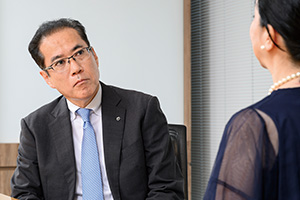
What truly matters is taking an interest in the other person and drawing out their thoughts and feelings
—President Ikeda, would you tell us about your career path at NTT and the lessons learned along the way?
I joined NTT in 1986, a year after the company was privatized. At that time, the telecommunications industry was changing completely, and I chose NTT with the expectation that it would be a company at which I could do something new. I also recall being drawn to NTT because it underpinned vital social infrastructure—telecommunications—and because I had always found it more appealing to work in a way that supports human connections and society from behind the scenes rather than in a way that would put me in the spotlight.
After joining NTT, I did not work in telecommunications per se; instead, I spent many years, primarily in the fields of human resources (HR) and labor management, handling “people-related” roles. The NTT Group has a vast workforce, and I feel that HR and labor management are more about building relationships of trust between people than about creating systems.
I have learned a great deal over those years, but my most significant lesson is that what one can achieve alone is limited. Companies and organizations can only produce results when the efforts of many people come together. I therefore believe it is crucial to remain grateful to those around me and create an environment in which my colleagues can work with a positive mindset.
For that reason, I place great importance on listening to others. People often want to talk about themselves, but I believe what truly matters is taking an interest in the other person and drawing out their thoughts and feelings. I believe the role of a leader is to understand each employee and create an environment in which they can work with a sense of purpose and pride.
A motto I often share is “You cannot change other people or the past, but you can change yourself and the future.” Another one is “Optimism is a matter of will, while pessimism is a matter of mood.” The future is not something to simply wait for; it is something we must carve out through our own determination. I aspire to be a leader who moves forward in step with many others whose collective strength I can draw on.
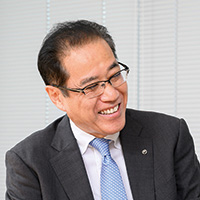
The key players in urban development are the people who live in, work in, and visit the city
—How do you plan to approach the second half of this fiscal year and carry that momentum into the next fiscal year?
The real-estate industry is facing significant challenges, such as soaring construction costs and rising material prices. Nevertheless, thanks to the individual efforts and ingenuity of our employees, our business operations for the current fiscal year have proceeded smoothly.
Our number-one priority is the future that lies ahead. In the real-estate and construction businesses, our current efforts do not yield immediate results; that is, many projects take years—from initial planning to final delivery—to complete. Therefore, we intend to use the second half of fiscal year 2026 not only to achieve near-term results but also to lay the groundwork with an eye toward the next five to ten years.
At the core of this effort is further enhancing synergies with various NTT Group companies. Exemplified by the NTT Hibiya Tower project, our initiatives to implement the NTT Group’s cutting-edge technologies, such as IOWN and AI, in urban spaces are gaining momentum. We aim to create new value that enriches people’s lives and upgrades work styles by integrating urban development with digital technology.
To pave the way for the coming fiscal year, we aim to evolve into a corporate group that transcends the boundaries of the real-estate and construction businesses while addressing societal challenges by integrating ICT, energy, and environmental technologies. Establishing the foundation for this evolution will be a key priority for the second half of the current fiscal year.
—Would you say a few words to the employees, researchers, engineers, and partner companies?
Firstly, I want all our employees to give their full commitment to their work. I have always believed that the ultimate responsibility for results lies with top management. I encourage you to take on new challenges boldly and pursue what you believe is right without fear of failure. I hope you will continue—unconstrained by precedents or established conventions—to strive to create new value.
I encourage researchers and engineers to take an interest in the field of urban development. The NTT Group possesses world-class technologies—including AI, IOWN, datacenters, telecommunications infrastructure, and energy control systems—and we have the platforms to implement these technologies in actual cities and buildings. We want to work together to introduce these technologies into society while creating urban spaces in which residents, workers, and visitors alike can experience true richness and convenience. Rather than letting our research and technologies remain mere development outcomes, we aim to use them to address local community challenges and create new value for cities.
I hope our partner companies will actively make use of our skills and services. The key players in the urban development that we envision are the people who live in, work in, and visit the city. We are eager to collaborate with a wide range of partners—transcending industry and sectoral boundaries—on any initiatives that deliver value to these people. The NTT Group possesses a nationwide network and a reputation built on trust over many years. By combining these strengths with your expertise and technology, we can achieve groundbreaking work. I invite you to reach out to us with any proposals—whether they involve specific technologies or new ideas. I look forward to continuing to take on new challenges with you as partners in shaping the cities of the future.