|
|||||||
|
|
|||||||
|
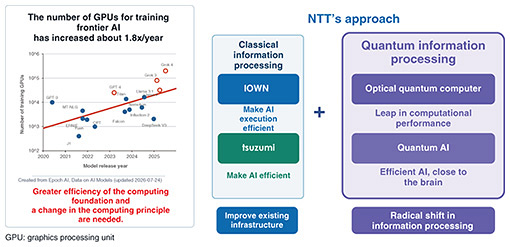
Feature Articles: Pioneering Optical Quantum Computers through Optical Communication Technologies NTT’s Challenge toward the Practical Development of Optical Quantum ComputersAbstractThe spread of artificial intelligence is driving up computational demand and power consumption, while certain problems remain difficult for conventional computers to solve within a practical time. Quantum computers are drawing attention as a new means of computation for such problems. Building on the technologies NTT has cultivated in optical communications and working together with OptQC, we aim to develop an optical quantum computer that is scalable and reliable. This article outlines where quantum computer development stands today, how the optical approach is positioned among the various schemes of quantum computers, and the direction of NTT’s research and development. Keywords: optical quantum computer, fault-tolerant quantum computer, quantum network  1. IntroductionArtificial intelligence (AI) technologies, generative AI in particular, are reshaping how we work and live. Their use now reaches beyond generating text and images into streamlining operations and supporting research and development. Underpinning this progress is the computing infrastructure that processes vast amounts of data. As AI models grow more sophisticated, however, the computational resources they require keep increasing, and the power consumed by datacenters grows with them. Simply adding processors to increase performance will not sustainably meet future computational demand. Some problems also resist a solution no matter how many resources are added. Analyzing the quantum properties of molecules and materials with precision, for example, steeply increases computation as the target becomes larger. Optimization problems that search for a desirable combination among many candidates show a similar explosion in computation. A quantum computer, which exploits the properties of quantum mechanics, is anticipated as a new means of computation suited to such problems. A quantum computer does not accelerate every calculation, though. It is thus necessary to identify the problems for which quantum computation is well suited and divide the roles between quantum and classical computers. For this reason, NTT is continuing to improve the efficiency of its classical information-processing foundation through the development of technologies such as the Innovative Optical and Wireless Network (IOWN) and the large language model tsuzumi while pursuing a fundamental transformation of future information processing through research and development on optical quantum computers and quantum AI (Fig. 1).
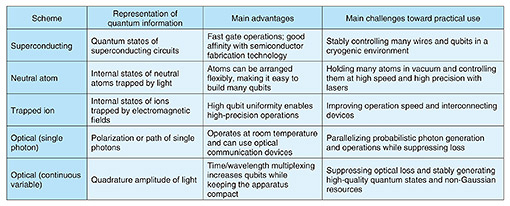
2. Current status and outlook of quantum computer developmentQuantum computers come in several schemes that differ in the physical system used to generate a quantum bit (qubit)*, e.g., superconducting circuits, neutral atoms, trapped ions, and light. Hardware development and cloud-based use are advancing for each scheme, yet a general-purpose, fault-tolerant quantum computer (FTQC) that solves a broad range of practical problems faster and more stably than a conventional computer has not been achieved. The superconducting scheme generates qubits with superconducting electrical circuits. It enables fast quantum operations but requires a cryogenic environment and a large number of control wires. The neutral-atom scheme is distinguished by its ability to arrange many atoms with light, though the atoms in vacuum must be controlled stably and with high precision by laser. The optical scheme operates at room temperature and can draw on devices and multiplexing techniques matured in optical communications; however, reducing optical loss, achieving high-quality quantum states, and generating non-Gaussian resources are important challenges (Table 1).
Each scheme thus has its own strengths and challenges to solve. There is currently no single scheme that is superior across all the axes of evaluation. Every scheme is at the stage of competing to see whether it can enable the development of an FTQC by drawing on its particular strengths. NTT is developing a continuous-variable optical quantum computer that encodes quantum information in the amplitude of light. In this scheme, pulses of squeezed light are lined up in time and passed through an optical circuit to generate a large-scale entangled state. The quadrature amplitude of each optical pulse is then measured sequentially, and the conditions for subsequent measurements are changed according to the measurement results, thus advancing the computation. Because the optical pulses can be multiplexed in the time direction, increasing the number of qubits used for computation does not require increasing the number of light sources or the scale of the main optical circuit by the same proportion. To develop an FTQC with one million physical qubits by 2030, NTT has begun collaborating with OptQC, a startup originating from the University of Tokyo [1, 2]. By fusing the light generation, transmission, and measurement technologies NTT has cultivated in optical communications research with the design and implementation technologies of OptQC for continuous-variable optical quantum computers, we aim to develop a system that can be scaled up in computational size and operate stably over long periods.
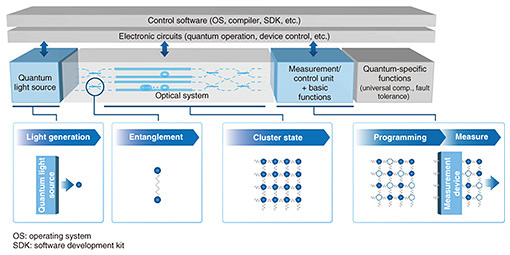
3. Bringing optical communication technology to quantum computing—NTT’s approachIn an optical quantum computer, a large-scale entangled state is created from light produced by a quantum light source, and computation is carried out by measuring that light sequentially. The measurement results are processed by electronic circuits and reflected in the conditions for subsequent measurements. Control software bridges the control of the apparatus and the execution of the quantum program. Because these elements operate in concert, computational performance depends not only on the quality of the quantum light but also on the loss in the optical circuit and on the performance of measurement and control (Fig. 2).
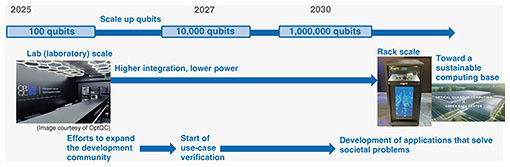
In the continuous-variable scheme in particular, the quality of squeezing and optical loss strongly govern computational accuracy. Even when a quantum light source generates a good state, light lost during transmission or measurement increases quantum noise and degrades accuracy. Stably generating a large-scale entangled state also requires keeping the phases of many optical pulses aligned with high precision. Maintaining these conditions over long periods calls for design and control technologies that keep the whole apparatus running stably, in addition to device performance. These challenges share common ground with the research and development of optical communication systems. To achieve long-distance, high-capacity communications, NTT has refined techniques for transmitting optical signals with low loss. We have also expanded transmission capacity through optical amplification and wavelength multiplexing and increased the amount of information per wavelength through coherent detection and high-speed digital signal processing. Quantum computation must handle quantum noise, but the foundational technologies for stably generating, transmitting, and measuring light are shared. The optical parametric amplifier used to generate squeezed light, for example, has long served in optical communications for repeater signal amplification and wavelength conversion. Executing optical parametric amplification before measuring a quantum signal may also make it possible to use the high-speed optical detectors developed for communications. Combining time multiplexing with wavelength multiplexing, moreover, increases the number of qubits accommodated in a single optical path. Applying such optical-communication-related technologies for higher speed and larger scale can be counted among the strengths of the optical scheme. Increasing the number of qubits alone, however, does not make a practical quantum computer. It is necessary to achieve fault-tolerant quantum computing that corrects the errors arising from optical loss and finite squeezing and keeps the computation going. By leveraging NTT’s theoretical research on quantum error correction and its knowledge of error-correction processing for optical communications, we aim to accelerate the development of an FTQC. 4. Toward true practical implementationTruly putting a quantum computer to practical use requires developing applications that lead to the solution of societal problems in parallel with improving the performance of the apparatus. Rather than waiting for large-scale computational power to be achieved, it is important to work from an early stage with partners who tackle real operational problems and verify the problems for which quantum computation is effective. Molecular and materials simulation and combinatorial optimization are among the applications under consideration for quantum computation. Even where speed-up is possible in theory, the overall processing does not necessarily surpass classical computation, because preparing the input data and reading out the results also take time. It is thus necessary to define the scale of the target problem and the accuracy required, estimate the number of logical qubits and the number of quantum operations needed, then compare with classical computation. To advance this verification, NTT is promoting collaboration with universities, research institutions, and partner companies in addition to OptQC. By running the verification of quantum-application research results on real hardware in parallel with reflecting the requirements for solving practical problems in the development of the apparatus, we seek an early path to true practical implementation (Fig. 3).
A future optical quantum computer should not be large or demand special conditions but be a computing resource that can be operated stably in a variety of datacenters. We therefore also aim to develop technologies for integrating it at the rack scale and enabling energy-efficient, stable operation. Quantum computation does not stand alone either; classical computational resources are also needed to divide problems, process results, and store data. We aim for a configuration in which an optical quantum computer is used as a quantum computation accelerator connected to the optical computing foundation of IOWN and linked at high speed with the classical computational resources required. 5. ConclusionAn optical quantum computer operates at room temperature, can scale up its computational power through the multiplexing approach of optical communications, and is expected to draw on the technologies NTT has cultivated in the field of optical communications. Developing an FTQC, on the other hand, requires solving a variety of problems. It is also necessary to clarify, through practical problems, the conditions under which quantum computation creates value. At NTT, we are advancing integrated research and development toward the development of a practical optical quantum computer—spanning the high-quality quantum-light-source device technology and high-speed quantum-signal detection technology that form the basis of scaling up and fault tolerance, the theoretical research on error-correction algorithms, and the research on application software. We are also researching the quantum communication technologies that will support a future optical-quantum-computer network. With the technologies we have cultivated to push the limits of optical communications at its core, NTT is setting out to open up this entirely new world of quantum computation. Our goal is to establish it not as a technology of the distant future but as a computing infrastructure that supports a sustainable society and contributes to solving real-world societal problems. Crossing the boundaries of fields and organizations, we will take on the development of a practical optical quantum computer through collaboration with a wide range of partners. References
|
|||||||