|
|||||||||||||
|
|
|||||||||||||
        |
Feature Articles: Pioneering Optical Quantum Computers through Optical Communication Technologies Broadband, High-level Squeezed-light Source Technology toward Large-scale, Fault-tolerant Optical Quantum ComputersAbstractBroad bandwidth and high squeezing levels are key to scaling continuous-variable optical quantum computers and enabling fault-tolerant operation. This article explains squeezed-light generation using optical parametric amplifiers based on periodically poled lithium niobate waveguides. It describes the achievement of more than 10 dB of squeezing through low-loss waveguide fabrication and high-precision phase stabilization, as well as an ultrabroadband squeezed-light source with a bandwidth of over 6 THz. Applications of these technologies to optical quantum computers and future prospects for large-scale, high-speed, fault-tolerant optical quantum information processing are also discussed. Keywords: squeezed light, optical parametric amplifier, periodically poled lithium niobate
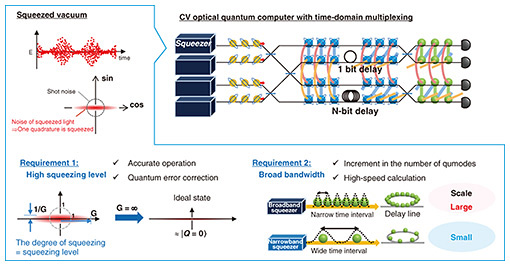
1. IntroductionIn continuous-variable (CV) optical quantum computers, squeezed light is used as one of the most important resource states for quantum computation. Squeezed light is a nonclassical quantum state in which quantum fluctuations, or quantum noise, in one quadrature component of an optical field are suppressed below the shot-noise level (Fig. 1). Under the uncertainty principle of quantum mechanics, the fluctuations in two orthogonal quadratures cannot be reduced simultaneously.
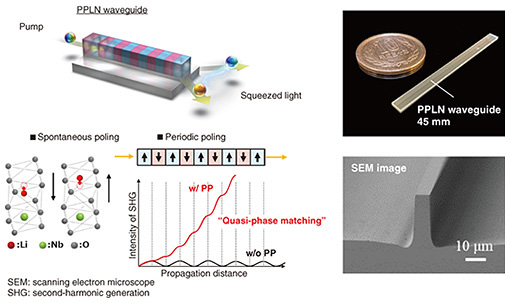
In a time-domain-multiplexed CV optical quantum computer [1], squeezed light is generated continuously and used to construct a large-scale entangled state, known as a cluster state, through a delay-line interferometer. The number of temporal modes that can be retained in the optical fiber used for longer delay line determines the scale of the generated cluster state. It is therefore important to define optical wave packets at short-time intervals, and this performance is governed by the bandwidth of the squeezed-light source. A broader bandwidth enables shorter squeezed-light wave packets, allowing for more quantum modes to be stored in an optical fiber of the same length, thus supporting larger and faster optical quantum computers. A high squeezing level is also required. The squeezing level indicates how strongly quantum fluctuations are suppressed relative to shot noise. A higher value means that the resource state contains less excess quantum noise. In CV quantum computation, residual quantum noise accumulates as computational error, so achieving a high squeezing level is essential for fault-tolerant quantum computation. In quantum error correction based on the Gottesman–Kitaev–Preskill code, a squeezing level exceeding 10 dB has recently become an important target. For time-domain-multiplexed optical quantum computers, therefore, broad bandwidth is key to scalability and high-speed operation, while high squeezing is key to fault tolerance. However, it is generally difficult to achieve both simultaneously. Using an optical cavity to obtain high squeezing limits the bandwidth to the cavity linewidth, whereas prioritizing broad bandwidth makes it difficult to obtain sufficiently strong nonlinear interaction. Developing a squeezed-light source that combines broad bandwidth with high squeezing is therefore a central challenge in current CV optical quantum computing research. In this article, we present a broadband squeezed-light source based on a periodically poled lithium niobate (PPLN)-waveguide optical parametric amplifier (OPA), demonstrating over 10 dB of squeezing and an ultrabroad bandwidth exceeding 6 THz, both of which are essential for scalable and fault-tolerant optical quantum computing. 2. PPLN-waveguide OPAsSqueezed light is generated using nonlinear optical effects. Representative methods include four-wave mixing based on the third-order nonlinear optical effect (χ(3)) and parametric down-conversion based on the second-order nonlinear optical effect (χ(2)). Squeezed-light sources for CV optical quantum computers now widely use second-order nonlinear optics because it provides a larger nonlinear coefficient and facilitates separation of the pump light from the quantum light. One of the basic devices based on second-order nonlinear optics is an OPA. An OPA can amplify or de-amplify the quantum fluctuations of a signal field in a phase-sensitive manner, generating squeezed light. Highly efficient squeezed-light generation requires both a material with a large second-order nonlinear coefficient and high-accuracy phase-matching technology. PPLN waveguides have been researched as the nonlinear medium for OPAs. Lithium niobate has a large second-order nonlinear optical coefficient. By periodically reversing its spontaneous polarization, quasi-phase matching can be achieved. This maintains nonlinear interaction over a long distance that would otherwise be lost through phase mismatch, enabling highly efficient parametric amplification (Fig. 2).
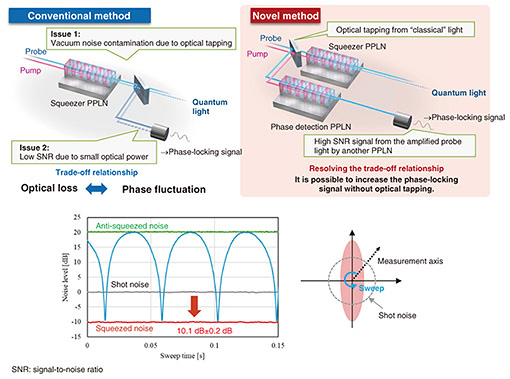
The waveguide structure confines light within a cross section only a few micrometers across while providing an interaction length of several centimeters. It therefore achieves much more efficient nonlinear interaction than a bulk crystal. PPLN waveguides have been researched and developed as nonlinear optical devices, including OPAs and wavelength converters, for optical communications. Over many years, NTT has accumulated technologies for low-loss waveguide formation, high-quality periodic poling, and efficient optical-fiber coupling. Because these technologies can also be applied directly to squeezed-light sources, NTT is extending device technologies developed for optical communications to quantum information processing. A waveguide OPA also differs substantially from the optical-cavity squeezed-light sources that have conventionally been used. Although an optical-cavity source can readily provide a high squeezing level, its bandwidth is limited by the cavity linewidth, which constrains the broad bandwidth required for time-domain-multiplexed quantum computation. A waveguide OPA requires no optical cavity and can generate extremely broadband squeezed light over the available phase-matching bandwidth. This is a major advantage in obtaining an ultrabroadband squeezed-light source for time-domain-multiplexed optical quantum computers. However, a highly efficient PPLN waveguide alone is not sufficient to complete a high-quality squeezed-light source. Achieving a high squeezing level requires not only stronger nonlinear interaction but also lower propagation loss in the waveguide, lower loss throughout the optical system, and high-precision phase stabilization. The following section describes our technologies for generating and detecting high-level squeezed light. 3. Broadband, high-level squeezed-light generationThe squeezing level is limited by many factors, including the strength of the nonlinear interaction, propagation loss in the waveguide, loss throughout the optical system, detection efficiency of the receiver, and fluctuations in the measurement phase. Obtaining a high-squeezing source therefore requires overall optimization of the device, optical system, and control technology. Low-loss waveguides are the first important requirement. Squeezed light is extremely sensitive to optical loss, and even slight propagation loss in a waveguide can substantially reduce the observed squeezing level. In addition to increasing nonlinear efficiency, the loss of the waveguide must therefore be minimized. For PPLN-waveguide fabrication, NTT uses mechanical machining with a dicing saw instead of the commonly used dry-etching process. Dicing-saw machining reduces the surface roughness of the waveguide sidewalls, thus suppressing scattering loss. The fabricated waveguides have been shown to exhibit lower loss than conventional structures while retaining highly efficient optical parametric amplification [2]. This waveguide technology has become an important foundation for subsequent improvements in squeezing. In the high-squeezing regime, controlling the relative phases of the pump light, squeezed light, and local-oscillator light used for homodyne detection is also important. Strong squeezing is necessarily accompanied by a large anti-squeezed component, so even a slight relative-phase fluctuation can substantially degrade the observed squeezing level. Above 10 dB, phase fluctuations of only a few milliradians cause pronounced degradation, making high-precision phase stabilization indispensable. Conventionally, a probe beam used as the phase reference is injected into the PPLN together with the pump beam. Part of the output optical signal from the squeezed-light-generating PPLN is tapped to generate a phase-error signal from the detected probe beam. Because this method also extracts part of the squeezed light, the tapped optical power has to be kept low. Reducing that power, however, degrades the signal-to-noise ratio of the phase-error signal and impedes high-precision phase control. To resolve this trade-off between optical loss and phase-error degradation, our group adopted a novel phase-locking method using a separate PPLN device dedicated to generating the phase-error signal [3] (Fig. 3). The method generates a high-power phase-error signal without introducing loss into the squeezed light, enabling measurements with smaller phase error than before.
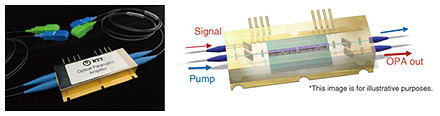
By combining the low-loss waveguide technology with high-precision phase stabilization, our group recently directly observed more than 10 dB of squeezing from a waveguide OPA [3]. This result represents world-leading performance for a waveguide squeezed-light source and demonstrates the squeezing level approaching fault-tolerant CV quantum computation. Furthermore, as mentioned above, time-domain-multiplexed optical quantum computers require not only high squeezing level but also broad bandwidth. Here, we evaluated the bandwidth of the squeezed light generated using a PPLN waveguide fabricated by the same method as that used in the above experiment and demonstrated a broad bandwidth of 6 THz [2]. This bandwidth greatly exceeds that of conventional optical-cavity squeezed-light sources and indicates the source’s suitability as an ultrabroadband source for time-domain-multiplexed optical quantum computation. Exploiting this broad bandwidth has also enabled high-speed generation of non-Gaussian states, including Schrödinger cat states, which are essential for universal quantum computation [4]. 4. Initiatives toward practical optical quantum computersApplying squeezed-light sources to practical optical quantum computers requires high stability and reproducibility in addition to high performance. NTT has developed optical modules in which PPLN waveguides are connected to optical fibers with high precision, obtaining squeezed-light sources that operate stably for long periods (Fig. 4). In addition to reducing size, waveguide modularization minimizes optical-axis adjustment and improves stability against environmental changes and maintainability. Such technologies are expected to play an important role in future optical quantum computers that use many squeezed-light sources in parallel.
Using this source, operation of a time-domain-multiplexed CV optical quantum computer began at RIKEN in 2025 [5]. This system can execute linear quantum operations on 101 modes and is planned to be extended toward universal quantum computation. 5. Summary and outlookThis article described the generation of broadband, high-level squeezed light using PPLN waveguides, which provides a crucial resource for CV optical quantum technologies. The PPLN-waveguide technology presented in this article is a representative example of extending nonlinear optical-device technologies cultivated in optical communications to quantum information processing. NTT will continue advancing bandwidth, squeezing level, and photonic integration to help put large-scale, high-speed, fault-tolerant optical quantum computers into practical use. References
|
||||||||||||