|
|||||||||||||||||||||||||||||||||
|
|
|||||||||||||||||||||||||||||||||
        |
Feature Articles: Pioneering Optical Quantum Computers through Optical Communication Technologies Real-time High-speed Quantum-signal Detection Technology for Ultra-fast Optical Quantum ComputersAbstractBroadband quantum-signal detection is essential for increasing the operating speed of measurement-based optical quantum computers. However, quantum states are extremely vulnerable to optical loss, making it difficult to directly use broadband homodyne detectors developed for high-speed optical communications. This article introduces a high-speed quantum-signal detection technology that uses optical parametric amplification to make quantum states tolerant to downstream loss. This technology enables real-time quantum-signal measurement with a 43-GHz-bandwidth homodyne detector. It also describes its application to Einstein–Podolsky–Rosen entangled states and Schrödinger cat states and discusses prospects for extending the detection bandwidth to the 100-GHz class and scaling the system through wavelength-division multiplexing. Keywords: optical quantum computer, high-speed quantum-signal detection, optical parametric amplification
1. IntroductionContinuous-variable optical quantum computers are regarded as promising for large-scale, high-speed quantum operations through measurement-based quantum computing (MBQC)*1 [1]. Further increases in quantum-computation speed require both broadband quantum-light sources and correspondingly broadband quantum-signal detection technology. NTT has developed an ultra-broadband squeezed-light source*2 covering frequencies from direct current to 6 THz by using an optical parametric amplifier (OPA)*3 based on a periodically poled lithium niobate (PPLN) waveguide*4 [2]. This source is a key element for high-speed MBQC operating at a high clock rate. Quantum states, however, are readily degraded even by small optical losses. Conventional experiments have therefore required low-loss homodyne detectors*5, the bandwidths of which have been limited to several gigahertz. Homodyne detectors for optical communications can operate over bandwidths of several tens of gigahertz or more, but their loss is too high for direct measurement of quantum states. Although broadband quantum-light sources had become available, quantum-signal detection has remained a bottleneck to higher-speed operation. We describe a high-speed quantum-signal detection technology developed to overcome this problem. Before detection, the quantum signal is amplified through optical parametric amplification, thus converting it into a state that is less susceptible to optical loss in the downstream detection system. This makes it possible to apply a fast but relatively lossy homodyne detector developed for optical communications to quantum-state measurement. We also describe real-time quantum-signal measurement at 43 GHz, observation of ultra-fast entangled states, and prospects for scaling through 100-GHz-class detection and wavelength-division multiplexing (WDM)*6.
2. Challenges in high-speed quantum-signal detectionIn MBQC, homodyne detection is repeatedly executed on a quantum-entangled state prepared in advance, and each measurement result is fed forward to subsequent quantum operations. A homodyne detector is therefore not merely a measuring instrument but an essential component that executes quantum computation. Its operating speed directly affects the processing speed of an optical quantum computer. Increasing that speed requires both broadband quantum-light sources and high-speed quantum-signal detection technology matched to those sources. NTT has established a foundation for generating high-speed quantum signals by using a PPLN waveguide-based OPA to produce broadband squeezed light extending into the terahertz range. Although this provides the quantum-light source required for high-speed operation, a detection technology of commensurate speed is needed to fully exploit the source performance. Quantum-state detection presents challenges that differ from those in classical optical communications. In homodyne detection, signal light interferes with local oscillator (LO) light*7, and the quantum state is read from the differential signal. Even a small optical loss in the detector or optical system introduces vacuum fluctuations and irreversibly degrades quantum states such as squeezed light and entanglement. Because lost quantum information cannot be recovered by downstream signal processing, homodyne detectors require extremely high detection efficiency and low loss. Conventional quantum-signal detection has therefore used low-loss homodyne detectors, but their bandwidths have been limited to several gigahertz, restricting further increases in speed. By contrast, broadband homodyne detectors exceeding several tens of gigahertz are in practical use in optical communications. Their designs prioritize high-speed operation and do not satisfy the low-loss requirement for quantum-state measurement, so they could not previously be applied directly to quantum-signal detection. Thus, despite the availability of fast homodyne detectors, detectors prevented their use for quantum-state measurement and made detection a bottleneck in accelerating optical quantum computers.
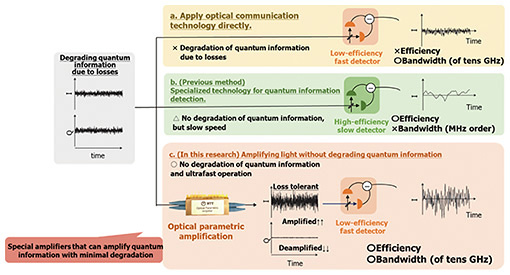
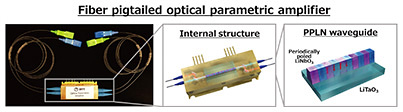
3. High-speed quantum-signal detection using optical parametric amplificationTo address this issue, we proposed a new quantum-state measurement scheme using an OPA (Fig. 1) [3]. This scheme requires an OPA with a low noise figure and high gain. We use a PPLN waveguide-based OPA that NTT has been researching and developing for over 25 years (Fig. 2).
In conventional homodyne detection, a quantum signal is input directly to the homodyne detector, so optical loss in and around the detector directly degrades the quantum state. A low-loss homodyne detector is therefore required for quantum-signal detection, making it difficult to use a high-speed detector designed for optical communications. In our scheme, an OPA is placed before the homodyne detector to optically apply phase-sensitive amplification*8 to the quantum signal. Through nonlinear optical interaction with pump light, the OPA amplifies one quadrature component while de-amplifying the other. Phase-sensitive amplification can selectively amplify the quadrature to be measured, increasing the signal level while preserving the quantum information. Amplifying the quantum signal to a sufficiently high optical power before homodyne detection also substantially reduces the effect of optical loss in the downstream detection system. In other words, the amplified signal becomes highly tolerant of losses in the detector and optical components that would otherwise degrade the quantum state. This enabled, for the first time, quantum-signal detection using a high-speed homodyne detector developed for optical communications that had previously been unsuitable for quantum-state measurement. The central feature of this scheme is not the development of a new high-speed homodyne detector. Rather, the OPA provides the quantum state with loss tolerance, enabling existing high-speed optical-communication technology to be used for quantum-signal detection. It transforms a technology previously regarded as fast but unusable for quantum measurement into one that is both fast and suitable for such measurement. By leveraging high-speed homodyne-detection technology cultivated in optical communications, the scheme establishes a new detection platform for accelerating optical quantum computers.
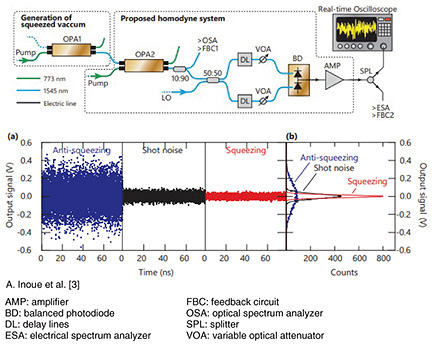
4. Demonstration and applications of high-speed quantum-signal detectionTo verify our scheme, we conducted real-time quantum-signal measurements using a high-speed homodyne detector developed for optical communications (Fig. 3). After phase-sensitive amplification of the quantum signal with an OPA, measurement with a commercially available 43-GHz-bandwidth homodyne detector enabled real-time measurement of approximately 5-dB squeezed light [3]. This extended the quantum-signal detection bandwidth from the conventional range of several gigahertz to 43 GHz and demonstrated for the first time that a high-speed homodyne detector developed for optical communications can be used to measure quantum states. This proof of principle is an important milestone toward increasing the processing speed of optical quantum computers.
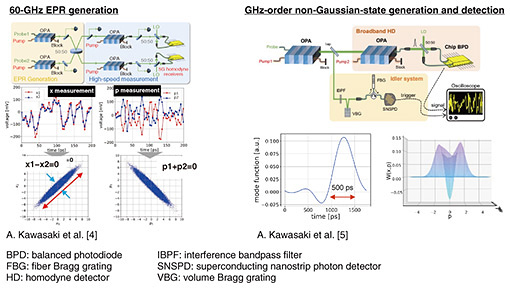
Building on this result, our scheme has been extended to measuring ultra-fast quantum states (Fig. 4). Using this high-speed quantum-signal detection technology, we achieved real-time measurement of an Einstein–Podolsky–Rosen (EPR) entangled state*9 generated with a temporal width of approximately 40 ps [4]. EPR entanglement is a fundamental quantum resource for continuous-variable quantum information processing, including quantum teleportation and MBQC. Such rapidly varying quantum states were difficult to measure directly with conventional low-speed homodyne detectors. The high-speed quantum-signal detection technology demonstrated real-time evaluation of quantum states on the picosecond scale, an important step toward high-clock-rate measurement-based optical quantum computers.
This high-speed quantum-signal detection technology has also been applied to high-speed measurement of Schrödinger cat states*10, important non-Gaussian quantum states in continuous-variable quantum information processing. These states are representative non-Gaussian resources expected to support fault-tolerant quantum computing and quantum error correction, and their generation and measurement are major research topics. Application of this technology showed that such non-Gaussian quantum states can also be measured at high speed [5]. The high-speed quantum-signal detection technology has thus developed from a method for measuring squeezed light into a versatile high-speed detection platform applicable to diverse quantum states, including EPR entangled states and Schrödinger cat states. Combined with still faster homodyne detectors, it is expected to provide foundational technology for further accelerating measurement-based optical quantum computers.
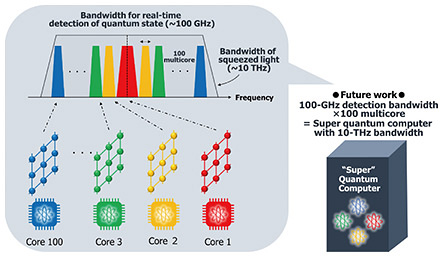
5. Future prospectsThe high-speed quantum-signal detection technology enables a homodyne detector developed for optical communications to measure quantum states and has achieved real-time quantum-signal measurement over a 43-GHz bandwidth. Its application has also expanded to diverse states, including EPR entangled states and Schrödinger cat states. Further acceleration of measurement-based optical quantum computers will require extending homodyne-detector bandwidths to the 100-GHz class. High-speed receiving devices in this class are being developed for optical communications. Applying our scheme may enable these devices to be used for quantum-signal detection. A 100-GHz-class detection bandwidth is expected to raise the operating clock of measurement-based optical quantum computers and substantially increase the amount of quantum information processed per unit time. Integration with WDM technology, which is widely used in optical communications, is also promising. The high-speed quantum-signal detection technology has increased speed in the time domain; simultaneous use of multiple wavelength channels would add parallelism in the wavelength domain (Fig. 5). Combining time- and wavelength-domain multiplexing for large-scale operation could dramatically increase quantum-information-processing capacity. High-speed homodyne detection will also be important as a platform for measuring such broadband, multichannel quantum signals.
We will continue integrating high-speed optical-communication technology with optical quantum technology. By advancing 100-GHz-class homodyne detection and integration with WDM, we aim to contribute to high-speed, large-scale measurement-based optical quantum computers.
These results were obtained in collaboration with the Furusawa Laboratory at the University of Tokyo. Part of this research was supported by the Japan Science and Technology Agency Moonshot Research and Development Program. References
|
||||||||||||||||||||||||||||||||