|
|||||||||||
|
|
|||||||||||
        |
Global Standardization Activities Latest Trends in TM Forum—Growing Adoption of Autonomous Network CertificationAbstractSince its establishment in 1988, TM Forum has expanded its scope from the standardization of telecom-business support systems and operations support systems to digital business, including network virtualization, cross-industry collaboration, and revenue growth through digital transformation. Its activities have recently focused on autonomous networks, which aim to automate network operations using artificial intelligence (AI), as well as requirements for trustworthiness, security, and information governance of AI and AI agents. TM Forum is also advancing the standardization of data architecture for AI. Through activities at TM Forum, NTT Group is incorporating its technical and business requirements into industry standards while exploring autonomous operations and AI agent use. Keywords: TM Forum, autonomous networks, AI and AI agents
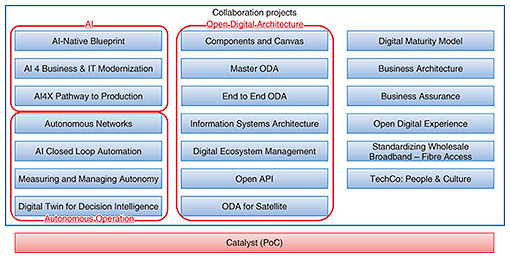
1. What is TM Forum?Established in 1988, TM Forum [1] is a global industry association for telecommunications operations with more than 800 member companies. Historically, TM Forum focused on business support systems (BSS) and operations support systems (OSS) that enable the operation and management of telecommunications services. Through these activities, it has developed a wide range of assets, including business process frameworks and information and data models. TM Forum has expanded its focus to digital business, including collaboration aimed at enabling network virtualization and helping companies generate additional revenue through digital transformation. TM Forum currently pursues three key missions: 1) composable information technology (IT) and ecosystems, 2) autonomous networks (AN), and 3) trustworthy artificial intelligence (AI) and data. It promotes the transformation of the telecommunications industry through standardization discussions conducted in collaboration projects, as illustrated in Fig. 1, proof-of-concept (PoC) activities known as Catalyst projects, and Innovation Hubs, where participants develop solutions on the basis of TM Forum standards and discuss related frameworks.
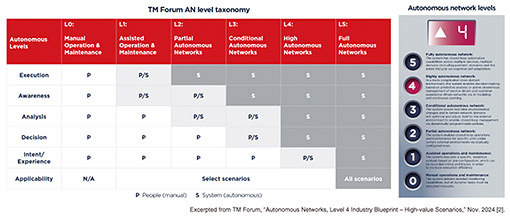
2. Collaboration projects2.1 AN projectANs deliver zero-wait, zero-touch, and zero-trouble user experiences through intelligent, autonomous operations. TM Forum has standardized various elements required to achieve autonomous operations, including an overall architecture, models, and application programming interfaces (APIs) for intent, which represents the objectives to be achieved through autonomous automation, as well as definitions of automation levels and methods for assessing them. Autonomous network levels (ANLs) provide a framework for evaluating the level of autonomy and automation in network operations on a six-level scale, ranging from Levels 0 to 5. Figure 2 shows the definition of each ANL [2]. TM Forum assesses the ANL from five perspectives: execution, awareness, analysis, decision, and intent/experience.
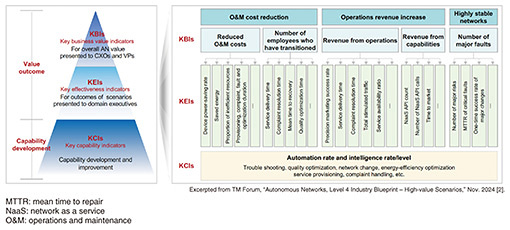
The key difference between Level 4, which is currently the highest level eligible for certification, and Level 3 is whether network operations can autonomously and automatically fulfill user intent. Focusing on this distinction, we are studying technologies for extracting intent [3]. The cumulative number of official ANL certifications has increased significantly, from 3 in 2024 to 96 as of June 2026. At DTW Ignite, one of the TM Forum events held in 2026, 38 new certifications were announced, 14 of which were for Level 4. TM Forum has been working not only on ANL assessment criteria but also on business value measurement (BVM), a set of quantitative metrics for evaluating the business value delivered by AN. Figure 3 shows TM Forum’s BVM framework. The framework is being developed to define three types of indicators: key capability indicators (KCIs), which measure autonomous operations capabilities; key effectiveness indicators (KEIs), which measure improvements in operational effectiveness; and key business indicators (KBIs), which measure the resulting business value.
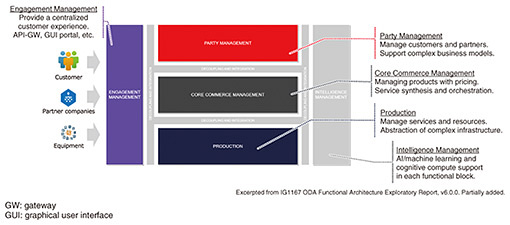
The AN project is currently advancing several discussions in parallel. These include discussions on architecture incorporating AI, such as how AN can be implemented using AI and agentic AI; ontology-based approaches to modeling intent, which represents the objectives to be achieved by AN; and assessment criteria for ANL certification. Discussions on AN had been led primarily by participants from Asia and Europe. However, interest in AN among North American communications service providers has grown, and they have begun participating in these discussions. Discussions have also intensified on autonomous operation scenarios that use generative AI and AI agents. To achieve autonomous operations by coordinating multiple AI systems and AI agents, participants are discussing protocols for communication and coordination among different AI systems and agents, including agent-to-agent protocols. The trustworthiness and traceability of AI systems and AI agents are also important topics under consideration. As part of the discussions on AI and AI agent trustworthiness, the concept of adaptive governance has been proposed. This concept dynamically adjusts the operation of AI systems and AI agents along three dimensions: autonomy, trust, and control. When the level of trust in an AI system or AI agent decreases, its degree of autonomy is reduced, and the level of human control is increased. Depending on the circumstances, operations may transition to a human-in-the-loop approach, in which human judgment is incorporated into the decision-making process. 2.2 Other projectsIn addition to the AN project, standardization discussions are under way in approximately 20 collaboration projects. This section introduces some of the key topics being discussed in these projects. AI-focused projects, such as AI 4 Business & IT Modernization, AI-Native Blueprint, and AI4X Pathway to Production, are examining information security and information governance requirements for the use of AI and AI agents. They are also discussing data architecture designed to support the effective use of AI. The Digital Twin for Decision Intelligence project is exploring how digital twins can be used to support decision-making within operational processes. Its discussions cover topics such as data architecture and relevant use cases. Projects related to the Open Digital Architecture (ODA), including Components and Canvas, End to End ODA, Information Systems Architecture, and Master ODA, are discussing how AI adoption and business collaboration can be enabled within BSS/OSS architectures based on the ODA functional architecture shown in Fig. 4. These projects are also exploring the use of ODA components, which serve as reference implementations of the ODA.
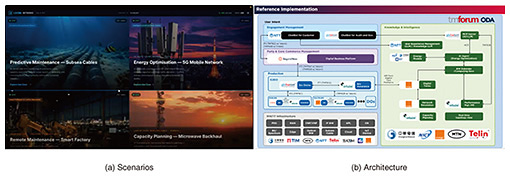
3. Catalyst projectsIn addition to collaboration projects, which develop industry standards, TM Forum conducts PoC initiatives known as Catalyst projects. A distinctive feature of these projects is that they demonstrate both the feasibility of implementing TM Forum standards and the business value that can be delivered through their application. At DTW Ignite, 59 Catalyst projects presented their PoC demonstrations, attracting approximately 1350 participants from more than 250 companies. More than half the demonstrations featured solutions combining agentic AI, AN, intent, and digital twins, highlighting the strong and growing industry interest in AI and AN. 3.1 Catalyst example: Living NetworksNTT Group is participating in the Living Networks Catalyst [4] in collaboration with 14 companies, including Telin, Orange, Verizon, Chunghwa Telecom, TIM, Beyond Now, and Infosim, as illustrated in Fig. 5. The Catalyst is implementing and validating AI-based solutions for automating and enhancing operations to achieve end-to-end ANL 4 across four use cases: automated maintenance of submarine cables, energy optimization in fifth-generation mobile communications networks (5G), remote maintenance of smart factories, and capacity planning for radio base stations.
NTT Group is focusing particularly on remote maintenance of smart factories. A chatbot is used to extract user requirements as intent. The information required for various communications configurations associated with network-service activation is then conveyed through a digital business platform. When changes in network performance or conditions are detected, the network autonomously takes corrective action to improve its status and reports the results to the user as necessary. Through collaboration with the other participating companies, NTT Group is verifying the feasibility of implementing the current standards, identifying additional standards that will be required in the future, and building broader support for the relevant technical requirements and use cases. The outcomes of these activities are used to develop contributions for future standardization. 4. ConclusionNTT Group considers discussions on intent models to be particularly important for ensuring alignment with 3rd Generation Partnership Project (3GPP) standardization activities for 6G. The TMF 921 Intent Management API is making it increasingly possible to implement intent-driven automation processes in the operations domain. Within this end-to-end process, AN operations in future 6G networks will require coordination with network domains such as radio access networks and core networks. Intent information defined within the 3GPP framework must therefore be communicated appropriately from TM Forum-based systems in the operations domain to the relevant network domains. NTT Group is promoting standardization activities so that future networks, including 6G networks, can flexibly provide network services that satisfy a diverse range of service requirements and user needs. References
|
||||||||||