|
|||||||||||||||||||
|
|
|||||||||||||||||||
        |
Regular Articles Applying Pupil-based Attention Estimation to VR Safety TrainingAbstractNTT Access Network Service Systems Laboratories, in collaboration with NTT Communication Science Laboratories, is conducting research on technologies for capturing workers’ attention states, which are related to hazard awareness and decision-making, from eye-tracking and related information and applying these technologies to safety training. This article introduces a virtual-reality training system developed to improve workers’ safety awareness. By leveraging findings from fundamental research on pupil-size fluctuations and short-term attentional states to address challenges in safety education, this system evaluates attention states in terms of hazardous areas during visual inspection and supports post-training review. Keywords: operation, pupil diameter, safety training
1. Issues with safety education for on-site workThe use of digital technologies has expanded across society, and telecommunications infrastructure has become an important social foundation that supports people’s lives and corporate activities. However, telecommunications facilities in Japan are aging, and the importance of facility maintenance and inspection work is increasing. Stable operation of telecommunications infrastructure requires continuous maintenance and inspection of optical fiber networks, utility poles, and other facilities deployed over a wide area from telecommunications buildings to users’ homes. Because these tasks are often carried out at heights or along roads, preventing slips and falls, falls from heights, and collisions with people or vehicles is important. To ensure the safety of staff working on the front lines, the NTT Group is continuously promoting employees’ safety awareness with the goal of achieving zero workplace accidents [1]. One approach to improving workers’ safety awareness is experiential learning using virtual reality (VR). Hazard-identification training can be conducted using VR in a safe environment while reproducing actual field work. Compared with conventional classroom-based safety training, this approach is expected to provide more effective learning experiences. However, there are two issues with using VR-based safety education in actual business sites. Issue 1: Difficulty in evaluating whether trainees are paying attention to hazardous areas Effective hazard prediction requires not only recognizing potential hazards but also directing attention to them appropriately in real-world work environments. Conventional VR training can use eye-tracking technology to understand the physical direction of a trainee’s gaze. However, gaze behavior alone cannot determine whether a trainee’s attention is actually directed to the object being viewed. Therefore, objectively evaluating whether trainees were able to detect the target hazardous areas has been challenging. Issue 2: High cost of creating training content suited to actual work In general VR training, training content is reproduced using three-dimensional (3D) models or computer graphics to recreate the work site. However, in work such as telecommunications facility maintenance, where field conditions are diverse, specialized production techniques are required to faithfully reproduce actual work. The training content must also be updated each time facilities or work content are updated, resulting in significant costs. Therefore, NTT Access Network Service Systems Laboratories and NTT Communication Science Laboratories applied findings from fundamental research on pupil diameter*1 and short-term attention states*2 to safety education challenges in the field and researched and developed a VR safety-training support system.
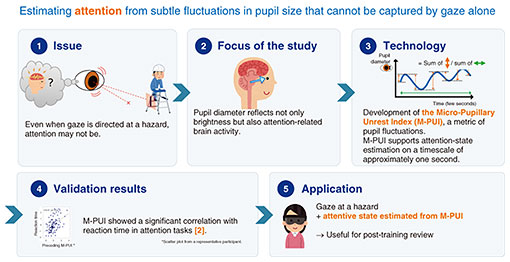
2. Attention-state estimation technology from pupil diameterThe attention-state estimation technology used in this system is based on fundamental research on pupil-diameter fluctuations and short-term attention states. The system uses eye-tracking information*3 obtained during VR training, specifically, pupil-diameter changes and gaze direction, to estimate whether trainees are paying attention to hazardous areas. Pupil diameter not only changes in response to dynamic changes in luminance levels in the visual scene but also reflects various internal states of the observer, including attentional state, through the locus coeruleus–noradrenergic system*4, which is involved in the regulation of attention and arousal. Therefore, by analyzing not only whether the gaze is directed toward a hazardous area but also the pupil-diameter fluctuation pattern at that time, it is considered possible to evaluate whether the trainee was simply looking at the object or was highly likely to be paying attention to it as a hazardous area. Short-term fluctuations in the attentional state are considered to contribute to moment-to-moment fluctuations in human performance during visual tasks. These fluctuations in the attentional state may also be reflected in moment-to-moment changes in pupil diameter. Thus, fluctuations in attentional state are related to fluctuations in both human performance and pupil diameter, and the dynamics of human performance may be captured by measuring specific components of pupil-diameter fluctuations. Pupil-diameter fluctuation patterns have been examined in relation to fatigue-related states that change over several hours, yet only under limited experimental conditions. On a finer time scale of seconds or less, we found that an index of short-term pupil-diameter fluctuations, called the Micro-Pupillary Unrest Index (M-PUI)*5, can reflect the short-term attentional state [2]. These findings from fundamental research suggest that the attentional state can also be assessed in complex settings such as safety training. In such training, it is important to monitor the trainee’s attentional state during the few seconds when their gaze is directed toward, or happens to pass over, a hazardous area. In our VR safety-training support system, the trainee’s attentional state is evaluated on the basis of the M-PUI when the trainee’s gaze is directed toward a hazardous area. If the M-PUI indicates a relatively attentive state while the trainee is looking at the hazard, the system determines that the trainee is likely attending to it cognitively. This enables the use of cognitive attention to hazardous areas as supplementary information for post-training review, providing information that cannot be obtained from conventional gaze-based evaluation alone (Fig. 1).
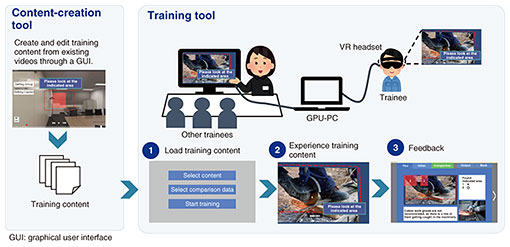
3. Implementation of the VR safety-training support systemBased on field challenges in safety education for telecommunications facility maintenance and inspection work, NTT Access Network Service Systems Laboratories developed the VR safety-training support system, which can easily create and deliver safety training content for visual confirmation suited to actual work, using MP4-format 2D or 360-degree camera video data captured at work sites and other locations. This system is divided into the following two tools (Fig. 2).
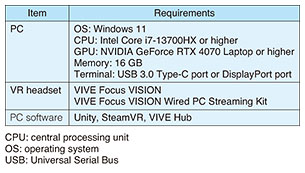
The system requires the designated VR headset [3], a graphics processing unit (GPU)-equipped personal computer (PC), and a dedicated wired kit for connecting the VR headset to the PC. The operating requirements are listed in Table 1.
4. Use caseThis system is intended for use in safety education for telecommunications facility maintenance and inspection work. In such work on utility poles or roads, for example, workers need to wear safety protective equipment to work while paying attention to multiple targets, such as vehicles and pedestrians passing nearby, footing conditions, and the equipment being worked on. However, less-experienced workers may sometimes lack sufficient attention to these targets. Using this system, hazard-prediction training content for telecommunications facility maintenance and inspection work can be created relatively easily from 360-degree video captured at actual work sites. Trainees can search for hazardous areas while looking around the work environment in VR space and experience safety confirmation. After training, because they can check gaze trajectories and attention-state analysis results, they can objectively reflect on hazardous areas they overlooked or areas where their attention was insufficient. By comparing training results between experienced and less-experienced workers, differences in how gaze is distributed and how attention is directed during safety confirmation can be visualized. This is expected to make the system useful not only for learning about safe work but also as teaching material for learning the hazard-detection expertise of skilled workers. 5. Future workWe aim to further develop this system not only for safety-education applications but also for estimating workers’ attention states at actual work sites and detecting overlooked hazardous areas and attention decline. It will thus be important to develop technology that can robustly estimate internal states in real time even under various factors that affect internal states, such as changes in the external environment, work conditions, and individual differences. By combining knowledge of field operations with findings from fundamental research on human-attention states and biometric information analysis, we will continue to support safety improvement and skill transfer in telecommunications facility maintenance and inspection work and contribute to the elimination of workplace accidents. References
|
||||||||||||||||||