|
|||||||||||||||||||
|
|
|||||||||||||||||||
        |
Feature Articles: Toward Commercial Deployment of IOWN APN step3 Vol. 24, No. 1, pp. 14–19, Jan. 2026. https://doi.org/10.53829/ntr202601fa1 Efforts toward Deployment and Dissemination of IOWN APN step3AbstractNTT proposed the IOWN (Innovative Optical and Wireless Network) concept in May 2019 and has been driving the research, development, and practical implementation of the All-Photonics Network (APN). The APN is a novel optical network infrastructure that features ultra-high capacity, ultra-low latency, and ultra-high energy efficiency. In March 2023, the NTT Group started offering APN services, and since then service menus have been expanded. This article introduces initiatives aimed at deploying and promoting “APN step3,” the next evolutionary form of the APN targeted for around 2028. Keywords: APN step3, technology demonstration, standardization
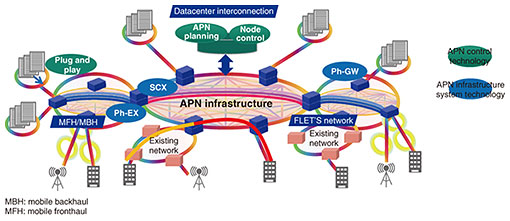
1. Toward the evolution of APNStarting with the launch of services in 2023, the All-Photonics Network (APN)—a component of the Innovative Optical and Wireless Network (IOWN)—has been continuously evolving. To respond to the rapid growth of artificial intelligence (AI) and datacenters as well as diversification of user needs, we aim to deploy “APN step3” around 2028, which will provide on-demand end-to-end optical connections and economically expand the APN on a wide scale. Achieving this evolution requires establishing and demonstrating underlying core technologies aligned with external trends and building an ecosystem through standardization activities. 2. Vision of APN step3Commercialized APN services include APN IOWN 1.0 [1] and All-Photonics Connect [2], both pioneering social implementations of IOWN APN features (i.e., APN step1 and APN step2). APN IOWN 1.0 commercialized the optical transport network (OTN) terminal device “OTN Anywhere,” enabling microsecond-level delay visualization and adjustment, delivering ultra-low latency. All-Photonics Connect offers guaranteed bandwidth communication up to 800 Gbit/s between user sites, providing large-capacity and stable optical path connections. These efforts concretize the potential of the IOWN APN’s large capacity, low latency, and low power consumption, forming the foundation for future development. Building on this, the future APN “APN step3,” planned for commercial deployment around 2028, envisions expansion from connecting major cities nationwide to regional bases, linking datacenter infrastructures via the APN. This promotes distributed power load and further utilization of renewable energy while aiming for economic wide-area deployment of IOWN APN features. Specifically, it extends the existing APN service coverage beyond point-to-point to offer nationwide, multi-destination flexible-switching end-to-end optical path on-demand services. Deploying APN step3 requires many elemental technology developments; this collection of feature articles in this issue focuses on advancements in network infrastructure systems and controllers and introduces key technologies for early commercial deployment in APN infrastructure system technology and APN control technology, along with demonstrations and external outreach efforts (see Fig. 1).
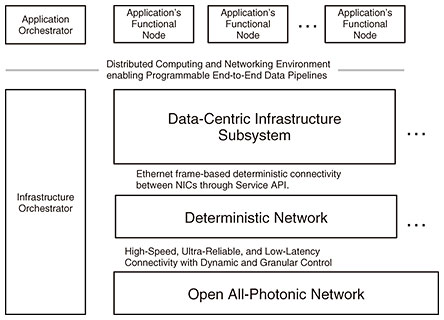
(1) APN infrastructure system technology Photonic Exchange (Ph-EX) equipped with wavelength conversion and inter-band wavelength conversion technologies to economically expand the provision range of end-to-end optical paths and reduce power consumption, Photonic Gateway (Ph-GW) accommodating diverse APN devices at entry points, and Subchannel Circuit eXchange (SCX) combining fixed communication and flexibility are introduced in the feature article “Key Technologies Driving APN step3 Deployment” [3]. (2) APN control technology Control and management technologies enabling connection between various devices/systems, including APN node systems, and controllers, plug-and-play technologies simplifying optical path establishment anytime/anywhere, and optical path design technologies instantly calculating routes and wavelengths to efficiently use limited wavelengths in on-demand optical path services are presented in the feature article “Control Technologies Supporting APN step3” [4]. (3) Integrated demonstrations of above technologies Having established these elemental technologies, integrated demonstrations and use case verifications on commercial networks confirmed end-to-end optical path setup capability. The APN step3 vision, use cases, and elemental technology introductions were exhibited at Expo 2025 Osaka, Kansai, Japan to promote commercial deployment externally. Details appear in the feature article “Demonstrating Timely Optical Path Establishment Achieved by APN step3” [5]. Further advancement of these technologies will enable the future APN to function as a network infrastructure connecting academic networks and widely distributed datacenters with high speed and capacity, continuously contributing to sustainable society and advanced digital services. The latter half of this article explains the network roles required for future development on the basis of APN step3, essential requirements, and use cases. Expanding the market to encourage price competition and lower introduction barriers through cost reduction of equipment, as well as regulation to prevent poor-quality services/products, is also crucial for APN development. NTT aims to build a value chain including standardization for international dissemination of open domain technologies. De facto standardization is promoted mainly within the IOWN Global Forum (IOWN GF) [6], targeting input and establishment of de jure standards, especially strengthening collaboration with the International Telecommunication Union - Telecommunication Standardization Sector (ITU-T) by actively exploring areas for cooperation and submitting results. 3. Evolution and future vision of the APN responding to diverse use casesNetworks and information technology (IT) change rapidly with new services and applications emerging continuously. Networks play a vital role in delivering advanced digital services, requiring multiple perspectives such as which sites to connect, and requirements for latency, bandwidth, and reliability need to be examined per use case such as AI inference, Internet of Things (IoT), robotics, and autonomous driving. It is important to consider not only network technology but also how services built upon it contribute to society, necessitating development of networks interoperable with IT, AI, cloud, and datacenter trends. Focusing on the rapidly expanding AI field, competition centered on generative AI is intensifying. Traffic is concentrated in metropolitan datacenters and Internet exchange points, but learning datacenters require massive graphics processing units (GPUs) and power demands, prompting relocation of datacenters to regions rich in renewable energy. Connectivity with overseas datacenters is also emphasized for global customers. In this environment, wavelength conversion technologies bridging operators and regions and APN control technologies enabling rapid design and service provisioning become critical. AI inference demands even lower latency than training, so inference datacenters may be located near users in major cities, requiring short-distance, minimal-device connections. Small-scale, agile container-type datacenters are increasing, demanding efficient and economical networks tailored to scale and purpose. Increasing numbers of companies using multiple AIs require mechanisms to flexibly switch and connect datacenters of varying sizes and locations. Beyond AI, further sophistication of IoT, robotics, and autonomous driving will expand new services needing supporting networks. Building on APN step3, the APN will evolve with strengthened integration with switching and routing to deploy optimal network infrastructure across Japan and globally. 4. De facto standardization efforts in IOWN GFWithin IOWN GF, Open APN and Data-Centric Infrastructure (DCI) are defined as components of the overall IOWN architecture. With the June 2025 revision to Version 3 of the Open APN Functional Architecture, a new layer called Deterministic Network (DN) connecting Open APN and DCI was specified (Fig. 2). Below is an overview of initiatives related to Open APN and the DN.
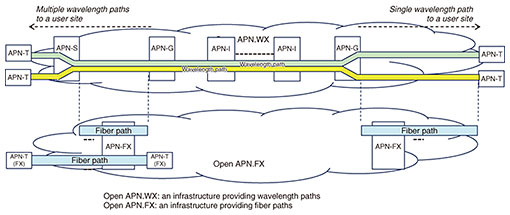
4.1 Open APN initiativesIOWN GF advances defining an open functional architecture allowing dynamic provision of end-to-end optical paths by combining fine-grained functions. The Open APN Functional Architecture defines the Open APN Wavelength Exchange (Open APN.WX) layer providing per-wavelength connections and the Open APN Fiber Exchange (Open APN.FX) layer providing per-fiber connections (Fig. 3). The fiber cross-connect function of Open APN.FX, having low wavelength dependency, can accommodate various optical signals including non-dense wavelength-division-multiplexing types widely used in short-distance use cases.
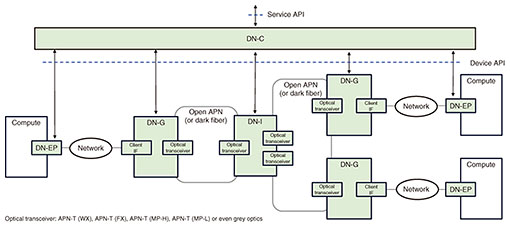
The latest Open APN Functional Architecture document published in June 2025 expands functions to improve efficiency and operability [7]. In the user plane, a branching function called Open APN splitter (APN-S) is newly defined between the Open APN transceiver (APN-T) terminating optical paths and the Open APN gateway (APN-G) at APN entry nodes. APN-S enables sharing ports and fibers between the APN-G and multiple APN-Ts, useful for use cases such as datacenter interconnection or mobile networks providing multiple wavelengths at one site. Discussions on a distinctive user-plane function, wavelength conversion, are also moving forward. In conventional optical networks, a wavelength assigned to an optical path can be changed when optical signals are converted to electrical signals and re-converted to optical ones again. However, this procedure requires signal processing in the digital domain, which incurs increased power consumption and latency. Therefore, low-power and low-latency wavelength conversion is attracting attention. The architecture defined in the Open APN Functional Architecture document published in June 2025 [7] allows for adding wavelength conversion functionality to Open APN interchange (APN-I) as needed. This enables the efficient use of wavelength resources and greatly expands the service coverage of end-to-end optical connections. In the management/control plane, reflecting APN step3’s goal of enhancing on-demand optical path provision, the concept of plug and play is incorporated, showing operation sequences for initial user device connection and optical path setup triggered by requests from user devices to the Open APN controller (APN-C), replacing requests from orchestrators or external management systems. Functions supporting network lifecycle management are added to the APN-C. IOWN GF promotes proof of concept (PoC) activities not only for defining architectures and publishing technical documents but also for demonstrating APN features’ usefulness, deepening technical issues, and raising awareness. PoCs are conducted in accordance with guidelines developed within IOWN GF on the basis of the Open APN Functional Architecture, expanding collaboration among member companies leveraging their assets. 4.2 DN initiativesIOWN GF is newly addressing the DN as a network supporting use cases such as service infrastructure for financial industry, remote media production for broadcast industry, and green computing with remote GPU service for generative AI and large language models. The DN connects sites via Open APN and enables deterministic communication (bandwidth and latency guarantees) between computer network interface cards. Figure 4 shows the DN architecture. It defines DN endpoints (DN-EPs) as endpoints of deterministic connections, DN gateway (DN-G) as the boundary between wide area networks and datacenters, DN interchange (DN-I) as connecting optical wavelength paths and exchanging deterministic connections, and DN controller (DN-C) as accepting service API (application programming interface) requests to provide deterministic connections between DN-EPs.
This architecture enables the provision of a single optical wavelength path to on-premises sites, yet logically multiplexing multiple deterministic connections. This enables simultaneous connections to multiple cloud sites and flexible switching, efficiently supporting diverse use cases spanning multiple datacenters. 5. De jure standardization at ITU-TWhile IOWN GF’s de facto standardization is advancing mainly in developed countries, global adoption of IOWN requires collaboration with ITU-T, responsible for de jure standardization. The initiative pursues: 1. Market expansion: Creating and enlarging global markets including emerging countries, reducing equipment costs through market growth. 2. Market stability: Eliminating poor-quality counterfeit services/products by reflecting standards compliance. 3. Others: Reducing risks of violating WTO (World Trade Organization) and TBT (Agreement on Technical Barriers to Trade) agreements. Companies participating in IOWN GF, including NTT, proposed at the July 2024 ITU-T Study Group 13 meeting a contribution titled “Framework for Low-latency, High-energy-efficiency Communications in Integrated Networking” as a high-level architecture for IOWN [8]. Approval was granted to start discussions as a new work item. This draft recommendation drafts use cases, high-level architecture, and requirements, aiming for completion in the first half of fiscal 2026. 6. Future outlookThis article introduced efforts toward deployment and dissemination of APN step3 services targeted around 2028. We will lead the world in advancing APN’s evolution through grand design, innovative core technology establishment and demonstration, and ecosystem construction via standardization activities. References
|
||||||||||||||||||